

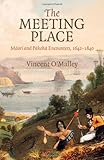
Vincent O'Malley. The Meeting Place: Māori and Pākehā Encounters, 1642-1840. Auckland: Auckland University Press, 2012. 320 pp. $44.95 (paper), ISBN 978-1-86940-594-6.
Reviewed by Richard N. Price (University of Maryland)
Published on H-Empire (April, 2014)
Commissioned by Charles V. Reed (Elizabeth City State University)
Price on O'Malley, The Meeting Place: Māori and Pākehā Encounters, 1642-1840
Between the arrival of Captain James Cook in 1769 and the Treaty of Waitangi in 1840, New Zealand was the site of a “middle ground” of cultural interaction and exchange. This is the basic argument of Vincent O’Malley’s excellent new book, The Meeting Place: Māori and Pākehā Encounters, 1642-1840. O’Malley writes in the tradition of James Belich’s masterly account of New Zealand history, Making Peoples (2002). But to make his point he draws on the idea of a middle ground in the history of imperial contact which originated with the work of American historians like Francis Jennings and Richard White, who applied it to the settlement of the North American continent. The term “middle ground” (like the term “meeting place” of the title) suggests something more permanent than the word “beaches,” used by historical anthropologists of the South Pacific. They all capture a moment in the imperial encounter when historical trajectories are about to begin, and the possibilities they contain remain open. Although O’Malley’s book is concerned with that moment in the history of New Zealand, it leads one to contemplate whether the idea of a “middle ground” could be usefully applied to imperial history more broadly.
Historians of colonial encounter have given too little attention to the various stages through which the imperial engagement passed. The dynamics of the imperial presence did not follow one prescribed historical path. There were, for example, relatively few examples of colonial conquest of the Cortes variety, when the imperial power barrels into an indigenous culture and fells it in one foul swoop. More common was the gradual and uncertain accretion of power and authority to the imperial agent. In such cases, there was likely to be a period when the historical direction that encounter would take was uncertain, when the balance of political, cultural, and economic power hovered unsteadily toward one side or another. Imperial historians--influenced too much by the legacy of Edward Said’s Orientalism (1978)--have not sufficiently recognized the uncertainty and instability that accompanied the making of empire. So O’Malley’s book is to be welcomed for the way he directs our attention to a phase in New Zealand’s history when the imperial outcome was not predestined; when there was, as he argues, a middle ground culture created by the interaction between Māori and Pākehā which contained the seeds of an alternative, more hybridized, outcome.
Captain Cook was not the first European to land in New Zealand. That honor belonged to Abel Tasman, who in 1642 alighted on the northern shores of the South Island and had a short and bloody meeting with local Māori. But it was only after Cook that both sides began to take seriously the measure of the other, as they were thrown into increasingly closer contact. Initially, this contact took the form of passing ships, often engaged in the boom trade of whaling or looking to resupply and refit. After c. 1810 there was a growing trickle of white settlers of various sorts, but most notably the determined and forceful missionary presence. From the beginning of this phase, the Māori showed a creativity and innovative response to European imminence. They quickly and astutely discerned the wiles, the needs, and the unpredictability of the British and others. Indeed, O’Malley’s book reinforces what one concludes from other sites of encounter: that the truly intercultural impulses are to be found amongst those who are subject to European presence. There were of course always Europeans who were interested in close engagement with Māori culture. But it was the Māori who were the most adept at cultural modification and adaptation. This was particularly manifested in the economic realm, and it is not surprising that this should be so. Early settlers of whatever hue were thoroughly dependent upon the local populations for the basic necessities of life and for learning how to cope with the natural environment. But the swiftness with which Māori recognized and seized the economic opportunities presented by the growing European presence--both passing ships which needed supplies, and settlers who needed sustenance--is noteworthy. Māori were also quick to take the opportunities of the imperial labor market, and pretty soon gained a substantial reputation as sailors on whaling ships, for example.
This was not a pretty process. And it would be a mistake to romanticize the idea of this middle ground period as one in which a Rousseau-like state of nature interaction produced a sort of Polynesian utopia. New Zealand was a very rough part of the world in the late eighteenth and early nineteenth centuries. It tended to attract Europeans who were used to living outside the norms of metropolitan society; sailors whose testosterone levels were in the stratosphere; runaway convicts and others from the penal colony of New South Wales; and entrepreneurs who were always one storm away from disaster. There was no European authority until the British began to tentatively assert control from the mid-1830s. O’Malley provides plenty of evidence of the way in which the learning curve for both sides was spotted with violence and conflict. The Māori had to pick out what would provoke the Europeans to sudden and (from their viewpoint) heedless violence. And the Europeans had to deal with what seemed to them to be the untrustworthy and shifty behavor of the Māori, who would suddenly erupt in fury when some unknown tapu was violated by unsuspecting whites.
But for all that, one of the key features of this “middle ground” period was precisely a period of learning, observing, and groping towards some kind of understanding. This occurred on many fronts: the economic, already mentioned, where perhaps the greatest strides were made; the sexual, which was probably the most successful in terms of mutual satisfaction; the cultural, whose most prominent feature was the creation of a Māori syncretic Christianity; and the political, where neither side gave much, but where there were opportunities for the chiefs to reinforce their authority and importance. For most of this period, until the interposition of the British state, the general advantage lay with the Māori. Indeed, it was not until 1858 that the white population of New Zealand surpassed that of the Māori. Until then--but particularly before the Treaty of Waitangi in 1840--Europeans had little alternative but to come to terms to one degree or another with Māori cultural norms and political authority. They had to learn what tapu to avoid; they had to reckon with the structures of chiefly authority; they had to gain some familiarity with Māori land ownership customs. Their contact was of necessity pretty close, especially in the north island. If they were male and single--as most of them were--they almost certainly learnt about Māori sexual customs. If they were married with children--like many missionaries--they saw their children play with Māori children and quickly learn the language.
The question for historians is: what was the significance of all of this? O’Malley strongly hints that in this middle ground period there was a potential for an alternative structure of colonial social relationships--a structure that would be a hybridized melange of British and Māori, and one that perhaps would have avoided the harsh racism that described race relations by the later part of the century, and which New Zealand, like the other settler colonies, had to live with for a century. But reading O’Malley, one is continually struck by the extent to which the British were reluctant to surrender any part of their cultural predispositions. This was most clearly demonstrated by the missionaries, who were at one and the same time spokespersons for the Māori in imperial culture and in New Zealand were concerned to undermine and change their culture. Thus, as O’Malley points out, although missionary children might play with Māori children, they were invariably shipped off to England to school, where they rapidly learnt to reject the kind of cultural tolerance they might have picked up as they gamboled around the New Zealand bush with their Māori playmates. Similarly, their parents might be obliged to tolerate the heathen cultural practices of the Māori all the while they depended upon the local rangatira for protection. But they were never willing to radically reshape Christian doctrine to fit Māori beliefs. Of course, we cannot say what would have happened had the “middle ground” of the 1814-40 period remained the arena for Māori-Pākehā relations. It might have contained enough vitality to allow a truly hybridized system to emerge. Speculation on that is perhaps not very helpful.
What is more helpful is to understand that imperial history needs to be seen as possessing openings and opportunities that were not taken, rather than being viewed (as it most commonly is) as a “fatal impact” or “fatal necessity” whose trajectory was written at the very first moment of contact. Vincent O’Malley has written that kind of book, one that conveys lucidly and with vivid and pertinent examples, the way that the history of imperial encounter developed through a dynamic that was locally driven, as well as imperially determined, and one that was driven by the past rather than being directed by certain future. His book is not only a great read, it also makes an important argument and it deserves to be read widely by imperial historians.
If there is additional discussion of this review, you may access it through the network, at: https://networks.h-net.org/h-empire.
Citation:
Richard N. Price. Review of O'Malley, Vincent, The Meeting Place: Māori and Pākehā Encounters, 1642-1840.
H-Empire, H-Net Reviews.
April, 2014.
URL: http://www.h-net.org/reviews/showrev.php?id=41547
 | This work is licensed under a Creative Commons Attribution-Noncommercial-No Derivative Works 3.0 United States License. |

