

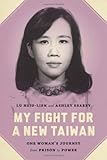
Lu Hsiu-Lien, Ashley Esarey. My Fight for a New Taiwan: One Woman's Journey from Prison to Power. Seattle: University of Washington Press, 2014. 344 pp. $34.95 (cloth), ISBN 978-0-295-99364-5.
Reviewed by Madeline Hsu (University of Texas at Austin)
Published on H-Asia (October, 2014)
Commissioned by Sumit Guha (The University of Texas at Austin)
A Taiwanese Woman Leader
Born in 1944 to a family of small business owners, Lu Hsiu-lien’s (Annette Lu’s) career as an international feminist, independence activist, and politician traversed eras of enormous political and economic transformation in Taiwan. Best known as vice president to Chen Shui-bian, the only Democratic People’s Party (DPP) candidate to serve as president, Lu’s autobiography is nonetheless most absorbing in its details of the tumultuous path that brought her eventually into the compromised corridors of power. In the disorder of Taiwan’s late twentieth-century emergence as a democratic, industrialized state, Lu’s intelligence, organizational skills, and commitment to populist causes of feminism and Taiwanese sovereignty propelled her to national prominence even as her instinctive impulsiveness and limited political discipline constricted her prospects. The last two traits produce an engaging autobiography that is nonetheless a political document with instances of surprising frankness and compelling personal details but also notable patches of silences and omission. Lu’s educational, administrative, activist, journalistic, and political trajectory provides a cook’s tour of Taiwan’s most recent six decades, spanning its paranoid positioning as Free China and the abuses of the Nationalist security state, the repression and submerged anger of the Taiwanese and the whispers of independence organizing brewing abroad, and rapidly improving educational and industrial infrastructure, as well as Taiwan’s integration into international systems of economic development and governance, its dependence on and precipitous loss of American backing in the 1970s, and its disorderly but nonetheless compelling transformation into a democratic state.
Lu’s road into public service reveals both the successes and failings of Nationalist efforts to politically integrate the Taiwanese by providing educational and economic access. Despite coming from a family poor enough to consider allowing her to be adopted not just once but twice, Lu had access to a merit-driven educational system that placed her into the leading Taipei First Chinese Girls’ High School and from there to the study of law at the premier National Taiwan University. She received a prestigious scholarship for graduate study at the University of Illinois, Urbana-Champaign, where she encountered many other students from Taiwan whose ranks included those bent on working hard and making new lives in the United States, underground independence activists, patriots protesting territorial claims to the Diaoyutai Islands, and Nationalist spies. Upon returning to Taiwan, her academic credentials garnered Lu ready employment in the Executive Yuan’s Law and Regulations Commission tasked with assessing proposed legislation.
Lu chose not to accept this easy path into integrated, bureaucratic respectability, and instead developed an active publication and speaking agenda promoting feminist causes and services and pressing for democratization of Taiwan, thereby gaining national and international visibility. From the start, Lu attracted both supporters and detractors but proved relentlessly successful in publicizing her causes and herself. Although this account, coauthored with former journalist and political scientist Ashley Esarey, credits Lu’s abilities for these successes, Lu was also timely in her politics and able to foster coalitions with other like-minded feminists and postcolonial activists from around the world, even as China and the United States negotiated their rapprochement during the 1970s. Her prominence brought other career opportunities in journalism and nongovernmental organizations (NGOs), and admission to Harvard Law School in 1976, where she gained the crucial support of law professor Jerome Cohen. This autobiography namedrops many key figures from Taiwanese and international feminist circles and dangwai (non-Nationalist) political organizations in a manner that is not so much self-aggrandizing but reflective of how effectively a Taiwanese activist, such as Lu, was able to circulate and meet like-minded leaders.
Lu left Harvard in the late 1970s in hopes of running for office in Taiwan. Perhaps precipitously, she joined the editorial team of Formosa Magazine (Meilidao zazhi) pressing sovereignty issues alongside many of the future leaders of the DPP: Shih Ming-te, Hsu Hsin-liang, Huang Hsin-chieh, and Lin Yi-hsiung. Demonstrations organized to protest cancelled elections spun out of control in December 1979, producing a spate of arrests, extended interrogations accompanied by physical and mental torture, and prolonged jail sentences for promoting sedition. The Kaohsiung Incident revealed how quickly Taiwanese resentments against Nationalist authoritarianism could be mobilized and the efficiency and brutality of a security apparatus wielded by an administration that had not yet accepted how the withdrawal of U.S. support would force it to reform. Lu served 1,933 days of her sentence, passing time by writing a novel on scraps of toilet tissue while gaining status as a martyr when chosen by Amnesty International as a prisoner of conscience. When she was released early in 1985, Chiang Kai-shek’s son and successor, Chiang Ching-kuo, was in the endgame of his presidency and shepherding Taiwan’s transition to a more legitimate, inclusive political system, signaled in part by the designation of the Taiwanese Lee Teng-hui as his successor in Nationalist rule of Taiwan.
As the terrain of electoral politics shifted rapidly after the late 1980s, with the legalization of opposition parties and major restructuring in acknowledgment that claims to retain rule of the mainland were untenable and expensive, Lu was well positioned to win office, first in the Legislative Yuan (1993-97) and then as Taoyuan County magistrate (1997-2000). As her male, former coeditors from Formosa Magazine jockeyed to run as the DPP’s candidate in the first truly contested presidential elections of 2000, Lu’s range of experiences, public reputation, and lack of her own power base made her an attractive vice presidential candidate, and she joined the ticket of the popular, former mayor of Taipei, Chen Shui-bian, campaigning against corruption and for greater democracy and environmental causes.
This autobiography closes quickly after Chen and Lu’s historic win; the eight years in which they occupied the presidential palace provide few stories of accomplishment or triumph. A brief epilogue glosses through the limited impact of Chen’s presidency, which was circumscribed by Nationalist control of the legislature, and disclaims complaints that his tight 2004 reelection was unduly influenced by a faked shooting attempt. After his second term ended in 2008, Chen was convicted of corruption. As vice president, Lu had no designated role except to assume the presidency if needed, and was unable to pursue her own projects due to her outspokenness, which caused difficulties for Chen’s administration. The book does not mention that she campaigned for the presidency in 2008 but performed poorly in the DPP primary despite having a clean reputation.
Even without a glorious finale, My Fight for a New Taiwan is an enjoyable narrative that captures how education and other broadening opportunities enabled the career and prominence of a smart and ambitious woman navigating the dramatic social and political transformations attending the industrialization and democratization of one of the four Asian “tigers.” Lu’s experiences highlight the fragmentation and oppressiveness of Taiwan’s transitions, even as they offer hope that other Asian states might move further down the path of becoming more open societies.
If there is additional discussion of this review, you may access it through the network, at: https://networks.h-net.org/h-asia.
Citation:
Madeline Hsu. Review of Hsiu-Lien, Lu; Esarey, Ashley, My Fight for a New Taiwan: One Woman's Journey from Prison to Power.
H-Asia, H-Net Reviews.
October, 2014.
URL: http://www.h-net.org/reviews/showrev.php?id=41507
 | This work is licensed under a Creative Commons Attribution-Noncommercial-No Derivative Works 3.0 United States License. |

