

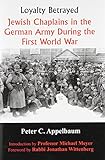
Peter C. Appelbaum, ed. Loyalty Betrayed: Jewish Chaplains in the German Army during the First World War. Portland: Vallentine Mitchell, 2014. 398 pp. $79.95 (cloth), ISBN 978-0-85303-847-4.
Reviewed by Jesse Kauffman (Eastern Michigan)
Published on H-War (January, 2015)
Commissioned by Margaret Sankey (Air University)
The Kaiser's Loyal Rabbis
Scholars of the First World War and of the history of German Jews will find a great deal of useful material in this book. However, the publisher should have made it clear what this volume is--a collection of primary sources produced by German army rabbis during the Great War and collected, translated, and annotated by Peter Appelbaum.
Loyalty Betrayed opens with an eloquent foreword by the London-based rabbi and scholar Jonathan Wittenberg, who has a personal connection to this volume; his grandfather served as Jewish chaplain in the German army during the First World War, and is one of the rabbis whose memoirs are translated here. Wittenberg's account is followed by a series of introductory essays, one by historian Michael Meyer and one by Appelbaum, providing historical background on Jewish chaplains and soldiers in Germany's militaries prior to and during the First World War. In addition to providing important historical context, the three introductory essays touch on themes that are embedded in the documents that follow. Many German Jews of the era of the Great War, they note, were intensely patriotic and, far from seeing some sort of conflict between their German and Jewish identities, believed them to be deeply intertwined--even mutually reinforcing. At the same time, however, many of them believed that they were not fully accepted as equals by their co-nationals. While the men whose sources are collected in this volume seem to have experienced very little hostility or bigotry in the army, their fate at the hands of the Nazis--many fled the country, and a few were murdered in the Holocaust--represented, as the title of the book notes, a terrible, tragic betrayal of their sacrifices and their loyalty. In this sense, the story of the rabbis represents the story of Germany's Jews as a whole.
Appelbaum includes in this collection excerpts from published wartime sermons, a postwar essay by Reinhold Lewin on what Lewin believed to be the deep rooted anti-Semitism of the German army, a chapter containing short excerpts from a variety of different sources, and the minutes of two meetings of Jewish military chaplains held during the war. The heart of the book, however, is the substantial collection of writing (mainly memoirs or other published accounts of their wartime activities) by five army rabbis: Georg Salzberger, Martin Salomonski, Bruno Italiener, Aron Tänzer, and the distinguished rabbi and philosopher Leo Baeck. Each of these is followed by a helpful summary by Appelbaum (though these are confusingly labeled "Author's Summary" rather than "Editor's Summary"). Equally helpful are the expository notes provided by Appelbaum, who explains the biblical references and the Jewish terms and customs mentioned in the rabbis' texts. Appelbaum also provides detailed information on the diseases, wounds, and other medical issues discussed by them. Appelbaum is uniquely qualified to explain this, since he enjoyed a long and distinguished career in microbiology (he holds both an MD and a PhD and is Professor Emeritus of Pathology at Penn State) before taking up his vocation as a historian.
In their writings, the rabbis vividly evoke the strenuous nature of their day-to-day lives at war, as they organize religious services, compose sermons, visit the sick and wounded in hospitals, preside over burials, and write to the grieving families of the fallen. All of this was very similar to the duties performed by their Christian colleagues, but given the centrality of communal meals to Jewish religious observances, the rabbis are also constantly searching out sources of food and drink. All of this provides insight not only into Jewish life in the German army during the war, but also into the nature of the war in the rear areas under military command, as well as how the bureaucracy and command structure of the German military functioned.
Beyond this, the richness of these documents will allow for scholars to use them to explore a great variety of topics and questions. The amount of time the rabbis spend in hospitals, for example, combined with Appelbaum's knowledgeable notes, make these excellent sources for students of military medicine during the war. (One of the most refreshing qualities of this book is that Appelbaum does not treat disease as a cultural trope, but as a real and terrifying facet of everyday life.) Those more specifically interested in Jewish history will find here much to ponder and analyze--especially regarding the nationalism of the rabbis, as well as their views of other Jews, both eastern and western. (Aron Tänzer reacts angrily to an "insolent letter from the chief physician of Reserve Wunderlich ... [a] meshuggene monster and fanatical Zionist from the Frankfurt orthodox community. Miserable rabble," he concludes [p. 212]). The impact of Germany's callous and clumsy "Jewish count" on the men is also illustrated; Georg Salzberger in particular is enraged, and powerfully evokes its psychological and emotional impact: "Every Company Clerk received the 'secret decree,' misunderstood it or had to misunderstand it, and acted as if he himself was from now on authorized, even duty-bound, to investigate his Jewish comrades, even Jewish officers and physicians, for slacking. And this too was calculated to undermine harmony, if not authority as well. The chasm between Jews and Christians, which had once been bridged, opened up again. The Jew felt marked.... One good thing has resulted, however: it has welded Jews together. Antagonisms between liberal and orthodox, Zionist and 'assimilationists' had already receded greatly. But now, in the field, in the face of our common distress, everything which separates us has been forgotten. People who before wanted to know nothing about their Jewish faith are at once emphatically reminded of it" (pp. 74-75).
By translating these sources and making them widely available, Peter Appelbaum has done a great service to the scholarly community. Perhaps less obviously, the clarity of the translations and the evocative nature of much of the writing make these documents well suited for use in a variety of courses, including those for undergraduates.
If there is additional discussion of this review, you may access it through the network, at: https://networks.h-net.org/h-war.
Citation:
Jesse Kauffman. Review of Appelbaum, Peter C., ed., Loyalty Betrayed: Jewish Chaplains in the German Army during the First World War.
H-War, H-Net Reviews.
January, 2015.
URL: http://www.h-net.org/reviews/showrev.php?id=41462
 | This work is licensed under a Creative Commons Attribution-Noncommercial-No Derivative Works 3.0 United States License. |

