

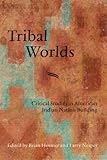
Brian Hosmer, Larry Nesper, eds. Tribal Worlds: Critical Studies in American Indian Nation Building. Tribal Worlds: Critical Studies in American Indian Nation Building Series. Albany: State University of New York Press, 2013. viii + 312 pp. $90.00 (cloth), ISBN 978-1-4384-4629-5; $26.95 (paper), ISBN 978-1-4384-4630-1.
Reviewed by Richmond Clow (University of Montana, Missoula)
Published on H-AmIndian (February, 2015)
Commissioned by F. Evan Nooe (University of South Carolina Lancaster)
New Directions in Defining Tribal Nationhood
The genesis for Tribal Worlds was the 2008 Tribal Worlds sessions at the American Society for Ethnohistory, during which participants nurtured ideas and discussed “shared scholarly” interests “about the nature and dimensions of tribal nationhood” (p. vii.) The meeting provided the foundation for this study of indigenous nationhood that transcends time, place, and perception. This book is the inaugural volume in the SUNY series by the same name, Tribal Worlds: Critical Studies in American Indian Nation Building.
During conference sessions, one force driving the inquiry was that tribal nationhood was radically different than Western views of nationhood. Conference participants identified definitions and manifestations of nationhood as two crucial areas for future inquiry and exploration; thus these topics are the focus of Tribal Worlds. The introduction and individual contributions are separated into two parts: “Definitions” and “Manifestations.” The two themes guide and encourage the writers to explore several dimensions as well as distinctions of tribal nationhood.
Five contributors present definitions of “tribal nationhood.” Anthony F. C. Wallace identifies the matrilineal kinship and clan system as the foundation for granting citizenship in the Tuscarora nation. This kin system gives way to an embattled Council of Clan Chiefs that serves as the governing body striving to keep internal balance. Equally important, when it comes to power, is that New York State and the United States recognize the Council of Clans Chiefs as the governing institution, demonstrating the important role that both the United States and New York play in tribal sovereignty. Next, Gerald F. Reid argues that nationalism implies a commitment to Mohawk identity in three southern Ontario Mohawk communities. This obligation began with the passage of the Enfranchisement Act of 1869, which attempted to replace existing community leadership with fixed term elections and male franchise. Opposition to an imposed leadership selection brought conflict between supporters of short-term elected leaders and lifetime hereditary leaders. This multi-decade battle to retain hereditary leaders failed, but also bound these reserves as community-nations.
The kinship theme continues in Cristina Gish Hill’s essay on Cheyenne nationhood in which she argues that kin relations were the core of Cheyenne political and economic success. Still focusing on kinship to define the structure of the Anishinaabe nation communities, Heidi K. Stark examines early nineteenth-century tribal nationhood relations. In treaties, both Canada and the United States embarked on a path to limit Anishinaabe sovereignty and expressions of their sociopolitical definitions of nationhood. Finally, Sebastian F. Braun is critical of definitions and insists that tribal nationhood often parallels Western concepts of nationhood and can be seen in political strategies of resistance and the employment of symbolism.
"Manifestations,” which are defined as the community implementation of tribal nationhood, comprise the book’s last section. The editors employ an expansive view of “manifestations” to illustrate tribal implementation of nationhood, including ecological relations, treaty rights, and art production. Beginning with ecological relations, Joshua L. Reid describes Makah whalers and sealers as ocean appropriators and explains how they have worked whales into their biography that has shaped their identity as whalers. In taking Braun’s view of commonality with Western ideas of nationhood, one might ask: how great is the difference between identity and the ecological and the social relations a whaler from Iceland has toward the whale, when he claims to be a whaler, and has worked the whale into his biography?
Chantal Norrgard describes the Bad River people’s use of tribal history to construct nationhood. From the Works Progress Administration historical project, the tribesmen gained historical evidence to defend their right to exercise treaty resource gathering claims. In a complementary piece, Adriana Greci Green constructs the historic Michigan Chippewa treaty gathering privileges, which are necessary for the production of tribal art. In 2007 the Inland Consent Decree was signed between Michigan and five tribes where the latter’s 1836 treaty gathering rights were restated. Jenny Tone-Pah-Hote continues the discussion of Kiowa women producing art and maintaining distinct Kiowa identity.
In both sections, on the one hand, the contributors provide important arguments for studying the radical or unique attributes of tribal nationhood. On the other hand, depending on one’s orientation toward defining what attributes comprise or embody tribal nationhood, commonalities can be found. For example, ecological relations provide shared experiences with non-tribal nationhood experiences and the case might be made that understanding the common threads of nationalism and processes of nationhood are also rewarding. The nineteenth-century Anishinaabe national decision to nest clan management and governance of common pooled resources under the national institution shared structural threads with the English decision to nest the governance of their commons with resource appropriators.
Studying cross-cultural resource appropriators’ institutions and policies provides an avenue for discussing alternatives to alterity, but at the same time opens the tribal nationhood discussion beyond opposites. This book presents starting points to discuss both arguments very well. Collectively, the editors and contributions provide a beginning point to initiate further academic conversations on the different orientations of tribal nationhood.
If there is additional discussion of this review, you may access it through the network, at: https://networks.h-net.org/h-amindian.
Citation:
Richmond Clow. Review of Hosmer, Brian; Nesper, Larry, eds., Tribal Worlds: Critical Studies in American Indian Nation Building.
H-AmIndian, H-Net Reviews.
February, 2015.
URL: http://www.h-net.org/reviews/showrev.php?id=41425
 | This work is licensed under a Creative Commons Attribution-Noncommercial-No Derivative Works 3.0 United States License. |

