

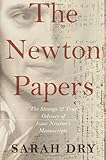
Sarah Dry. The Newton Papers: The Strange and True Odyssey of Isaac Newton's Manuscripts. New York: Oxford University Press, 2014. 256 pp. $29.95 (cloth), ISBN 978-0-19-995104-8.
Reviewed by Rebekah Higgitt (University of Kent)
Published on H-Albion (October, 2014)
Commissioned by Jeffrey R. Wigelsworth (Red Deer Polytechnic)
Aimed at a wider audience than just academics, The Newton Papers tells the story of Isaac Newton’s archive from the time of his death to the present day. Drawing on existing scholarship, it is a story well worth sharing with anyone interested in Newton and how we have, over three hundred years, come to know him and shaped his legacy. Sarah Dry has a colorful and intriguing cast of characters on which to draw, who represent a surprisingly varied set of motives for engaging with Newton’s life and literary remains. They include, naturally, the Cambridge heirs of Newtonian mathematical physics, like George Stokes, but also bibliophiles and collectors, like J. M. Keynes, and the philologist and biblical scholar Abraham Yahuda. In general, Dry handles these multiple strands with confidence. We see how each found in Newton a reflection of their own interests: his legacy has been a resource for, variously, supporters of both the particle and wave theories of light (David Brewster and Jean-Baptiste Biot); investors inspired by physical laws to believe they could predict the rise and fall of prices (Roger Babson); those seeking deeper sources of unified intellectual endeavour (Yahuda); and professional historians of science.
The story begins with Newton’s death in 1727 and the papers he left, perhaps deliberately, in an ambiguous position: “unassigned but also undestroyed” (p. 9). Decisions had to be made by Newton’s direct descendants, as they judged whether what they possessed had monetary or other immediate value. The rough and repetitive nature of the archive was immediately clear, as was the fact that much of it recorded matters unrelated to Newton’s eighteenth-century fame. Because of their contested nature, these, rather than the mathematical papers, are the main focus of this book. What, if any, value should we grant the “non-scientific” labors of a “scientific” hero? There were, Dry says, little more than “brief, troubled glimpses” of the archive before the twentieth century (p. 4), although the narrative passes through a host of—often self-styled—intellectual heirs who grappled with this question. The overarching narrative follows first the attempt to separate the scientific and biographical material from the troublesome religious, historical, and alchemical papers, before changing intellectual fashions raised the desire to unify them and grasp Newton’s mental world as a whole. Finally, much more recently, his various projects have been understood as different types, yet all worthy of consideration for what they tell us of these various fields; of late Stuart Britain; and, of course, of Newton himself.
The first part of the book largely, though not entirely, relies on scholarly work focused on biography and Newton’s posthumous reputation in the eighteenth and nineteenth centuries, including my own book Recreating Newton (2007), itself reliant on the work of Richard Yeo, Patricia Fara, Rupert Hall, William Ashworth, and others. Although an important aspect of this story is how biographers sought, and then were forced to deal with, revelations from the archives, the reliance on this scholarship nevertheless leads to inclusion of material that is perhaps tangential to a focus on Newton’s archive, particularly if, as appears from the opening chapter, Newton’s own papers, known as the Portsmouth Papers, are the intended common theme. Likewise, following these sources into discussions of the nature of genius—and the linked question of Newton’s personality, mental health, and scientific method—there is a lack of attention to how eighteenth- and early nineteenth-century authors dealt with Newton’s scientific manuscripts. A different approach arises as Dry turns to the later nineteenth century and the Cambridge men who catalogued and categorized the Portsmouth Papers. This section draws strongly on Andrew Warwick’s Master’s of Theory: Cambridge and the Rise of Mathematical Physics (2003) to explore how mathematical teaching and examining at Cambridge influenced perceptions of the archive, greatly outweighing attention to, say, Biot and Brewster’s optics.
The story comes alive as we reach the twentieth century and meet individuals who engaged deeply with the archive. We gain an understanding of their unique perspective and its lasting impact on subsequent scholarship. Particularly fascinating here is the account of Yahuda, who found in Newton an “outstandingly humanistic and moralistic figure” whose accounts of early Christianity and biblical exegesis offered “redemptive potential” for the Jewish faith at a time of crisis in the 1930s (pp. 146, 140). Since the sections on earlier periods deal with quite a number of people who seem to have had less to say directly about the archive itself, this approach is not balanced across the book as a whole. This is at times compounded by a lack of clarity on just what the archive contained, and what was published when. It is curious, for example, that Dry suggests that the famous story of Newton describing himself as a boy picking up shells on the seashore might be an invention of Brewster’s (p. 68). It is, in fact, contained in the Portsmouth Papers and was first published in 1806 by Edmund Turnor—an occasion of access to the archive that is entirely missed in this book.
A strength of The Newton Papers is that is charts changing attitudes to historic books and, particularly, autograph manuscripts. Dry is very good on the early nineteenth-century historical turn within science and related scientific approach to historical sources. Bookkeeping astronomy is linked to new techniques in life insurance and archival digging for historical manuscripts, geological strata, and fossils. Yet, alongside this rational and “scientific” approach to archives, is the Romantic sense that the handwritten page can reveal the mind of the man. Manuscripts “had come to hold value as records of the emotional flavour of a work’s creation” (p. 54). As the book goes on, however, there is perhaps overmuch attention to the history of the book trade to serve as background to the twentieth-century sale, dispersal, and purchase of Newton’s manuscripts, although these sections reveal the extent to which the author has consulted scholarship beyond the history of science. In all cases, however, secondary sources could have been better acknowledged and the book would have benefited from a further reading section.
Having read an uncorrected proof, I assume that most of the slips, typos, and incomplete endnotes have been corrected in the final version. I suspect, though, that some of the repetitions and lacunae could not have been corrected at this final proof stage. There is, at times, too much assumed knowledge: for example, a reference to “the Waste Book, with its significant mathematical notes” would leave many scratching their heads (p. 11), as would a number of names dropped in without proper introduction. Some of this is clearly down to a lack of editorial scrutiny. In too many places someone or something is mentioned in passing and only described later. The appearance of the name Gustave David and an allusion to Keynes buying a copy of the Principia only becomes comprehensible in the following chapter, when we learn who David was and the story of the purchase (pp. 114, 124-125). This is the most obvious of a number of such slips. Other odd errors include being told of Yahuda’s “participation in the extraordinary efforts of the international Zionist movement” and his “lifelong anti-Zionism” (pp. 141, 149).
Such errors detract from the book; they leave a sense that the author is not fully in control of the, admittedly complex, material. This is a shame, when elsewhere shifts in history, changes in scholarship, and multiple biographies are handled with aplomb. The various motivations of scholars driven to understand Newton’s mathematical, scientific, alchemical, historical, and theological papers are clearly portrayed. We are, as a chapter title says, “Getting to Know the Knowers,” and it is hard to resist the temptation to ask about this author’s own motivation. She is, as explained in the acknowledgments, married to one such “Knower” of the Newtonian archive, who has played a central role in unifying the archive as never before through the online Newton Project. One wonders if Dry is familiar with the “appetite for suffering” noted in other would-be Newton editors (p. 174). The manuscripts are, however, now widely accessible to whomever is interested in looking, and today’s scholars have a stake in ensuring people want to do just that. As Yahuda said, the work seems to bear “the stamp of Newton’s genius and it will always have value” (p. 139): that in itself seems to be enough.
If there is additional discussion of this review, you may access it through the network, at: https://networks.h-net.org/h-albion.
Citation:
Rebekah Higgitt. Review of Dry, Sarah, The Newton Papers: The Strange and True Odyssey of Isaac Newton's Manuscripts.
H-Albion, H-Net Reviews.
October, 2014.
URL: http://www.h-net.org/reviews/showrev.php?id=41332
 | This work is licensed under a Creative Commons Attribution-Noncommercial-No Derivative Works 3.0 United States License. |

