

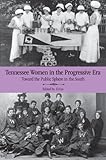
Mary A. Evins, ed. Tennessee Women in the Progressive Era: Toward the Public Sphere in the New South. Knoxville: University of Tennessee Press, 2013. 232 pp. $44.00 (cloth), ISBN 978-1-57233-913-2.
Reviewed by Kathi Badertscher (Indiana University)
Published on H-SHGAPE (July, 2014)
Commissioned by K. Stephen Prince (University of South Florida)
Reconsidering the “New Woman” in Tennessee
Tennessee women Ida Wells-Barnett and Mary Church Terrell are well known in Progressive-Era annals for their prominence in the suffrage movement. Mary A. Evins’s volume of eight essays, including one of her own, demonstrates that many more women engaged in interesting activities to improve their communities. Taken together, the eight chapters showcase Southern women’s work, beyond suffrage, Wells-Barnett, and Terrell, to introduce readers to “a slice of Tennessee history” (p. xv). Photographs add interest throughout the book; endnotes appear with each chapter.
In 2007 Evins and her collaborators held the symposium “Intersecting Missions: The Work of Women in Progressive Women’s Organizations in Tennessee, 1870-1930.” This resulting collection of essays expands historians’ understanding of the Progressive Era’s Tennessee women’s work in two ways: the mix of community engagement work and the time period in which women were active.
Evins’s preface notes that authors present women’s work rather than just biography. The chapters vary considerably in this regard. Janice M. Leone’s “Practical Religion,” Minoa D. Uffelman’s “Tomato Clubs as Salvation,” and Carole Stanford Bucy’s “Shall the Women Be Silent” focus almost exclusively on one woman. The essays by Jean S. Hamm, Sonya Ramsey, and Mary A. Evins each deal essentially with two women. Only two, Paula K. Hinton’s essay on antilynching and Mary Ellen Pethel’s essay on amateur athletics, encompass an array of women. The heavy focus on one or two women, however, does not detract from the authors’ purposes in any way. In fact, the six largely biographical chapters reinforce the value and legitimacy of biography as a qualitative research method. These six essays provide a deeper understanding of the individual women’s motives, strategies, and goals, as well as the social, cultural, economic, or political context in which they lived and worked.
Elizabeth Israels Perry, past president of the Society for Historians of the Gilded Age and Progressive Era, introduces the volume by reasserting the historiographic challenges she raised in “Men Are from the Gilded Age, Women Are from the Progressive Era” (2002). Tennessee Women in the Progressive Era convincingly supports Perry’s case for the “long Progressive Era” (p. 7). Instead of narrow time frame from the 1890s to 1920, Evins’s collection shows that women were committed to reform work beginning earlier than 1901 and ending many decades later, and will add to the recent debate over periodization.
More interesting than the erosion of the Progressive Era’s relatively short duration is the variety of initiatives in which women participated. At times women worked to advance a cause, reform their community, or test gender boundaries. Some women worked quite deliberately for societal change. Others engaged in activities that interested them, unintentionally acting as agents of change.
Readers will expect that religion informed women’s work during this era. Three essays highlight particular aspects of women’s contributions to the Social Gospel movement. Leone’s essay on Belle Bennett and the Woman’s Missionary Council reveals not only their settlement house work but interracial egalitarianism that boldly challenged Jim Crow practices at the turn of the century. In “To Teach, to Preach, and to Heal,” Jean S. Hamm describes the Lutheran Women’s Missionary Society and the “ripples and waves” it created (p. 66). What began as schools for poor Appalachian children evolved into Bible schools, standardized testing, trained school nurses, and a medical center, all of which laid the foundation for existing programs today. Carole Bucy examines Silena Holman’s public correspondence with Disciples of Christ minister David Lipscomb in the Gospel Advocate and Holman’s struggle against rigid gender boundaries in patriarchal southern churches.
Women’s work in education was another acceptable extension of the domestic sphere in most regions of the country. Sonya Ramsey’s “The Destiny of Our Race Lies Largely in Their Hands” illustrates black women’s pursuit of higher education as an interrelated triumvirate of goals: self-improvement, racial uplift, and community service. This chapter highlights the tremendous challenges black women faced, but also sources of strength from both the black and white communities, including the National Association of Colored Women, black and white suffragists, and the General Federation of Women’s Clubs (albeit segregated). In “‘Dangerous’ Women’s Work,” Mary Evins profiles white educators Lucy Gage and Julia Green. The contrast between these two women’s diametrically opposite personalities and styles adds another level of interest when reading of their accomplishments.
It is a commonplace that Progressive-Era women championed temperance and suffrage through voluntary association and public relations. Paula K. Hinton’s “Women Who Fought to Stop Lynching in Tennessee” analyzes the “spider web” of women and organizations that fought for over fifty years to prevent and end lynching in the south (p. 125). Women’s clubs connected individual women to the cause via the Association of Southern Women for the Prevention of Lynching (ASWPL).
Minoa D. Uffelman’s chapter on Virginia Moore’s canning clubs and Mary Ellen Pethel’s chapter on young women athletes round out the collection with analyses that stretch the reader’s conception of Progressive-Era women’s work. Moore championed tomato clubs to teach rural women how to preserve food at home, which sounds innocuous but contained a reform agenda. Moore linked domesticity with public policy as she strove for U.S. Department of Agriculture funding and programs to benefit women. The collegiate athletes in “Sport and the Outward Life” competed despite prevailing stereotypes surrounding femininity, proper dress, and female physical strength.
Each essay is the result of solid research and a compelling mix of primary and secondary sources. Like most edited collections, however, chapters are uneven in terms of readability, organization, historiographic context, clarity of argument, and persuasiveness. Each chapter leaves unanswered questions; Evins’s preface and Perry’s introduction note just a few. Hinton’s lynching chapter does not explain sufficiently how petition signatures dovetailed with antilynching laws. Bucy’s essay leaves the reader with the impression that Lipscomb exploited Holman rather than empowered her; did she really have a voice or was she merely a puppet to advance his dogma? Authors do not link their contributions to the other essays, so readers may find redundancies and lose the larger sweep of the story in minute details.
Tennessee Women in the Progressive Era supports the editor’s assertion that progressivism and “new women” resulted from intertwined social forces. Yet this collection does not attempt to create a composite of Tennessee’s women progressives or Tennessee’s new women. To the contrary, a composite remains even more elusive because the book exposes such diversity in women’s work, backgrounds, race, and geography. Evins quite rightly cautions readers that this collection of essays is a beginning and does not include many topics. Readers with particular interests may be disappointed. They will not find Catholic or Jewish women’s work; nursing, medicine, or public health; playgrounds; social work; housing; or corrections. This book instead opens the door for scholars in the future to continue the exploration of Tennessee women’s work, whether paid or voluntary, secular or spiritual, urban or rural.
If there is additional discussion of this review, you may access it through the network, at: https://networks.h-net.org/h-shgape.
Citation:
Kathi Badertscher. Review of Evins, Mary A., ed., Tennessee Women in the Progressive Era: Toward the Public Sphere in the New South.
H-SHGAPE, H-Net Reviews.
July, 2014.
URL: http://www.h-net.org/reviews/showrev.php?id=41265
 | This work is licensed under a Creative Commons Attribution-Noncommercial-No Derivative Works 3.0 United States License. |

