



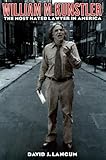
David J. Langum. William M. Kunstler: The Most Hated Lawyer in America. New York: New York University Press, 2000. xii + 452 pp. $34.95 (cloth), ISBN 978-0-8147-5150-3.
Reviewed by Thomas Hilbink (Institute for Law & Society, New York University)
Published on H-Law (May, 2000)
TRACING THE TRAJECTORY OF A RADICAL LAWYER
In my final year of college I was deeply engaged in writing my senior thesis, a history of the Lawyers' Constitutional Defense Committee, a group formed in 1964 to provide legal assistance to civil rights workers participating in the Mississippi Freedom Summer.[1] A number of attorneys mentioned to me that William Kunstler had encouraged them to volunteer for the group.[2] It seemed important that I talk to him. I called, he agreed to be interviewed, and I headed to Greenwich Village.
His home and office were in a row house on a small street near Sixth Avenue, his office window looked up from the basement to the street. Upon entering, I found the scene to be just as I imagined it would be: Total chaos. Kunstler and his partner, Ron Kuby, were hard at work. There were mementos all around from icons of the political left. Papers were piled on the desk and his glasses were balanced on his forehead. This was exciting. I spoke to him -- in between shouts to and from Kuby -- for about an hour and then he suggested I accompany him to a class he was teaching at New York Law School.[3] As we walked down the street towards Sixth Avenue he put his arm in mine, the way a grandfather might do for closeness and support. He asked me how I liked college and other such things. As we stood on the corner a cabbie stopped, rolled down his window, shook Kunstler's hand, and drove off. "My public," Kunstler said with a mix of glee, irony, and arrogance. We hopped in another cab. "Are you Sikh?" Kunstler asked, and then engaged the driver in a conversation about some Sikh clients for whom he had worked. We arrived at our destination, shook hands, and I headed back uptown. William Kunstler, in our brief encounter, was a warm, attentive person who seemed to care about me, a college student! I cared in return. He had charmed me. You could say I loved him.
If David Langum's recent biography, William M. Kunstler: The Most Hated Lawyer in America, is any indication, I was in good company. The book's title carries a certain irony. Though hated by many in his professional capacity, William Kunstler was a man who needed to be loved and who possessed a "consuming need for belonging" (p. 208). He sought out allies and friends and charmed many of those who abhorred him. For Langum, a professor of law at Samford University, this only raises a dilemma: "How could a man who so craved admiration and love make such outrageous statements? Kunstler's actions would seem almost calculated to bring about public disapprobation and opprobrium, rather than love and admiration" (p. 349).
Langum has, by and large, produced what Judge Richard Posner has described as a "scientific" biography, wherein the author seeks to identify psychological causes of the subject's beliefs and actions.[4] The major questions driving the biography are: "What made this guy tick? What inner qualities did Kunstler possess that made him do what he did?" Again, to use Posner's language, Langum has gone in search of Kunstler's "essential self."[5] To this end, the book spends a great deal of time discussing the private man behind the public persona.
In the early chapters Langum analyzes Kunstler's childhood. We learn that Kunstler was ashamed of his father (a proctologist) and his middle-class upbringing. Kunstler's childhood desires to be "part of the black world" and to join a "goyim gang" are revealed. To his credit, Langum is careful not to point to any one of these experiences as the root cause of Kunstler's mid-life transformation into a radical lawyer. He does use them, however, as harbingers of Kunstler's future.
According to Langum, Kunstler's shame of being middle-class caused him to reject many aspects of middle-class life, and his desire to belong to a group other than his own explains his identification with civil rights workers, prisoners, and anti-war radicals, among others. In one chapter after another, these childhood characteristics reappear. For example, in discussing Kunstler's involvement in New Left culture during the Chicago Seven trial, Langum explains, "This identification with the defendants reflected Kunstler's old need for a sense of belonging, and paradoxically a desire to belong to a group in which he could never fully fit" (p. 125). It is in such moments that Langum finds the answer to the biography's central dilemma: what many (or most) saw as outrageous behavior worthy of disapprobation and even opprobrium, others (especially defendants and their allies) saw as heroic and worthy of deep love and respect. There was an intensity of feeling that surely brought Kunstler what he was looking for.
I must admit to a bias against biographies whose methodology involves putting their subjects on the couch. Much more interesting to me (reflecting my bias as an historian) are the ways in which a person both reflects and shapes his or her historical setting. I will concede that many people read biographies to discover the inner life of the subject, but using personal experience to explain a life requires a delicate balance, recognizing the many forces that influence a person's life trajectory. A person is shaped by personal experience (the micro) as well as historical forces (the macro).[6] It is understandable that biographers often look primarily at personal experiences to explain their subjects. After all, people tend to make sense of their lives at the micro level. Nearly a century of Freudian psychology has encouraged us to look first and foremost to inner rather than outer influences. But ultimately, the macro -- historical -- factors play a large role as well. It is in documenting such factors that the historian can make the greatest contribution. Such information places the individual in a context that helps the contemporary reader make more sense of that person's life as well as the historical contingency of all lives.
It is such context -- which makes exemplary biography so elusive --that is missing from The Most Hated Lawyer in America. The reliance on so much personal detail to explain the motivations of a public figure seems misplaced. I was often unsure why Langum included some information. For instance, the need for detailed documentation of Kunstler's sexual experience as a teenager is unclear, not only due to its prurient nature, but in its failure to illuminate the nature and importance of Kunstler's life and work. Of course, the personal may be political. Arguably, Langum's significant attention to Kunstler's sexual history (especially in the 1960s) reveals the extent to which he adopted the counter-culture ways of his clients. But I am reminded of Laura Kalman's skepticism towards such information. "By its very nature," she writes, "biography tempts us into believing that there is a relationship between private self and public life. On its face, that proposition seems sensible. But who can be certain what motivates oneself, much less another? If we hypothesize a connection between Kennedy?s pursuit of women and his recklessness in the Bay of Pigs catastrophe, how do we explain his restraint with respect to Laos?"[7]
Of course, Langum does not fail to detail Kunstler's public life. In fact, his retelling is highly entertaining. I found myself reading some passages aloud to anyone who would listen. Kunstler's public career encompassed many of the most significant (or at least well-publicized) trials of the late 20th century. While not the most radical lawyer of his era, he was at least the best-known radical lawyer and was one of the best attorneys around at putting on a good show for "his public." More than that, however, The Most Hated Lawyer in America begins to fill a gaping hole in the historiography of the legal profession. Up to now, those hoping to understand the philosophy and development of radical lawyering have had to rely primarily upon sociological literature. Austin Sarat's and Stuart Scheingold's edited volume, Cause Lawyering, is to date the best analysis of the field. Others, such as Jerold Auerbach's Unequal Justice (which is less interested in the radical fringes of the bar) and Jonathan Black's edited volume Radical Lawyers: Their Role in the Movement and in the Courts also explored what distinguishes radical lawyers from their peers in the profession.[8] Langum deserves credit as a pioneer in exploring the practice of a lawyer who "adopted a completely, utilitarian, instrumentalist view of law" (p. 165).
Langum's book draws on the experience of its protagonist to provide critical information about the "birth" of radical lawyering in the 1960s. The book's best chapter covers the Chicago Seven trial, the "personal rubicon" of Kunstler's career (p. 126). The case stemmed from the protests and riots at the Democratic National Convention in Chicago in August 1968. On trial was a loosely connected group of anti-war leaders accused of inciting the riots. The defendants were less interested in countering the charges against them than in using the courtroom as a forum for putting the United States' Vietnam policy on trial while exposing the authoritarianism underlying the government's actions at home and abroad. Langum quotes defendant David Dellinger:
"At the beginning the commitment to conduct a political trial meant conducting a collective defense and having the defendants control the lawyers rather than allowing them to control the line of defense on technical, legal grounds. We wanted to bring our politics into the courtroom, not in the form of arbitrary outbursts. We wanted not only to affirm what we had done and why but to make it clear to any honest observer that the guilty parties were the government and the system" (p. 105).
At the outset, Kunstler took a traditional approach to the defense. He did not understand his clients' wishes and thus devoted his opening statement to extolling the importance of the First Amendment. His clients were furious and quickly demonstrated what they wanted. Kunstler soon caught on. The results are well-known; the courtroom became a circus where the excesses of government bias and zealotry were on full display. Chicago taught Kunstler to question and undermine "the traditional structure and process of the criminal procedure without challenging its fundamental political legitimacy" (p. 153). In this chapter and those that follow, Langum does an excellent job of illuminating the problematic aspects of radical lawyering, such as the tension between defending a cause and defending a client (p. 123; p. 213), client selection (p. 166), and other conflicts with traditional professional responsibility. This is one of the book's most valuable contributions -- Langum gives an historical perspective to contemporary debates in lawyering theory.[9]
These lessons carried Kunstler through the remainder of his career as he served as counsel in many celebrated cases. In the 1960s he represented members of the Black Panthers in conspiracy trials. He advocated for the Attica prisoners in 1971. He defended American Indian Movement activist Leonard Peltier a few years later. In the 1980s and 1990s, when there were fewer activist movements demanding legal assistance, Kunstler continued to represent unpopular clients, using their trials to expose government excess and injustice. In this period his clients included Clayton Lonetree (a Marine accused and convicted of espionage), Colin Ferguson (the man who killed six people on the Long Island Railroad in 1993), John Gotti, El Sayyid Nossair (acquitted of the charge that he assassinated Rabbi Meir Kahane), and Sheikh Omar Abdel-Rahman (accused of conspiracy in the World Trade Center bombing).
Although the book is rich in historical data, as stated above, I often wished for more historical context to Langum's account. For instance, in Langum's brief discussion of Kunstler's years at Columbia Law School, I was left wondering in what ways Columbia's intellectual atmosphere may have influenced the young Kunstler. Given that Columbia was a hotbed of Legal Realism (though admittedly less so in the late 1940s than in the 1930s), I wish that Langum had provided background and speculation about how Realism (and his legal education) influenced Kunstler's ideas about law and legal practice in the twentieth century (as Laura Kalman did in her biography of Abe Fortas).[10]
Similarly, Langum could have done more to explain the origins of radical lawyering in the 1960s. He discusses attorney Arthur Kinoy's influence on Kunstler's approach to lawyering, but only mentions in passing that Kinoy's ideas of practice were born in the labor movement. The roots of radical legal practice are given short shrift. Such cursory treatment of historical roots occurs throughout the book, which often focuses on its narrative "present" while failing to demonstrate how past events contributed to those developments.
As a result, a reader could finish the book with the impression that Kunstler's ideas about lawyering sprung nearly fully formed from the 1960s and not as the result of larger historical changes -- in politics, in legal theory, in bar membership -- over the course of the twentieth century. Similarly, Langum fails to set Kunstler's trajectory within larger trends in the legal profession in the 1960s. In the early 1960s, hundreds of attorneys spent time working in the South as part of the direct action phase of the Civil Rights Movement. These attorneys learned (and developed) new approaches to lawyering as a result of their interactions with civil rights workers. It was the organizing "traditions" that many of these workers insisted upon respecting that helped establish a "new" approach to lawyering in the 1960s: "The traditional view of lawyers has been that they should remain independent from their clients and not be too closely identified with them" (p. 75). However, through their work in the South, Kunstler and others broke down those barriers between lawyer and client. The lawyer's neutrality was replaced by a professed interest in the goals of the client. Lawyers became part of the movement rather than legal representatives of the movement. In many situations, movement lawyers believed that "legal tactics should not be based on the likelihood of success in court but on the effect of the legal tactic on the activists, their motives, their interests, and their morale" (p. 74). The legal system was not merely a forum for resolving disputes. Rather, it became another battleground in a multi-front war against racism and inequality. Courts were considered "a tool to gain the political objectives of clients" (p. 75).
Following their conversion to this new approach to lawyering, thousands of attorneys abandoned traditional practice. To be sure, only a small percentage of those became full-fledged "radical" lawyers, but they nonetheless were using the law to challenge the status quo and explicitly to advance political ends. Between 1964 and 1974, the number of attorneys engaged full-time in cause lawyering[11] skyrocketed. Whereas only four "public interest" firms existed in 1964, one survey counted 108 in operation by 1975.[12] In addition, thousands of attorneys worked under the aegis of the federal Legal Services Program.
Langum doesn't touch on these larger changes and where Kunstler fits within them. Contextualization also might have illuminated how Kunstler was similar to and differed from those in the relatively small community of radical lawyers that flourished in the late 1960s and early 1970s. Around the country, but especially in major urban areas -- Los Angeles, San Francisco, New York, and Boston -- lawyers not only challenged professional tradition in the courtroom but in the office as well. Some were more radical than Kunstler, who, as Langum shows, was never willing wholly to abandon some aspects of bourgeois life. Groups such as Bar Sinister in Los Angeles sought to engage in solely radical lawyering -- rather than mixing profit-making legal work into their practice. Their office structures reflected their politics as well [13]. Few of these collectives remain in existence today. Why did they fail while Kunstler's small practice thrived?
Kunstler, then, was in good company as he moved out of traditional legal practice in the 1960s. His life story serves as a "prism of history" that allows one to trace the development of what Sarat and Scheingold dub a "deviant strain" of the legal profession through the life of one man. Langum hasn't done that, and, as he points out in his introduction, that was not his goal. What he has done, however, is to provide a valuable and lucid account of the extraordinary legal career of a man who played a significant role in challenging the law and the legal profession in the 1960s and beyond; a man who was for many the embodiment of the leftist lawyer. In the process it demonstrates that though he was much hated, William Kunstler also loved and was loved by many in return. Langum captures the controversial attorney's personality and life. It is an immensely enjoyable tale, almost like talking to Kunstler himself.
Notes
[1]. Thomas M. Hilbink. "Filling the Void: The Lawyers' Constitutional Defense Committee and the 1964 Freedom Summer." Undergraduate Honors Thesis, Columbia University, 1993.
[2]. My favorite story came from Faith Seidenberg, a Syracuse attorney who is famous in her own right for groundbreaking women's rights work. Seidenberg was doing legal work for the Congress of Racial Equality, handling arrests after a large protest in Syracuse. As Seidenberg told me: "I was loaded with all these people and I was going crazy and my mother had called in the middle of it and she said to me, 'Oh, you sound terrible. Is there anything I can do for you?' And I said off the top of my head, 'Yes, get me William Kunstler.' Hung up and you know, like the next day this guy calls me and he says, 'I'm William Kunstler,' and I practically went through the desk. I said, 'Oh, no,' and he says, 'Your mother called me.' So that's how it got started." Faith Seidenberg, interview by author, tape recording, New York, NY, 5 October 1992. Interview on file with the Columbia Oral History Research Office.
[3]. William Kunstler, interview by author, tape recording, New York, NY, 6 October 1992. Interview on file with the Columbia Oral History Research Office.
[4]. Richard A. Posner. "Judicial Biography," New York University Law Review 70 (1995): 502, 503.
[5]. Ibid.
[6]. "Micro" information is often available to biographers through interviews with the subject (if still alive), oral history (if not), or through interviews with those close to the subject. In Kunstler's case, he left behind two memoirs filled with personal anecdotes as well as innumerable profiles and interviews (on which Langum relies heavily). Langum also collected information through interviews with those who were close to Kunstler, both personally and professionally.
[7]. Laura Kalman. "Review Essay: The Power of Biography," Law & Social Inquiry 23 (1998): 479, 491.
[8]. Austin Sarat and Stuart Scheingold, eds., Cause Lawyering (New York: Oxford University Press, 1998); Jerold S. Auerbach, Unequal Justice: Lawyers and Social Change in Modern America (New York: Oxford University Press, 1976); Jonathan Black, ed., Radical Lawyers: Their Role in the Movements and in the Courts (New York: Avon, 1971).
[9]. See, e.g., Derrick Bell. "Serving Two Masters: Integration Ideals and Client Interests in School Desegregation Litigation," Yale Law Journal 85 (1976): 470; Gerald P. Lopez, Rebellious Lawyering: one Chicano's vision of progressive law practice (Boulder, CO: Westview Press, 1992); William B. Rubenstein. "Divided We Litigate: Addressing Disputes among Group Members and Lawyers in Civil Rights Campaigns," Yale Law Journal 106 (1997): 1623-1681.
[10]. Laura Kalman, Abe Fortas: A Biography (New Haven, CT: Yale University Press, 1990).
[11]. This term is used by Austin Sarat, Stuart Scheingold, et al. in their recent (non-historical) study of the field. It is unclear how such attorneys self-identified at the time. See Sarat and Scheingold, eds., Cause Lawyering, passim.
[12]. Nan Aron, Liberty and Justice for All: Public Interest Law in the 1980s and Beyond (Boulder, CO: Westview Press, 1989).
[13] Marlise James, The People's Lawyers (New York: Holt, Rinehart and Winston, 1973).
Copyright (c) 2000 by H-Net, all rights reserved. This work may be copied for non-profit educational use if proper credit is given to the author and the list. For other permission, please contact H-Net@h-net.msu.edu.
If there is additional discussion of this review, you may access it through the network, at: https://networks.h-net.org/h-law.
Citation:
Thomas Hilbink. Review of Langum, David J., William M. Kunstler: The Most Hated Lawyer in America.
H-Law, H-Net Reviews.
May, 2000.
URL: http://www.h-net.org/reviews/showrev.php?id=4119
Copyright © 2000 by H-Net, all rights reserved. H-Net permits the redistribution and reprinting of this work for nonprofit, educational purposes, with full and accurate attribution to the author, web location, date of publication, originating list, and H-Net: Humanities & Social Sciences Online. For any other proposed use, contact the Reviews editorial staff at hbooks@mail.h-net.org.

