

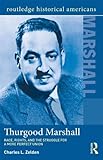
Charles L. Zelden. Thurgood Marshall: Race, Rights, and the Struggle for a More Perfect Union. New York: Routledge, 2013. viii + 228 pp. $130.00 (cloth), ISBN 978-0-415-50642-7; $34.95 (paper), ISBN 978-0-415-50643-4.
Reviewed by Michal Belknap
Published on H-Law (February, 2015)
Commissioned by Michael J. Pfeifer (John Jay College of Criminal Justice, City University of New York)
The Frustration of Faith: Thurgood Marshall and the Constitution
Who got it right? Was President Lyndon Johnson a champion of African American rights or the obstacle to voting rights legislation depicted by the movie Selma? While debate rages over the character and motivations of the alleged opponents in the fight to secure passage of the Voting Rights Act of 1965, those who fought the battle for African American civil rights in the courtroom rather than in the streets or the halls of Congress have received far less attention. Charles Zelden redirects our attention to the most important figure in that facet of black America’s struggle for equality with this lively little book about Thurgood Marshall.
It is one of what Paul Finkelman characterizes as “a series of short, vibrant biographies.” As the editor of that series Finkelman is hardly objective, but with respect to Zelden’s little book, his characterization is completely accurate. Zelden has managed to pack a great deal of information, and even four primary documents, into 228 quite readable pages. Although footnoted, this book is clearly not one intended for a scholarly audience. Nor should readers expect it to be a definitive biography of Marshall. But it does provide undergraduate readers with a lively and insightful introduction to a man who was not only the first African American to sit on the US Supreme Court but also one of the most successful civil rights lawyers of the twentieth century.
As Zelden tells his story, Marshall was a man whose life bristled with contradictions. Raised in segregated Baltimore at a time when the realities of American race relations defied the egalitarian promises of the Constitution, he nevertheless considered this country’s social and constitutional order to be fundamentally sound. They were, Marshall recognized, marred by racism and discrimination, but as he saw it, those were cancers corrupting what was otherwise a fundamentally healthy organism. Convinced of the perfectibility of the Union, he saw his job as a lawyer, and later as a judge, to be making that union more perfect. Furthermore, Marshall believed, for a while at least, that his objective was attainable. One of the contradictions in his life, an inconsistency for which Zelden never provides a fully satisfying explanation, is that between the optimistic young civil rights lawyer, who believed law could reform America, and the angry old man who who spent his last years on the Supreme Court writing often bitter dissents against the increasingly conservative decisions of the Burger and Rehnquist courts.
In his very first sentence, Zelden declares: “Thurgood Marshall was an angry man” (p. 1). These words might lead one to conclude that Zelden views anger against racism, discrimination, and judicial rulings perpetuating them as the essence of his subject. Yet just one page later he writes that the words which best describe Marshall’s life’s are “faith” and “optimism” (p. 2). Two pages after that, the reader learns that it was “a mixture of anger, optimism, and faith in the law’s redemptive power that shaped the man.” Obviously, there is some inconsistency in Zelden’s characterization of his subject. The problem, however, lies with Marshall rather than with his biographer.
Born in an increasingly segregated Baltimore, young Thurgood Marshall was told by his father to fight anyone who called him a “nigger.” But his father also instilled in him a love of debate and arguing, and he came to prefer talking his way out of trouble to fighting. During his early years the separation of the races that the law required only occasionally significantly burdened young Thurgood, and it was not until his senior year at all-black Lincoln University that “his dislike of segregation matured into a deep-seated commitment to oppose Jim Crow” (p. 18). This was about the same time that he fell in love, got married, and became a serious student. Indeed, Marshall became the top scholar at Washington’s Howard Law School and the leading protégé of its dean, Charles Hamilton Houston, who was in the process of transforming previously undistinguished Howard into an academy for civil rights litigators. At Howard Marshall’s growing anger found a focus. Under Houston’s tutelage, he became committed to the idea of using the law to promote social change.
As a fledgling attorney Marshall had been forced to commute by train from his home in Baltimore to Howard in Washington, DC, because Maryland’s state law school would not admit African Americans. He sued the University of Maryland, successfully seeking to force it to admit blacks. Houston and his young protégé won the case, and Thurgood Marshall, who had been eking out a marginal existence in civil practice, became a civil rights lawyer. Houston, who was the attorney for the National Association for the Advancement of Colored People (NAACP), persuaded that organization to hire Marshall as his assistant.
When Houston returned to private practice in 1938, Marshall replaced him as the head of the organization’s litigation arm, which became known as the NAACP Legal Defense and Education Fund, Inc., or simply the “Inc. Fund.” As the chief of the Inc. Fund, he was both a legal strategist and a fundraiser, and his duties required him to travel throughout the South. On those trips he always carefully stayed within the rules of the region’s segregated society. While necessary to protect himself from lynching, those many concessions to Jim Crow are yet another example of the contradictions that characterized the life of Thurgood Marshall.
As an Inc. Fund litigator Marshall achieved a series of victories in the Supreme Court, winning decisions that held unconstitutional all-white Democratic primaries, segregation of interstate buses, racially restrictive covenants in real estate deeds, and eventually school segregation. Legal scholars may disagree with Zelden about the doctrinal significance of Shelly v. Kramer (which he does not think was very great). But his accounts of the NAACP’s victories in the 1950 graduate school segregation cases and in the landmark Brown v. Board of Education (1954) are compact and insightful retellings of those oft-told stories that are enriched by information concerning the Supreme Court’s internal deliberations in those cases.
Readers are likely to learn more they did not previously know, however, from the following chapter on the implementation of Brown. Borrowing a cynical assessment of the approach the Supreme Court took from Marshall himself, Zelden entitles this chapter “All Deliberate Speed means S-L-0-W.” In explaining why so little happened in the wake of the Supreme Court’s landmark ruling Brown ruling, he examines among other things the interrelationship between his subject’s personal life and the pace of desegregation litigation. Although a chronic philanderer, Marshall became so distraught when his first wife developed terminal cancer that he stopped working for several months to nurse her and even tend her bedpans. After she passed away, Marshall fell into a deep depression. In another of those contradictory happenings that typify his life, though, he bounced back from his despair so quickly that within a year after her death he had married a secretary with whom he had been carrying on an affair. Zelden includes other information that also contradicts the usual heroic picture of the civil rights fighter, noting that, rather than planning how to follow up on Brown, his entire NAACP staff took an ill-advised “breather” after winning the landmark case.
What it needed to be doing instead was preparing for the additional litigation that would be required to secure implementation of Brown. Another of the contradictions in the Thurgood Marshall story is the contrast between the familiar picture of a triumphant Marshall and his co-counsel on the steps of the Supreme Court on May 17, 1954, and the reality of what Brown achieved. There was so little forward movement toward school desegregation during the next decade that Benjamin Muse later characterized this period of foot-dragging, massive resistance, and violence as the “Ten Years of Prelude.” Marshall had asked the Court for an order requiring immediate desegregation, but he had not really expected to get it. When the justices merely remanded Brown and its companion cases to the courts in which they had originated with instructions to resolve the issues that remained undecided “with all deliberate speed,” his reactions were mixed. Marshall and his legal team had wanted Brown to be the case that ended the legal dispute over school segregation. Instead, all they had gotten was a ruling that, as Zelden perceptively observes, opened the way to endless disputes about the quality of southern schools and over whether various plans and administrative arrangements did enough to make those in the South equal to those in the North. “By 1959,” he writes, Marshall’s optimism on desegregation was largely spent” (p. 108).
Yet, Marshall did not, like a growing number of black Americans in the 1960s, turn toward extremism and violence. Noting yet another contradiction in the man, Zelden observes that rather than attacking “the Establishment,” he was part of it. His critics often accused Marshall of radicalism, but while willing to cooperate with the Communist Party of the United States, he was so far from being a supporter of the CPUSA that in the early 1950s he began a quiet cooperation with J. Edgar Hoover, the ferociously anticommunist director of the FBI. Unlike communists, Marshall had a fundamental faith in the American system. He just wanted American law to treat all people equally. His outlook placed him at odds with Dr. Martin Luther King Jr. and the young civil rights activists of the 1960s, both of whom wanted to overturn a racist legal order by breaking the law. The NAACP defended these protesters in court, but as Zelden makes clear, Marshall “did not understand the dynamic that increasingly was driving the civil rights movement” (p. 123). Perhaps it was time for him to move on.
In 1961 he did so. President John F. Kennedy made Thurgood Marshall a federal judge, appointing him to the United States Court of Appeals for the Second Circuit. While Zelden may be right in contending that Marshall thought like a member of the Establishment, the fact of the matter is that he was not. For one thing, the bench and bar were almost entirely white, and he was black. Southern segregationists delayed Marshall’s confirmation for more than a year. Besides being different racially, he was out of place professionally. Marshall had spent his entire legal career as a civil rights litigator, and consequently he lacked familiarity with the array of nonracial legal issues that a court of appeals judge confronts. He struggled in his new job. Eventually, though, Marshall mastered its complexities and proved the critics who had questioned his competence wrong. He was, however, never really comfortable in his new role. Fortunately for Marshall, President Johnson offered him a prestigious way to get back into the courtroom, making him the government’s top lawyer by appointing him solicitor general. He proved to be effective in that capacity, but it was not his legal ability that the president valued. What Johnson wanted was what Thurgood Marshall represented. Zelden makes it clear that he got the job because he was a Negro and because the president viewed appointing him as a way of advancing the moderate gradualist stance on civil rights that Marshall represented. His greatest value, certainly to the Establishment of which he wished to be a part, was as a symbol.
It was Marshall’s symbolic value that carried him to the pinnacle of his profession. Lyndon Johnson was determined to make him the first African American Supreme Court justice. There was no vacancy for LBJ to fill, but one fortuitously appeared when the president appointed Justice Tom Clark’s son, Ramsey, to be attorney general. This created a situation in which Justice Clark would have to recuse himself from participating in any case in which the federal government was a party. That effectively compelled the still comparatively young Clark to resign from the Supreme Court. Strangely, Zelden avoids the issue of whether Johnson deliberately forced Clark to step down in order create a place for Marshall on the nation’s highest court.
Instead, he focuses on the last and perhaps largest contradiction in the career of Thurgood Marshall: his failure to implement as a Supreme Court justice the views that had inspired him throughout his career. It was not Marshall himself but rather the rightward drift of the country and of the Supreme Court after 1969 that were responsible for this. As liberal allies such as chief justice Earl Warren and associate justices Abe Fortas and Arthur Goldberg departed, and were replaced by conservatives such as chief justices Warren Burger and William Rehnquist and associate justice Antonin Scalia, Marshall found himself more and more out of step with a majority of the Court. He felt increasingly isolated. Eventually, his only ally and friend on the Court was that lion of liberalism, William Brennan. Marshall continued to fight for the causes in which the two of them believed deeply: racial integration of the public schools, affirmative action, African American voting rights, and abolition of the death penalty.
He almost always lost, however. Marshall remained the same committed judicial activist he had always been, but he changed as liberal activism came to seem increasingly futile. He began to write increasingly bitter dissents. As Marshall approached the end of his life in 1993 the anger that Zelden sees as one of the defining characteristics of the man was very much in evidence. He clung to life primarily to deny to those he feared would destroy what he had spent his life fighting to achieve the opportunity to appoint his successor. “This was Marshall’s nightmare,” says Zelden. It was “why he remained on the Court until he was physically unable to serve” (p. 170). Zelden’s conclusion makes perfect sense, but his evidence suggests Marshall’s earlier optimism, rather than a fundamental feature of his personality, was mainly a function of age and mostly the product of times when things seemed to be getting steadily better. Darker times brought out a darker side of Thurgood Marshall.
Interestingly, Zelden has drawn two of the four documents he has chosen to include in this book from the optimistic period of his subject’s life and two from what I would call his pessimistic phase. Together, they demonstrate what seems to be a clear change in outlook as he aged and the world turned increasingly against him and his values. Collectively, they offer readers a demonstration of the contradictions that seem to define his life. There were two Thurgood Marshalls, not one. Zelden has done a superb job of telling the story of each. One only wishes he had devoted a bit more attention to explicating the contradictions between them.
If there is additional discussion of this review, you may access it through the network, at: https://networks.h-net.org/h-law.
Citation:
Michal Belknap. Review of Zelden, Charles L., Thurgood Marshall: Race, Rights, and the Struggle for a More Perfect Union.
H-Law, H-Net Reviews.
February, 2015.
URL: http://www.h-net.org/reviews/showrev.php?id=41121
 | This work is licensed under a Creative Commons Attribution-Noncommercial-No Derivative Works 3.0 United States License. |

