

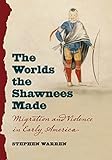
Stephen Warren. The Worlds the Shawnees Made: Migration and Violence in Early America. Chapel Hill: University of North Carolina Press, 2014. Maps. 336 pp. $39.95 (cloth), ISBN 978-1-4696-1173-0.
Reviewed by Jamie Mize (UNC-Greensboro)
Published on H-AmIndian (July, 2014)
Commissioned by F. Evan Nooe (University of South Carolina Lancaster)
Migration and Identity in Protohistoric and Colonial Shawnee Society
In The Worlds the Shawnees Made, Steve Warren examines Shawnee identity, and how, even though they lacked a shared sacred ground, the Shawnees maintained a cultural distinctiveness from their various American Indian neighbors. According to Warren, a renowned Shawnee scholar and associate professor at Augustana College, migration and reinvention allowed the Shawnees to maintain their culture in the face of violence and other pressures brought by colonialism. Central to Warren’s thesis is his idea of the Shawnees as “parochial cosmopolitans.” Due to their migrations, the Shawnees were highly attuned to the complexities of colonial life, but they also remained committed to their villages and often maintained a local focus. Because the Shawnees often lived in completely different geographical regions, and because their social power structures placed authority at a village level, Warren argues that the only way to truly understand the Shawnees is to examine them at the local level. Shawnees did not think in “tribal” terms in the colonial period; therefore, historical approaches should avoid this designation as well.
Even though Shawnee identity was not homogenous, cosmologies, ritual practices, and a shared language knitted the Shawnees together while dispersion and migration became central aspects of their lived experience. According to Warren, Shawnee cosmologies do not focus on place, but rather, they “emphasize transience, mobility, and alliance” (p. 21). In light of their traditions of migration it is not surprising that no archeological markers of the Shawnees exist. Warren traces the shortage of Shawnee archeological evidence to the lack of archeological studies of colonial sites. This coupled with the fact that historians rarely study protohistoric peoples creates a very real gap in Shawnee scholarship. Warren suggests that the best way to remedy this issue is to rely on “circumstantial” evidence from the protohistoric peoples of the Ohio River Valley, known as the Fort Ancient Tradition, to connect their culture to that of the colonial Shawnees (p. 19). As such, Warren relies on archeological sources along with archival evidence from French, British, and other colonial archives, as well as numerous and assorted published memoirs and manuscripts.
The Worlds the Shawnees Made is divided into three chronological sections. The first section opens with a survey of Fort Ancient peoples. Warren labels these peoples the first “parochial cosmopolitans” because even as they “adjusted their way of life to suit new, colonial circumstances they maintained their attachment to their village-based way of life” (p. 25). Even though Fort Ancient peoples left the Middle Ohio River Valley, they moved as villages. Warren asserts that the most likely reason for the migrations of Fort Ancient peoples was disease. He is rather adamant that Iroquois raids into the Ohio River Valley were not a principal factor in the end of Fort Ancient Traditions. To support this assertion, Warren relies on archeological evidence. Archeologists have not discovered “time-sensitive European artifacts dating to the period between 1650 and 1720.” The absence of such artifacts coupled with the lack of archaeological indications of violent deaths leads Warren to assert that the “absence of such evidence proves that the depopulation of the Ohio Valley occurred largely before the Iroquois conquest of the Ohio Valley” (p. 74). Warren suggests continuity between the Fort Ancient peoples and the Shawnees due to the fact that they both practiced fragmentary migrations. While the Fort Ancient peoples moved as villages, the Shawnees formed their villages and made decisions based on five patrilineal kinship designations. Prior to the historic period, each of the five society clans held a designated territory with a town that shared the clan name. From the historic period forward, however, these larger territorial units broke down into smaller, “patrilocal” communities, and the largest clan, numerically, “seems to have determined the identity and the leadership of the town itself.” In addition to the five societal clans, Shawnee society was further divided into twelve clans that held ceremonial importance. While clan identity had an impact on Shawnee migrations, kinship affiliations also “fragmented and coalesced with each other as they moved” (p. 78). Warren demonstrates this point in the remainder of the book as he analyzes Shawnee migrations through village-based analysis.
The second section examines Shawnee society at three different village sites in disparate geographical locations, and the varying colonial challenges they faced in each place: the Illinois River Valley, the Savannah River, and the Upper Chesapeake. Regardless of location, Warren argues, continuities existed between precolonial and colonial American Indians, and a failure to acknowledge this fact has led to an overemphasis on the “ruptures of colonialism” (p. 82). In the Southeast, the Shawnees obtained a foothold by aligning themselves first with the Westos in the Indian slave trade, but they achieved a preeminent place for themselves when they destroyed the Westos at the behest of the English. The Indian slave trade provided security for groups such as the Shawnee, but the slaving of these smaller, autonomous peoples “forced coastal villagers such as the Catawbas and interior tribes such as the Creeks to coalesce” (p. 84). The use of Shawnee as a trade language by the eighteenth century offers additional evidence for the influence of the Shawnee in the Southeast.
While the Shawnees warred with other Indian peoples during slaving expeditions in the Southeast, in the Upper Illinois River Valley Shawnees warred with each other. To demonstrate the nature of this conflict Warren analyzes a battle in 1680 at the village of Kaskaskias in which a group of Shawnees, allied with the French and Illinois peoples, fought against an invading force of Iroquois and other Shawnee peoples. Warren argues that previous attempts to explain this conflict as a civil war overlook the importance of local concerns to the Shawnee peoples. Rather than viewing themselves as a tribe, the Shawnee remained “parochial cosmopolitans” and made decisions based on a village or local level. Warren suggests that older alliances brought the Shawnees to Kaskaskias, and the lure of trade with the English, and the violence and depletion of resources at the Grand Village eventually led the Shawnees to migrate. The final chapter in section 2, the weakest chapter in this section in terms of source base, discusses the Shawnee presence in the Chesapeake. According to Warren, these Shawnees chose “absorption into the Iroquois Confederacy” rather than a direct alliance with the English (p. 153). The Shawnees were permitted to settle in the Chesapeake as long as they acted as a buffer against raids on the Iroquois, and as a result, they experienced many of the retaliatory attacks by the Catawba and other southern tribes.
Just as the first two sections suggest continuity from Fort Ancient Traditions to colonial Shawnees, the third section argues for a reconsideration of historians’ periodization of removal. Warren argues, “we must situate the Indian Removal Act of 1830 into a much longer history of forced relocation,” beginning in the 1720s (p. 156). Central to this point are the competing histories of the Shawnee and the Iroquois. The Iroquois believed that they defeated the Shawnees and forced them to relocate, thus the Iroquois equated the Shawnee migration to the Upper Chesapeake and Pennsylvania with subjugation. The Shawnees viewed their migrations as voluntary rather than coerced. According to Warren the memory of the Iroquois (and subsequently the English) regarding the Shawnee migration “has defined Shawnee history since the late seventeenth century,” ultimately resulting in loss of sovereignty for the Shawnee people (p. 149). The issue of sovereignty and the importance of whether or not the Iroquois defeated the Shawnees culminated with the Walking Purchase in the early eighteenth century. The Walking Purchase, the proverbial final straw, of English and Iroquois assumptions on the authority of the latter over all eastern Indian groups led the Shawnees to quit their settlement in Pennsylvania and return to the Ohio River Valley.
According to Warren, “after the Walking Purchase, Native people in Pennsylvania understood that land-hungry settlers would inevitably consume their estates. The Ohio country became the only remaining alternative for those seeking economic and cultural freedom” (p. 195). Once back in the Ohio River Valley, Shawnee societal structure underwent an evolution. Charismatic individuals became chiefs, breaking the tradition of hereditary chiefly lineages. Warren asserts that this social change emerged from the “increasingly selective and voluntary nature of Indian identities” (p. 189). The impacts of colonialism and migration wrought many changes on Indian societies. According to Warren, the Shawnees and other Indians began to identify a “common racial heritage that had supplanted village-based identities. To the settlers, and perhaps now to themselves, a kind of 'Indian' racial identity bound them together in a common fate” (p. 197). This shared “Indian” identity provided the groundwork for the revitalization movements that occurred in the late eighteenth and early nineteenth centuries. The connections that the Shawnees made with other Indian groups through their many travels and migrations proved beneficial to their revitalization and pan-Indian efforts. Warren’s theme of parochial cosmopolitanism is perhaps best seen in this final example. Ultimately, Shawnees chose to relocate for their own local reasons, but after years of migrations, the Shawnees had established intertribal connections and alliances in most locations east of the Mississippi River.
The Worlds the Shawnees Made is an excellent contribution to Shawnee scholarship, as well as American Indian history overall. Warren’s work is solidly ethnohistorical, and he does much to draw cultural connections between geographically disparate villages to demonstrate the existence and persistence of Shawnee identity. This work, however, needs a conclusion. Warren covers a tremendous amount of ground, both geographically and chronologically; furthermore, each section has its own thesis. A conclusion would remind the reader of the overarching goal of the work, as well as clarify how the different parts fit into one whole. This is something that the author does well in his introduction, and it would be helpful to the reader to have at the end as well. This work is also more appropriate for specialists rather than general readers. Warren often mentions historical events, such as Bacon’s Rebellion, but he fails to fully contextualize the importance of the event to his narrative. Those lacking a strong base in early American history might find themselves lost. This caution goes double for his discussion of the protohistoric Fort Ancient peoples. Warren admits that no definitive evidence exists to connect the Shawnee to the Fort Ancient Tradition; however, he often speaks of them synonymously, and at times it is difficult to ascertain if he is specifically referring to Fort Ancient peoples or Shawnees. Ultimately, The World the Shawnees Made is a major contribution, not only because of the relatively small amount of Shawnee scholarship on the era covered by the author, but also because of the time span and geographical distance that Warren is able to narrate in one work. In addition, Warren’s work provides an excellent model for scholars of ethnohistory. Chapter 1 is a fascinating ethnography of Shawnee society and identity that Warren bases on his fieldwork and interviews among the Shawnees. Ethnohistorians and Shawnee specialists, in particular, would benefit from reading this book.
If there is additional discussion of this review, you may access it through the network, at: https://networks.h-net.org/h-amindian.
Citation:
Jamie Mize. Review of Warren, Stephen, The Worlds the Shawnees Made: Migration and Violence in Early America.
H-AmIndian, H-Net Reviews.
July, 2014.
URL: http://www.h-net.org/reviews/showrev.php?id=41077
 | This work is licensed under a Creative Commons Attribution-Noncommercial-No Derivative Works 3.0 United States License. |

