

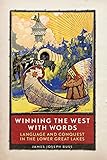
James Joseph Buss. Winning the West with Words: Language and Conquest in the Lower Great Lakes. Norman: University of Oklahoma Press, 2011. vii + 328 pp. $34.95 (cloth), ISBN 978-0-8061-4214-2.
Reviewed by Robert Michael Morrissey (University of Illinois)
Published on H-AmIndian (May, 2014)
Commissioned by F. Evan Nooe (University of South Carolina Lancaster)
Silencing the Past in the Old Northwest
In Winning the West with Words, James Joseph Buss explores the ways in which nineteenth-century writers, artists, and other meaning-makers constructed a history of the Midwest that excluded Indians and the multicultural past of the region. Focusing on diverse discursive productions, from treaty negotiations in the late 1700s, to the famous paintings of George Winter in the mid-1800s, to the pageants commemorating the centennial anniversaries of Midwestern states in the 1910s, Buss shows how Anglo-Americans erased traces of Native and mixed-race histories while replacing them with simplified stories about heroic pioneers and vanishing Indians. As Buss argues, Anglo writers and memory-makers conquered the West with language, committed “literary genocide,” and constructed a simple but misleading narrative that ignored a more complex interracial past (p. 6). Through seven robust and well-researched chapters, each one focused on a distinctive set of texts or artistic representations, Buss convincingly argues that the writing and commemoration of history were themselves acts of colonization, part of a history of conquest and dispossession.
Buss’s central claim is definitely convincing, and joins a flourishing conversation. Influenced by authors like Michel-Rolph Trouillot, recent historians have focused great attention on the production of history and memory, providing models and a theoretical framework for understanding history and commemoration as fundamentally political acts. In Native American history, writers such as Jean O’Brien, Jill Lepore, Peter Silver, and Phil Deloria have blazed a trail that Buss happily and skilfully follows in Winning the West with Words. Acknowledging his debt to these authors in a very nicely written introduction, Buss lays out the stakes and significance of his study. Importantly, Buss shows that while his project and questions are not totally original, they are especially necessary for the region he explores, since Midwestern authors did such a thorough and comprehensive job of erasing Indians and cross-cultural history from the region’s identity. Indeed, coming at a moment when scholars like Jon K. Lauck and others are calling for renewed attention to the Midwest as a region, Buss’s introduction is particularly timely, since it so clearly and compellingly explains how the Midwest’s historical identity became distorted, oversimplified, and homogenized.
Throughout the book, certain key concepts guide Buss’s narrative. First, Buss deploys Coll Thrush’s concept of the “place-story” to good effect, treating it as his central problematic. As readers of H-AmIndian know well, the Midwest in the colonial period was home to a complex set of exchanges and entanglements between Indians and European colonists, leading Richard White to describe the region as a “middle ground.” Buss’s objective for the book is to show how Midwestern writers invented an alternative—even fictionalized—set of place-stories that ignored these “middle ground” realities and instead presented a world in which neither racial mixing, Native adaptation, nor even Native survival, were really possible. Moreover, even as they erased Indians through what O’Brien called “narratives of Indian extinction,” Midwestern writers cast themselves as victims of Indian violence or occupiers of empty land. Thus their stories resembled what Mary Louise Pratt called “anti-conquest.” For Buss, the drama is in the way Midwestern memory-makers manipulated and selected the past, using what Patricia Limerick called “shifty language” to justify and enhance their power.
Part 1 of the book focuses on texts that distorted history even as they did the work of conquest. Chapter 1 focuses on treaty negotiations and “a decade-long war of words” fought in newspaper reports of treaty councils (p. 39). This process culminated at the second Treaty of Greenville after the War of 1812, where Indians were deliberately silenced, and where William Henry Harrison constructed a distorted narrative even as he refused to allow Indians to represent themselves in treaty records at all. In chapter 2, Buss shows how squatters and illegal settlers in the West made a similar move, using petitions to narrate and justify their own conquest of Indian land. As they did so, squatters and speculators—whose interests were ostensibly opposed—united against Indians and constructed a narrative and common identity as “pioneers.”
Part 2 of Buss’s investigation details the social and cultural history of what he calls “clearing the middle ground.” Chapter 3 is a largely social history about the Wyandots’ efforts to resist removal in the years after the War of 1812, showing how missionaries failed to create a narrative that would allow Indian persistence. Chapters 4 and 5 focus on the paintings of George Winter. Like George Catlin, Winter traveled to the Northwest in the 1830s as part of a conscious effort to preserve the evidence of a vanishing race. Buss shows how Winter’s ambition was positively scientific since he tried to position himself as an objective observer. But while many have read Winter’s paintings as ethnographic, Buss shows that Winter actually painted many of his scenes years after his trips. Moreover, crucial differences between the paintings and the sketches reveal an artist telling stories and altering the past to disappear or exoticize the Indians. By the 1860s, Winter was painting scenes that were more romantic than real, buying into simple stereotypes rather than depicting the complicated middle ground he had witnessed.
Chapter 5 is the strongest of the book. Here Buss focuses on the fascinating story of Frances Slocum, an English woman taken captive by Miami Indians in the late 1700s who became the object of great attention after she was “discovered” living an “Indian” life in the Miami Country. Soon a celebrity, Slocum, or Young Bear, was memorialized in several popular narratives, as well as evocative paintings by George Winter. Importantly, authors had to “spin” a central issue of her life, which was her refusal to leave her Indian kin and return to live with family in Pennsylvania in the 1830s. As Buss skilfully argues, Anglo writers had a challenge narrating Slocum’s story since the reality of her choices “threatened to expose racial categories too fluid and unstable to justify conquest and, perhaps more important to the region, Indian removal” (p. 141). Though they tried to construct her as a white victim, Slocum’s real history revealed a multicultural reality that the Anglo authors tried to erase. As Buss powerfully concludes, “The whitening of Young Bear happened more successfully in the minds of white audiences than in reality” (p. 162).
Part 3 of the book looks at the act of commemoration, and the self-conscious efforts by Anglo Midwesterners to write and tell the story of their region as history proper. Chapter 6 focuses on the distorted productions of “Pioneer and Old Settler Associations,” as well as county histories, which proliferated in great numbers in the late nineteenth century. Unsurprisingly, these formulaic texts were unabashedly progressive, romanticizing and glorifying the takeover of the landscape and the elimination of Indians. In this they were similar to the narratives produced in commemorative celebrations such as the Cincinnati Fair in 1888, a focus of chapter 7, where white historians constructed an image of Indians as primitive foils for heroic American progress. Using language of scientific “progress” and an understanding of linear and progressive cultural development from primitive to civilized peoples, nineteenth-century interpreters explained why Indians were destined to be erased from the Midwestern stage. Continuing this theme, Buss’s epilogue explores the absurdly romantic and racist language in pageants commemorating the statehood of Ohio, Indiana, and Illinois.
This is a strong book, well written and persuasive. To be sure, there are moments when Buss seems to push his evidence to the limit. For instance, Buss’s argument in chapter 4 rests on what he considers key differences between George Winter’s sketchbooks and the paintings he based on them years later. As Buss argues, Winter’s substitution of a jacket for a cloak on the back of one Native figure in a certain painting was likely done in order to emphasize the Indians’ exotic and primitive identity. But was it truly an example of “shiftiness,” or a simple style choice, or a function of the particular paints on Winter’s palette at the time of the painting? Without more evidence, the insinuation seems a bit much. Similar examples of interpretive overreach can be found occasionally in Buss’s discussion of key texts. Still, this may be considered a strength rather than a weakness of the book, since Buss is clearly working hard to tease out meaning, identify silences, and read between the lines of these productions. And if there are occasional paragraphs that seem less than convincing, Buss’s overall argument is powerful and leaves the reader with little doubt about Buss’s conclusions.
And in this connection, Buss’s fine book left me thinking about a similar recent book, Edward Watts’ In this Remote Country (2006). Focused similarly on nineteenth-century discursive productions of Midwestern history, and sometimes even using the same sources as Buss, Watts argued a very different point. For Watts, Anglo writers did not try to erase or forget Native and especially French colonial histories in the Midwest; rather, they used them as a romantic foil against which to imagine nineteenth-century America. As Watts argued, Midwestern writers romanticized the French colonial and Native past—the middle ground that Buss’s authors so wanted to forget and erase—not only to lionize, but also importantly to critique the racism, individualism, and competitiveness of nineteenth-century American society. While their arguments are in many ways opposed, taken together the two works remind us of the important ways in which the past has been used, constructed, and distorted in particular contexts, and for particular reasons. Buss wants us to remember that the very construction of Midwestern history in the nineteenth century was a political act, erasing a complex past. His book is an excellent new voice in a fascinating conversation about history, memory, and identity in the Midwest and in American history more generally. It should find a wide audience among Native American historians, historians of the West, and cultural historians.
If there is additional discussion of this review, you may access it through the network, at: https://networks.h-net.org/h-amindian.
Citation:
Robert Michael Morrissey. Review of Buss, James Joseph, Winning the West with Words: Language and Conquest in the Lower Great Lakes.
H-AmIndian, H-Net Reviews.
May, 2014.
URL: http://www.h-net.org/reviews/showrev.php?id=40978
 | This work is licensed under a Creative Commons Attribution-Noncommercial-No Derivative Works 3.0 United States License. |

