

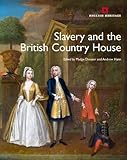
Madge Dresser, Andrew Hann, eds. Slavery and the British Country House. Swindon: English Heritage, 2013. xv + 180 pp. $100.00 (cloth), ISBN 978-1-84802-064-1.
Reviewed by Tim Mowl (University of Buckingham)
Published on H-HistGeog (December, 2013)
Commissioned by Robert J. Mayhew (University of Bristol)
Contested Legacies: Slavery and Material Culture in Britain
This illuminating study does not disguise its format as conference proceedings, which is how it started life. The symposium Slavery and the British Country House: Mapping the Current Research was held in November 2009. The two sponsors were the University of the West of England, where Madge Dresser is an associate professor of history, and English Heritage, for which Andrew Hann works as Properties Historians’ team leader. This explains the particular range of interests presented here and also accounts for the varied geographical constituencies of the thirteen chapters--from Bristol and its hinterland in the west to Richmond-on-Thames in the east, the Isle of Wight in the south and north to Nottingham, Derbyshire, and Liverpool. This results in a surprising richness and diversity of country houses built either directly or indirectly from the proceeds of the Atlantic trade.
Hann and Dresser’s opening sections, which are concerned with the Slave Compensation Commission and West Country houses respectively, are data-filled analyses of the evidence of slave ownership. Dresser charts a whole series of houses in the lee of Bristol whose owners benefited from slave money, particularly an interesting cluster around Wraxall. She is at pains to record, several times in this survey, that the research is a “work in progress,” signaling the need for others, including herself, to follow up with specific case studies. While most of her data relates to plantation ownership and marital connections within the slave trading families, she makes some circumstantial stabs at slave influence. One concerns the appearance of a black servant in what Dresser perceives to be a “naïve depiction of Kingsweston House” that is used for the book’s cover (p. 37). Black servants were symbolic of owners’ wealth and social standing in late seventeenth- and early eighteenth-century portraits, often mere studio props, as Caroline Bressey points out in a later chapter, and do not necessarily denote slavery connections, though Edward and Robert Southwell were government administrators of West Indian affairs. Furthermore, though the family depicted is undoubtedly the Southwells of Kingsweston, the classical alcove in the background is not a rendering of the main house, but one of the two niches flanking its forecourt, now lost.
Other chapters consider specific houses and landscapes, both in Britain and in the Caribbean, one of the most engaging being Victoria Perry’s analysis of landscape aesthetics and tourism with its focus on Valentine Morris’s savage picturesque cliff-top walk at Piercefield near Chepstow. This extraordinary layout, which teeters on the edge of the Wye to evoke sensations of the Burkean sublime, is well known to garden historians, but its connections with the slave trade have never been fully highlighted. Perry’s account is admirable for its deft combination of primary source scholarship, based on her doctoral research, with a first-hand account of walking the site. However, her assertion that the “origins of the ‘landscape tour’ were entwined with the British plantation economy in the Americas” is only partially proven (p. 105), as she offers no other examples of picturesque sites near the Atlantic trading ports. Rather, as Susan Sloman has argued in Gainsborough in Bath (2002), it was the transport links between South Wales and the Midlands--what is now the A38--that provided the impetus for several owners, patrons of Thomas Gainsborough, to share aesthetic ideas and create a linked series of picturesque landscapes. Indeed, one other cliffside walk, laid out later by Humphry Repton at Blaise Castle in the Bristol suburbs, was commissioned by John Scandrett Harford, an active abolitionist.
With the Codringtons of Dodington Park, Natalie Zacek seems at first to be on safer ground, but, as she acknowledges, the present house was built for Christopher Bethell-Codrington, who was “never directly involved with the West Indian plantations.” Undeterred, Zacek argues that Wyatt’s great Greek revival house “is certainly imbricated within the discourse and practice of slavery” and proceeds to unravel this layered history (p. 106). Her chapter is essentially an exercise in reception theory, tracing the ways in which Dodington has become a symbol of the family’s involvement in Antigua. This culminates in the controversy over Sir Simon Codrington’s decision in 1980 to sell the Codrington Papers, one of the “most important and comprehensive archives relating to the history of slavery” (p. 111). All this produces a lively narrative, well judged for a lecture theater, though the career of the earlier Christopher Codrington, born in 1688 on the Barbadian estate of his namesake father, and governor-general and commander in chief of the Leeward Islands, might have offered more tangible family connections with slavery. Disappointingly, Zacek writes airily that his troubled governorship lies beyond the scope of her chapter.
This arbitrary selection of sites and topics inevitably produces a partial representation of slavery. The book is none the worse for that, but it is generally uneven in tone and approach. This will come as no surprise to any academic convening a conference with an overarching theme. Contributors will invariably attempt to showcase their own research rather than toe the conference line. In the case of Laurence Brown’s chapter on Marble Hill and Northington Grange, slavery and classical culture cohere effectively if, again, somewhat tentatively. Henrietta Howard invested heavily in shares of the Compagnie des Indes and the South Sea Bubble, enabling her to build Marble Hill and make good use of Honduran mahogany in the construction of the Great Room, while Northington was owned by the great Drummond and Baring banking dynasties, which both had strong connections to the slave economy of the Atlantic. So far so good then; but surely it is special pleading to argue that Alexander Baring’s architect, Charles Robert Cockerell, had John Flaxman design a chimney piece for the dining room with a frieze depicting women servants “who were most probably enslaved or foreigners,” to provide a conscious reference to slavery (p. 93). Such prestidigitation, even if it is footnoted with reference to scholarly work on the hetairai (companions/elite prostitutes) in Attic vase painting, is too much for this reviewer. The remainder of the chapter charts Baring’s banking career and his opposition to emancipation in meticulous detail and is all the more revealing of its subject because it avoids any forced connections between slave money and the “material construction of classicism” (ibid.).
Given that English Heritage underwrote this book, Caroline Bressey’s quietly belligerent chapter about the heritage body’s presentation of two of their properties is a surprise and a welcome relief after such attempts to yoke slavery to material culture. She focuses on a double portrait of Dido Elizabeth Belle (who was black) and her cousin Lady Elizabeth Murray (who was white), which was the focal point of an exhibition at Kenwood House in 2007 to commemorate the abolition of slavery, but which is not now shown in the permanent collection. Bressey argues that, as a result, the “diverse historical geographies contained within traditional spaces of Englishness,” such as Kenwood, have been lost (p. 116). The chapter is all the more refreshing as it quotes a 2010 speech by David Cameron concerning the selling abroad of Britain’s heritage, one that Bressey implies is a vision of an “old (white) England” (p. 115), an idea that continues to be exploited by the British National Party. Of course, the presentation of specific historical narratives might have as much to do with available wall space or the appointment of a new properties manager than a conscious filtering out of racially tense contested histories. Bressey finds Osborne House far more satisfying in a “number of objects that speak to black historical geographies and the complexities of British imperialism” (p. 118). There is no getting away from that at Osborne, given that Queen Victoria, its principal and only resident after the death of Prince Albert, was empress of India. At the end of two fascinating tours we even get some retail therapy in the shops.
Other chapters deal with country houses in Derbyshire, Bexley, and Liverpool, and there is an archaeologically focused paper by Roger Leech on lodges, garden houses, and villas in both England and St. Kitts and Nevis. Here there might have been an opportunity to provide a telling link between architectural decoration and slavery at Redland Chapel. Like Paul Fisher of Clifton Hill House, which Leech does cover, John Cossins was a London grocer with connections to the Atlantic trade. At Redland Court, his architect, John Strahan, deployed in 1735 a debased version of Palladianism, but at Cossins’s chapel up the hill a more spirited rendering of classicism by William Halfpenny culminated in two carved blackamoor heads on the external wall of the most sacred east end. This would appear to be as clear an expression of Bristol’s slaving connections as the 1720 grave at Henbury parish church to the black slave, Scipio Africanus, brought to the light of Christianity by his master, the Earl of Suffolk. However, the intention in this series of papers to provoke debate and stimulate new approaches to the understanding of our built heritage is admirably realized and should encourage a reappraisal of the somewhat tendentious link country houses and their landscapes have with slavery.
If there is additional discussion of this review, you may access it through the network, at: https://networks.h-net.org/h-histgeog.
Citation:
Tim Mowl. Review of Dresser, Madge; Hann, Andrew, eds., Slavery and the British Country House.
H-HistGeog, H-Net Reviews.
December, 2013.
URL: http://www.h-net.org/reviews/showrev.php?id=40621
 | This work is licensed under a Creative Commons Attribution-Noncommercial-No Derivative Works 3.0 United States License. |

