

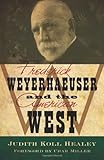
Judith Koll Healey. Frederick Weyerhaeuser and the American West. St. Paul: Minnesota Historical Society Press, 2013. xiv+256 pp. $27.95 (paper), ISBN 978-0-87351-891-8.
Reviewed by William Lang
Published on H-Environment (January, 2014)
Commissioned by David T. Benac (Western Michigan University)
The economic history of the United States includes a familiar list of iconic names that represent major industries: Henry Ford, Andrew Carnegie, John D. Rockefeller, and others. Their mention conjures historic events, graphic images, oft-quoted expressions, even caricatured likenesses. Frederick Weyerhaeuser is rarely grouped with the Ford-Carnegie-Rockefeller crowd, even though he was as thoroughly instrumental in creating the modern industry he dominated--forest products--as were the titans of automobile, steel, and oil production. Judith Knoll Healey’s new biography of Weyerhaeuser goes a long way toward fixing him as a legitimate hero in America’s industrial pantheon. Frederick Weyerhaeuser and the American West is a triumphalist and intimate biography of a brilliantly innovative industrialist as seen through newly available family diaries, letters, and images. Unlike his industrialist contemporaries, Weyerhaeuser had held his own counsel, as he told Lincoln Steffens in 1907: “I am never interviewed. I don’t care for write ups” (p. 174). Healey’s purpose is to pull back the curtain to reveal Frederick Weyerhaeuser as the progenitor of an industrial empire.
In 1852 at age eighteen, Weyerhaeuser came to America with his family from Nierdersaulheim, Germany. His father had died before Frederick turned twelve, leaving the family with poor prospects. His mother chose to follow other family members, resettling in Erie, Pennsylvania, where Frederick worked in a family-run brewery for four years and where he met Elizabetha Bloedel, six years younger than Frederick, also born in Neidersaulheim, and raised from infancy in America. The two married in 1857, one year after Frederick had moved to Rock Island, Illinois, where other relatives had taken up farmsteads. He labored briefly in a brewery but quickly took up a minor job at a sawmill, beginning his lifelong work in the lumber trade. Weyerhaeuser succeeded in the sawmill business, as Healey explains, as much from his intelligence and diligence as his industriousness and honest dealings with associates. By 1858, he had taken advantage of poor economic conditions during the 1857 recession to buy up logs and formed a partnership with his brother-in-law, P. C. A. Denkmann, to operate a failed mill. He made business decisions that often looked risky to others, but Weyerhaeuser rarely faltered, first buying timberlands in Wisconsin to feed his mill and later investing in co-operative river transport of logs, from forests to mills. In 1872, his leadership in the business vaulted him to elected presidency of he Mississippi River Logging Company. He succeeded in part, as a newspaper article noted in 1888, because of his strength of personality: “Mr. Weyerhaeuser is a good deal of a diplomat, and perhaps that is one reason why he is popularly known as ‘Bismarck.’ He never expresses an opinion until it is ripe, and is seldom entrapped into a declaration of his purpose until he is ready to act” (p. 129).
The Mississippi River Logging Company offered him opportunities for more investment. After taking another risk and purchasing Minnesota timberlands, Weyerhaeuser packed up his family--seven children--and moved to St. Paul in 1891. Living next door to railroad magnate James J. Hill on Summit Avenue, he became interested in Pacific Northwest forests. By 1899, he had made perhaps the most momentous purchase in the history of American forestry, buying more than 900,000 acres of railroad-held coniferous timberland in Washington State. That purchase led directly to the establishment of Weyerhaeuser Timber Company in 1900, a firm headed by Frederick, with fifteen partners, that built the world’s largest sawmill in Everett, Washington, on Puget Sound. That beginning led directly to an expansive enterprise--the company dropped “timber” from its name in 1959--that continues to dominate American forest industries today.
Frederick Weyerhaeuser died in 1914, just short of his eightieth birthday, arguably too early to know if his creation had stamina. Healey quotes him as philosophically noting not long before his death: “A man’s success cannot be determined while he lives. At least not until the lives of his children have been lived” (p. 3). That opinion drives much of the discussion in Frederick Weyerhaeuser and the American West, with Healey keeping the focus on Weyerhaeuser as a man driven to succeed, but who also held family dear. She draws heavily from family correspondence to underscore Weyerhaeuser’s desire that his business success become a family success. He succeeded to a remarkable degree, for his children and other relatives became managers and executives in Weyerhaeuser Timber Company, generation after generation. In her effort to reveal Weyerhaeuser’s temperament, Healey’s descriptive biography moves fluidly and easily between events in his business and family affairs. The connections are largely relational, not causal, and they are presented more in tandem than integrated. This is not a critical history. Readers will not find pointed analyses of Weyerhaeuser’s business ethics or discussions of the legality of his land acquisitions that raised some concerns, especially among Progressive politicians. Some may find the author’s characterizations of Weyerhaeuser’s political detractors too defensive or even breezy, but her purpose is elsewhere. She succeeds in exposing Weyerhaeuser’s personal life, and she convincingly argues that his seemingly single-minded focus on accomplishment was imparted wholly to his family. What she presents may not answer all of the important questions about him, but she offers a revealing portrait of the man and one new to even knowledgeable readers.
Healy’s method deserves some comment. In pursuit of Weyerhaeuser’s personality and to better reveal the context of his private and business lives, she intersperses lengthy extracts--even full letters--from the family’s private papers, the main new source for this biography. These excerpts are set in a different typeface and break the text, forcing readers to stop and read the excerpt or continue on with Healy’s narrative. Where at times the technique stumbles, on the whole it is effective, and the result is a close connection to the family members and their dynamic that cannot be reproduced in a narrative. Healy indulges in another device, however, that is more questionable. “In order to bring the reader closer to the person behind the public man,” Healy explains, “I have briefly dramatized scenes from parts of Frederick’s life” (p. 227). These “scenes” appear before each section of the biography and are fictive re-creations of episodes suggested by diaries, letters, and other family materials. These vignettes have the opposite effect from the author’s expectation. They actually disconnect the reader from the subject, while the letter and diary extracts pull the reader into the revealed moment. This biography will be welcomed by historians interested in late nineteenth-century forestry, industrial combines, and the lives of ambitious immigrant families. There is not much about the general history of the American West, as suggested in the title, but there is plenty in Healy’s rendition of the life of Frederick Weyerhaeuser to reveal the man behind the successful company that still bears his name.
If there is additional discussion of this review, you may access it through the network, at: https://networks.h-net.org/h-environment.
Citation:
William Lang. Review of Healey, Judith Koll, Frederick Weyerhaeuser and the American West.
H-Environment, H-Net Reviews.
January, 2014.
URL: http://www.h-net.org/reviews/showrev.php?id=40489
 | This work is licensed under a Creative Commons Attribution-Noncommercial-No Derivative Works 3.0 United States License. |

