

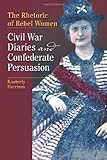
Kimberly Harrison. The Rhetoric of Rebel Women: Civil War Diaries and Confederate Persuasion. Carbondale: Southern Illinois University Press. xviii + 242 pp. $40.00 (paper), ISBN 978-0-8093-3257-1.
Reviewed by Sheila Phipps (Appalachian State University)
Published on H-CivWar (March, 2014)
Commissioned by Bonnie Laughlin-Schultz (Eastern Illinois University)
Southern Women's Rhetoric
Scholarly focus on the American Civil War has widened to include its effect on citizens thanks to the use of private sources such as women’s diaries. Women who understood the monumental importance of the event splitting the country in two began memorializing their experiences on the pages of their journals. Kimberly Harrison, in The Rhetoric of Rebel Women: The Civil War Diaries and Confederate Persuasion, sheds an interdisciplinary light on the subject by using these same private sources but studying them from the standpoint of rhetoric. While rhetoric has long been studied through public sources such as speeches, lectures, and editorials, Harrison turns to the abundant private sources generated by women during the Civil War to find out how women coped in dangerous wartime situations. She asks how war altered Southern elite women’s public speech, what written strategies they employed during the war, and how they turned from receptacles to generators of patriotic rhetoric. She argues that they made use of their journals to both understand the war and support their side in it. According to Harrison, the rhetorical skills women possessed at the beginning of the conflict determined how well they withstood the dangers and pressures that war visited upon them.
Harrison used over a hundred diaries and journals written by privileged Southern slaveholding women from across the South and from women at different stages of life. Some of these women lived in areas occupied by Union forces, some were occasionally touched by warfare, some were living as refugees, but almost all were caught up in the enthusiastic creation of a new nation and the exigencies of maintaining a home during the turmoil of war. They felt the blurring of lines between public and private roles and between war front and home front, switching from protected to protector of home, family, and possessions. They lived a contradictory life—helpless victims needing their men to fight harder to save the South, yet brave defenders of home and hearth in the absence of their men. They walked a fine line between maintaining their feminine virtue and fulfilling masculine obligations without losing status.
Harrison uses the term “self-rhetorics” to describe Southern women’s ability to create their patriotic identity. The diaries became a stage to develop arguments or determine when silence was the best and safest response. It provided a place for developing character for the positions women found themselves in, a place to prepare for uncomfortable encounters with the enemy or to replay scenes already lived to analyze their behavior in wartime reality. Harrison relies as well upon the phrase “gendered rhetorics of honor” to describe the ways they made sure that they had upheld what was expected of them under the code of Southern honor in the new roles they needed to assume. Harrison finds that, contrary to the view of Southern women as apolitical, many diarists revealed political savvy as they described their patriotic motives and public interactions. Their diaries provided a space to plan how far to go in supporting the Confederacy or resisting the Union, while maintaining the standards of a lady.
Wartime stress changed women’s roles. They found themselves in the unfamiliar position of protecting their own home and family or forced into dependency upon the kindness and generosity of extended family. Shortages required sacrifice and innovation. Women who had entered the marketplace only as consumers were now in charge of maintaining and sometimes contributing to the family finances, possibly taking on work outside of the home. And, of course, women who had ostensibly been shielded from the challenges of managing slaves were suddenly thrust into not only overseeing them but also making sure not to lose them as slaves caught the scent and promise of freedom. Harrison finds in Southern women’s diaries their recorded prayers and devotionals related to the immediate dangers and effects of warfare. The strength of faith sustained these women, as evidenced by their spiritual rhetoric. Ultimately, Harrison measures the power of Southern women’s rhetorical ability to record their experiences, opinions, and identification with Confederate nationalism against the silence of many on the pages of their diaries after the South’s defeat.
Harrison’s creative study of rhetoric in southern women’s Civil War diaries provides a useful analytical tool for historians of the era to look more closely at the words they used to describe their experiences. She proves that rhetorical study provides a more nuanced and effective approach to investigating the ways women adapted to war under very clear and restrictive gendered roles. Although readers might argue that women were invited into the public discourse much earlier through the sectional debate, Harrison’s work is a welcome addition to the growing trend of including the home front in studies of the American Civil War.
If there is additional discussion of this review, you may access it through the network, at: https://networks.h-net.org/h-civwar.
Citation:
Sheila Phipps. Review of Harrison, Kimberly, The Rhetoric of Rebel Women: Civil War Diaries and Confederate Persuasion.
H-CivWar, H-Net Reviews.
March, 2014.
URL: http://www.h-net.org/reviews/showrev.php?id=40486
 | This work is licensed under a Creative Commons Attribution-Noncommercial-No Derivative Works 3.0 United States License. |

