



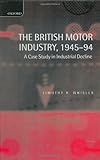
Timothy R. Whisler. The British Motor Industry 1945-94: A Case Study in Industrial Decline. New York: Oxford University Press, 1999. 300 pp. $105.00 (cloth), ISBN 978-0-19-829074-2.
Reviewed by Susan Bowden (University of Sheffield)
Published on EH.Net (April, 2000)
Four months after the publication of Whisler's British Motor Industry, BMW announced its intention to dispose of Rover. The publication of Whisler's assessment of the decline of the British motor industry would thus appear to be well-timed. It is also against this announcement that readers will come to Whisler's book for an understanding of how and why this once dynamic industry floundered.
The British Motor Industry is a welcome addition to the now voluminous literature on the motor industry in the UK. Whisler's has produced a "new" synthesis which aims to place the declining fortunes of the industry into an overall explanatory perspective. That perspective is grounded in economic theories of path dependency and lock-in. His thesis is that strategy formed a managerial lock-in which meant that despite the numerous structural and indeed personnel changes in the industry over time, the industry was locked into a prevailing ethos which failed to read the signals of changing market conditions. The strategy was inherited from the original founder, Morris, and was to pervade all subsequent manifestations of organisational form and structure. Strategy was the outcome of a pervading if mis-calculated belief in the innate superiority of the company's products: all the company had to do was make cars.
The thesis was originally set out by Roy Church in the Economic History Review. In that sense, Whisler's perspective is not new. What is new is the detailed elaboration of how that ethos dominated managerial thinking. Much of the book concentrates on the earlier formations of the company, most notably events prior to the spectacular collapse of 1975. Chapters follow a thematic approach detailing, inter alia, with design and development, product quality and reliability, production methods, domestic and export markets and distribution structures: all of which contain an immense amount of detail, but all of which tend to focus more on the specifics of one firm rather than the industry as a whole.
The problem with the path dependency, lock-in thesis, is that it can become a retrospective self-justifcation for the problems of the industry, especially when applied not, as in the usual case, to technology but to managerial culture. Thus reference to the new literature on professional lock-in might have helped -- as it is some readers might feel confused as to exactly how and why cultural lock-in should occur. Equally, readers from the industrial, economics and managerial disciplines might question why reference to market signals -- most particularly why the strategy and culture did not respond to changed signals -- is not addressed by Whisler. Thus we have references to issues of asymmetric information and transaction costs, but such issues are never really fully explored. The role of the financial markets, shareholders and Government --who were as much agents in this story as management -- is equally never fully assessed. The pages dealing with divided issues, for example, relies on one source and fails to pick up the relations between the company and its shareholders.
The issue of Government policy is particularly pertinent in this respect. The news of BMW's decision has been dominated by the "employment" question. If one is to understand path-dependency then one has to look to game theory and to bargaining between agents. A self-perpetuating ethos may be allowed to continue, if the agent concerned has superior bargaining leverage. Whilst Government's prioritized employment in marginal constituencies (as motor plants were located), then management was under no real pressure to effect real change. This theme runs through the entire history of the industry -- from the first assessments of the future prospects towards the end of the Second World War, to civil servants meetings under the Thatcher Regime and indeed to the current Government's reaction to BMW's decision.
Dissecting and synthesizing the troubled history of the British motor industry is not an easy task, and Whisler is to be congratulated for taking this on and for producing a wealth of detailed analysis which makes an important contribution to the literature. As the above makes clear, this reader would have welcomed more -- but surely an indication of a good book is that the reader becomes engrossed and finishes wanting not less, but more.
Copyright (c) 2000 by EH.Net and H-Net, all rights reserved. This work may be copied for non-profit educational use if proper credit is given to the author and the list. For other permission, please contact review.editor@eh.net.
If there is additional discussion of this review, you may access it through the network, at: http://eh.net/.
Citation:
Susan Bowden. Review of Whisler, Timothy R., The British Motor Industry 1945-94: A Case Study in Industrial Decline.
EH.Net, H-Net Reviews.
April, 2000.
URL: http://www.h-net.org/reviews/showrev.php?id=4036
Copyright © 2000, EH.Net and H-Net, all rights reserved. This work may be copied for non-profit educational use if proper credit is given to the author and the list. For other permission questions, please contact the EH.NET Administrator (administrator@eh.net; Telephone: 513-529-2850; Fax: 513-529-3309). Published by EH.NET.

