

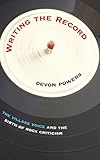
Devon Powers. Writing the Record: The Village Voice and the Birth of Rock Criticism. American Popular Music Series. Amherst: University of Massachusetts Press, 2013. xi + 160 pp. $22.95 (paper), ISBN 978-1-62534-012-2; $80.00 (cloth), ISBN 978-1-62534-011-5.
Reviewed by Thomas Conner (University of California--San Diego)
Published on H-1960s (April, 2014)
Commissioned by Zachary J. Lechner (Centenary College of Louisiana)
Pop’s Public Intellectuals and Their Problems
In the introduction to his book Performing Rites (1996), Simon Frith describes a lively dinner with friends, full of boisterous conversation that inevitably turned to pop music--likes, dislikes, latest finds, the usual. He ultimately aligns the scene with his overall assessment of the virtues of this particular kind of communication: “Part of the pleasure of popular culture is talking about it; part of its meaning is this talk, talk which is run through with value judgments.”[1] Such talk has been one of the chief examinations of Frith’s academic career--how such talk, specifically of lowly popular culture, is welcomed or shunned, facilitated or forsworn by those inside the academy. Sure, now there is an International Association for the Study of Popular Music, and scholarly publishers are slinging titles about singers from Woody Guthrie to Morrissey,[2] but in a previous, post-Theodor W. Adorno/pre-Frith era, such allowances, embraces, sell-outs (whatever you wish to call it) were largely unthinkable. It is within that past that Devon Powers claims to have found the rootstock not only of rock criticism itself--which she argues was the professionalization of the very inexorable, value-laden conversation described by Frith--but also of a de rigueur brand of public intellectualism.
In Writing the Record: The Village Voice and the Birth of Rock Criticism, Powers explores cultural journalism during the mid-1960s at New York City’s alt-weekly newspaper the Village Voice “in an effort to make popular music criticism more connected to, and meaningful within, American intellectual history and life.” She explains that the paper’s presentation of “pop intellectuals” within its influential pages constituted an overall argument that “mass culture, previously considered a wasteland,” was worthy of “serious conversation and invested study” (p. 124). As critics at the Voice engaged with pop music as a means to discuss larger social issues, “they behaved as public intellectuals,” and, Powers argues, deserve to be included in any analysis and/or celebration of such figures (p. 3). But Powers’s thesis goes well beyond a long-overdue defense of the many scholarly merits of pop criticism and its practitioners. What makes this book most worth reading, particularly for a university audience, is that she attempts her own critical evaluation of the “false divide between journalism and academia, ‘true’ criticism and ‘mere’ reviewing,” which, she claims, “at best selectively understands the manifestations and potentialities of criticism” and, at worst, “has resulted in a surprising yet long-lasting dearth of scholarly inquiry into journalistic criticism of all kinds” (p. 11).
Powers is a former full-time music critic. So is Frith. So am I. Each of us somehow has managed to steer our careers onto campuses--Powers is teaching at Drexel University, Frith is Tovey Chair of Music at the University of Edinburgh, and earlier this year I left my post as pop music critic at the Chicago Sun-Times to pursue a communication PhD at the University of California-San Diego. After twenty years in newspapers as a music critic and editor, I can speak (and have spoken) at length to the ever-changing degrees of permeability along this boundary between the gutter and the ivory tower. I will muzzle that lecture for now; my own professional experience largely is noteworthy here as, frankly, a b.s.-detector. As a semi-seasoned veteran of the very newsroom-to-venue reporting experience that Powers is trying to summarize and evaluate, I recognize in her competent analyses and worthwhile insights a refreshing wisdom otherwise lacking in so many other commentaries on this seemingly low profession. Public intellectualism--taking theory for a trot outside the academy walls--is crucial to an open society, though the importance of the reverse--bringing a clear understanding and explanation of actual practice inside the university gates--is too often neglected. Powers’s skill with the latter significantly boosts her stature as an important emerging theoretician.
Powers rests her study on a claim that the Village Voice was “decidedly different” from other publications in its ability to nurture a new breed of cultural critic, if not an entirely new style of thinking (p. 16).[3] Gerrymandering such a focused place and a space for study seems a very dissertation-y thing to do, and Writing the Record is indeed a handsomely renovated PhD thesis, complete with a readily identifiable lit review chapter. (Chapter 2, “Pop,” is an excellent and succinct summary of twentieth-century communication research, from the Progressive Era through Paul Lazarsfeld’s administrative versus Adorno’s critical approaches, with proper emphasis on the latter’s paranoia about mass culture and the “centuries-old deliberations about the social worth of popular entertainment” [p. 44].) But her historical case is solid. The newspaper’s writer-driven climate and leftward leanings, the building steam of narrative forms within the New Journalism, New York City in the early ’60s as an epicenter of not only folk and jazz music but also initial and sometimes fumbling attempts at public criticism of them-- all of this contributed to the Voice’s advantageous position from which to observe the transition of rock and roll (“guitar-based music that grew directly out of rhythm and blues during the late 1940s and early 1950s”) into rock (which “emerged in the mid-1960s and was primarily the province of white performers”) (p. 139). The self-consciousness of the newer popular art form demanded the same of its commentators, which in turn required a new language for its expression. Rock became something everyone heard and everyone talked about, but not everyone truly appreciated. It is not that low culture was being elevated on high, rather that the terms of discussing high culture were being brought low. As Powers explains it, “the traditional lines that demarcated high and low culture had begun to dissolve, but the ability to exercise good taste had not”; in addition, the very means with which to communicate the taste making “warrants remark for its specifically undemocratic tone: the culture might be accessible, but the terms on which to appreciate it were not” (p. 55, original emphasis).
The two main “protagonists” of Powers’s study are Voice music critics Richard Goldstein and Robert Christgau (p. 19). It is important to note that Writing the Record leans heavily on Goldstein, with serious focus on Christgau’s work not arriving until the last twenty pages of the book. This proportion is both laudable and unfortunate. It is laudable because Goldstein was a superlative music critic, and any championing of his, alas, small body of work is welcome and worthwhile if only for the aesthetic joy to be had from reading his writing. Goldstein, as Powers notes, pioneered certain hallmarks of pop music criticism, namely, trying out a subjective and Gonzo approach to the reporting, installing generational criticism as part of the formula, and “warning against the infiltration of base commercialism at every turn” (p. 71). More than that, though, Powers’s third chapter, “Hype,” delves deep underneath the surface effects of its title subject and uncovers the dilemma every rock critic has felt upon discovery that they are--no matter how we have convinced ourselves that we are using our critical powers only for good--to varying degrees complicit in the music industry’s hype machine. The source of Goldstein’s original optimism, and eventually his disillusionment, was a steadfast belief in “the agency of the audience community over any outside structure that might corral it” (p. 89). The word “community” is key for Goldstein and throughout this chapter, including this poignant observation, which should be tacked above the entrance to pop cultural studies departments across the land: “Much of the scholarship on popular music and commercialization relies on simplified understandings of how rock commercialized in the 1960s, and overemphasizes the role of economics while not paying enough attention to the idea of community” (p. 78).
The short shrift given to the later arrival but longer Voice tenure of Christgau (1969-72 and 1974-2006; Goldstein was there from 1966 to 1969), however, while understandable to maintain a manageable temporal focus to her study, denies Powers adequate opportunity to underline the crucial contrast between the divergent approaches of the two critics. The analysis of Christgau’s early work at the Voice--hasty, by comparison to that of Goldstein’s, and for some reason focusing only on the introductions to Christgau’s record-review columns and never on the bodies of the critical texts themselves--understates the eventual triumph of Christgau and his service-journalism approach to pop criticism. (Late in December 2013, Christgau flew his particular critical banner, writing in a film review, “On the surface level, which is the most important level.”[4]) Powers mentions, only in passing, that “it was Christgau who solidified the reputation of the post-’60s Voice as the preeminent music writers’ paper and a launching pad for up-and-coming scribes” (p. 123). Lord knows, I am not advocating for any further veneration of the self-described Dean of American Rock Critics--I have heard quite enough--but the eventual bloom of the Voice’s critical formula into an entire nationwide industry of pop music criticism, which Powers mentions and to which she alludes, is left dangling here as a ripe target for further study.
Amid this dense but speedy examination of Christgau’s professional genesis, Powers begins concluding her overall arguments by discussing the loss of a popular monoculture (itself a weak substitute for the idea of a real community, which Powers notes earlier is too often overlooked) as it relates to a critic’s--especially a newspaper critic’s--alleged general audience. I say “alleged” here because despite all available readership surveys and, now, direct feedback via the Internet (in both audience messages and online viewership metrics), a critic rarely has a clear idea who his or her audience is. This uncertainty leads to the question all critics mutter to themselves, at all experience levels: Does any of this matter, and to whom? “Mattering,” Powers’s final chapter, points out that “certain kinds of work rarely have to justify that they matter” but that rock criticism is definitely one (p. 125). She mostly considers “the mattering” in terms of the critic to him- or herself and/or his or her audience; I can assure you that the argument about mattering is a constant requirement within the newsroom, as well, as editors and managers throughout the decades consistently question the payroll’s return on investment in music criticism. Questions of mattering become more important as the style of cultural criticism that Powers claims was forged and normalized by Voice critics now finds itself not necessarily marginalized but definitely compartmentalized on blogs--less public than “counterpublic,” which Powers defines as “a style of publicity that mounts a strategic defense against the vulgar populism that equates reach with importance” (p. 133)--something of a yang to Jürgen Habermas’s original yin within his famed sphere.
It is in this final discussion of importance and impact that Powers’s book is especially valuable within universities at this particular historical moment. Mattering might be “of strong interest to academics, not only for study but also as relatives to our own practice as (counter)public intellectuals” (p. 133). The joke, you see, is on me. I bailed from one industry suffering from a failed business model and a massive identity crisis, only to find myself in an academy on the threshold of facing several of these same issues. It seems every time I turn around or open a journal, there is another fellow egghead yammering about the importance of returning to our occasional visibility as public intellectuals, with various prescriptions on how to do so.[5] Agreed, yes, let’s do it, straightaway! But why these discussions now? Could it be that the economy has us rattled; that falling enrollments have us defensive; or that the deafening alarms about Massive Online Open Courses (MOOCs) suddenly have us feeling the need to straighten our ties, run a comb through our hair, and step up to remind the exoteric world of the value of the esoteric? Mattering, indeed--and Powers’s whole point here seems to be that academics could do a lot worse than looking to journalistic critics for lessons in negotiating this existential angst. “I contend that the best way to unfurl the knotty problems of public intellectualism,” she writes, “is not to avoid the term, but to see it for what it is: the most recent iteration of intellectuals’ ongoing crises of identity, but one which I reclaim as acutely important given the challenges that face journalism, academia, and other knowledge-centric professions” (p. 12).
Notes
[1]. Simon Frith, Performing Rites: On the Value of Popular Music (Cambridge: Harvard University Press, 1996), 4.
[2]. Will Kaufman, Woody Guthrie, American Radical (Urbana: University of Illinois Press, 2011); and Gavin Hopps, Morrissey: The Pageant of His Bleeding Heart (New York: Continuum, 2009).
[3]. Essentially, this is a discussion of knowledge production and development, and what Powers ultimately is describing is the formation of a “thought collective,” run through with a distinct “thought style,” as laid out in the pre-Thomas Kuhn framework of Ludwik Fleck’s Genesis and Development of a Scientific Fact (Chicago: University of Chicago Press, 1979).
[4]. Robert Christgau, “The Lost World of ‘Llewyn Davis’: Christgau on the Coen Brothers,” Rollingstone.com, December 4, 2013, http://www.rollingstone.com/movies/news/the-lost-world-of-llewyn-davis-christgau-on-the-coen-brothers-20131204.
[5]. For one perspective from my field, see Ernest J. Wilson III, “Communication Scholars Need to Communicate,” Inside Higher Ed, July 29, 2013, http://www.insidehighered.com/views/2013/07/29/essay-state-communications-scholarship. Wilson is the dean of the Annenberg School for Communication and Journalism at the University of Southern California.
If there is additional discussion of this review, you may access it through the network, at: https://networks.h-net.org/h-1960s.
Citation:
Thomas Conner. Review of Powers, Devon, Writing the Record: The Village Voice and the Birth of Rock Criticism.
H-1960s, H-Net Reviews.
April, 2014.
URL: http://www.h-net.org/reviews/showrev.php?id=40279
 | This work is licensed under a Creative Commons Attribution-Noncommercial-No Derivative Works 3.0 United States License. |

