



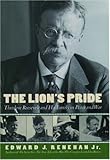
Edward J. Renehan, Jr. The Lion's Pride: Theodore Roosevelt and His Family in Peace and War. New York: Oxford University Press, 1998. xii + 289 pp. $27.50 (cloth), ISBN 978-0-19-512719-5.
Reviewed by Stephen M. Streeter (Department of History, Wilfrid Laurier University)
Published on H-Pol (April, 2000)
All in the Family: The Roosevelts' Obsession with War
Few figures in U.S. history better symbolize America's violent past than the colorful Theodore Roosevelt. Whether leading his Rough Riders in a daring charge up San Juan Hill in Cuba, hunting big game in the African safari, or carrying a big stick in Latin America, Theodore Roosevelt epitomized American aggressiveness during the Progressive era. Although Roosevelt's bellicosity has been amply described by his biographers, Edward J. Renehan, Jr. is one of the first historians to try and explain how Roosevelt transmitted his military values to the next generation. The Lion's Pride: Theodore Roosevelt and His Family in Peace and War maintains that Roosevelt's children readily embraced their father's patriotism. All four of Teddy's sons served with distinction in the First World War; even his daughter Ethel, the reserved "asset child," braved the horrors of European battlefields to nurse the wounded. Military honor, however, came at a high price for the Roosevelt family. Quentin, the youngest son, died in aerial combat over Germany; Ted and Archie suffered debilitating wounds; while Kermit, the only son to escape the war physically unharmed, sank into alcoholism and eventually committed suicide.
The early chapters of The Lion's Pride explore the origins of Roosevelt's attachment to war. The most general explanation offered is that Theodore Roosevelt was simply a product of his time. Elite families in the Gilded Age such as the one in which Teddy grew up tended to romanticize warfare, but the particular circumstances of Roosevelt's early life also explain why he became, as Mark Twain once remarked, "insane" over the subject of war. Teddy was ashamed that his father, Theodore Roosevelt Sr., had eluded the Civil War by hiring a substitute. He also fretted over the fact that he could count many more merchants than warriors among his relatives. According to Renehan, Roosevelt scorned the privileged commercial classes. Universal military training, he maintained, would help unify the nation by eroding social distinctions. "His ideal was a peace- and wartime draft that would conscript farmer, machinist, and Ivy Leaguer alike early in life, casting them together side by side and inspiring in them a sense of egalite et fraternite that would last a lifetime" (p. 26). Roosevelt's conviction about duty to country was so firm that he could march off to the Spanish-American-Cuban war while his first wife, Alice, lay on her deathbed.
To show how Teddy Roosevelt's obsession with war rubbed off on his children, Renehan intersperses accounts of Roosevelt the warmongering politician with descriptions of Roosevelt the nurturing father. At his home, known as Sagamore Hill on Oyster Bay, Long Island, Roosevelt helped his children gain an appreciation for the natural world by teaching them to swim, hike, hunt, and ride horses. They also listened eagerly to their father's ghost stories about "illustrious ancestors," including several of Teddy's uncles, who, unlike Roosevelt Sr., could be depicted as respectable Civil War heroes (p. 12). In addition to glorifying war, Theodore Roosevelt imparted in his children a strong sense of obligation to uphold the family honor. "A boy with your ancestry," Roosevelt once chided a nephew who had grown homesick at parochial school, "must be worthy of his ancestry" (p. 13).
Probably no single event made a greater mark on the Roosevelt household than the Spanish-American-Cuban War. Roosevelt's daughter by his first marriage, "Sister," swooned merely upon visualizing the gallant Rough Riders. For years afterwards, Roosevelt's sons played war games wielding the very sword that their father had brandished in the charge up San Juan Hill. The war fever that gripped the nation in 1898 infected all of Roosevelt's sons, who later earned reputations on the battlefield more for their boldness than their cunning. In this respect, they emulated their father. Child psychology, Renehan notes, has affirmed that "attitudes are caught more than they are taught" (p. 34).
The need for Roosevelt's sons to prove their valor increased dramatically after Teddy left the White House. As World War I approached and Roosevelt's health deteriorated, it became painfully clear to him that opportunities for earning further glory on the battlefield were rapidly diminishing. After President Wilson rejected Roosevelt's proposal to head an elite company of soldiers similar to the Rough Riders, his sons were left to carry the family torch into the Great War. Although Roosevelt clearly took great pride in his sons' achievements, after Quentin perished in a dogfight over Germany he began to doubt privately that he had been the best role model: "To feel that one has inspired a boy to conduct that has resulted in his death, has a pretty serious side for a father," he mused (pp. 5-6). Yet Theodore Roosevelt, like everyone in the family, maintained a stiff upper lip in public when it came to mourning the dead. Indeed, the loss of Quentin only made it even more imperative for the Roosevelts to treat the First World War as a noble venture, eminently worth dying for.
At first glance, The Lion's Pride appears to be a fine account of one of the most intriguing families in American history. The author is obviously comfortable with his subject and he writes skillfully about the Roosevelts. The book seems to be aimed at a popular audience, for Renehan avoids a lengthy discussion of historiography and theory, and instead presents a straightforward narrative that is pleasant to read. The story will most likely appeal to those who are fascinated with Roosevelt memorabilia and are easily moved by the heroism of war. As Stephen E. Ambrose comments about the book on its back jacket cover: "No father, no son, no mother, no daughter could read it without tears."
Unfortunately for scholars, however, Lion's Pride is of limited usefulness. One minor stylistic problem is that the narrative jumps around so much chronologically that a reader unfamiliar with the historical period could easily get lost. Granted, the author wanted to connect the personal with the political, but the passages about Roosevelt's children do not always seem to follow logically from a discussion of Teddy's political views. The appearance of choppiness seems to have been exacerbated by the division of 245 pages of text into nineteen chapters. In any case, much greater attention is lavished on Theodore Roosevelt than his offspring. This lopsided coverage probably reflects the unevenness of sources, but the author fails to warn the reader in advance. The unfortunate effect is that we never quite gain insight into the perspectives of the rest of the family, especially the sons. Ted, Kermit, Archie, and Quentin undoubtedly admired their father and were inspired by him, yet surely other factors influenced their upbringing. Renehan barely mentions the role of Theodore's wife, Edith, who undoubtedly spent more time with the children than Teddy did. This problem reflects a more general weakness in the book, which is the lack of critical discussion surrounding issues of gender and masculinity.
Because Renehan fails to engage in historical analysis (the facts apparently speak for themselves in this book), an uncritical reader could easily miss the many contradictions in the story. The author insists, for example, that Roosevelt and his sons embraced military service as a social leveler. But the Roosevelt family's considerable wealth and prestige rested upon a racial and social hierarchy that Roosevelt himself was quite proud of. As the historian Gail Bederman has explained, Roosevelt worried about the declining birth rate among first-generation Americans and the mixing of "old" with "new" immigrants -- what he and other nativists disparaged as "race suicide."[1] The idea that Roosevelt somehow embraced war because he disdained the business class also appears untenable. Walter LaFeber has shown that Roosevelt energetically pursued empire on behalf of U.S. commercial interests in Central America and the Caribbean, while Gabriel Kolko has argued that Roosevelt did not live up to his reputation as a "trust-buster."[2]
The Lion's Pride may be a great book for history buffs who want to celebrate the heroism of the Roosevelts. But those readers who want a more sophisticated understanding of Theodore Roosevelt and his family would do better to consult the masterful biography by H. W. Brands, a far better researched account that offers provocative insights into issues that Renehan leaves largely unaddressed.[3]
Notes
[1]. Gail Bederman, Manliness & Civilization: A Cultural History of Gender and Race in the United States, 1880-1917 (Chicago: University of Chicago Press, 1995)
[2]. Walter LaFeber, Cambridge History of American Foreign Relations. Vol. 2. The Search for Opportunity, 1865-1913, ed. Warren I. Cohen (New York: Cambridge University Press, 1993); Gabriel Kolko, The Triumph of Conservatism (New York: Free Press of Glencoe, 1963).
[3]. H. W. Brands, T.R.: The Last Romantic (New York: Basic Books, 1997).
Copyright (c) 2000 by H-Net, all rights reserved. This work may be copied for non-profit educational use if proper credit is given to the author and the list. For other permission, please contact H-Net@h-net.msu.edu.
If there is additional discussion of this review, you may access it through the network, at: https://networks.h-net.org/h-pol.
Citation:
Stephen M. Streeter. Review of Renehan, Edward J., Jr., The Lion's Pride: Theodore Roosevelt and His Family in Peace and War.
H-Pol, H-Net Reviews.
April, 2000.
URL: http://www.h-net.org/reviews/showrev.php?id=4023
Copyright © 2000 by H-Net, all rights reserved. H-Net permits the redistribution and reprinting of this work for nonprofit, educational purposes, with full and accurate attribution to the author, web location, date of publication, originating list, and H-Net: Humanities & Social Sciences Online. For any other proposed use, contact the Reviews editorial staff at hbooks@mail.h-net.org.

