

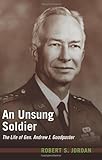
Robert S. Jordan. An Unsung Soldier: The Life of Gen. Andrew J. Goodpaster. Annapolis: Naval Institute Press, 2013. 240 pp. $40.95 (e-book), ISBN 978-1-61251-279-2; $40.95 (cloth), ISBN 978-1-61251-278-5.
Reviewed by Chris Booth
Published on H-War (October, 2014)
Commissioned by Margaret Sankey (Air University)
It can be said that many if not most of the prominent players during the Cold War have been studied and written about in length. Their lives and their contributions to the forty-year-plus saga are detailed in biographies that recount events ranging from covert operations and secret, backroom meetings to foreign diplomacy and troop movements. Therefore, it is truly a rarity in today’s setting to pick up a book and be pleasantly surprised to read about a key contributor to the Cold War and have very little background knowledge on the person beforehand. However, that is exactly what author Robert Jordan has achieved with his biography of General Andrew J. Goodpaster in An Unsung Soldier: The Life of Gen. Andrew J. Goodpaster. Goodpaster was an influential individual throughout the majority of the Cold War, but his contributions were often overshadowed by larger personalities who demanded the spotlight. Thankfully due to Jordan’s diligent research and hard work, Goodpaster has finally received his just recognition for helping guide the United States through one of the most challenging events in the country’s history.
While focusing on Goodpaster’s career, An Unsung Soldier is more than just a typical biography, however. Jordan weaves in numerous examples of how critical the man was to the American Cold War effort. Born in Illinois in 1915, Goodpaster proceeded to succeed in almost every aspect of his military career, beginning with his tutelage as a cadet at West Point. It was quickly apparent to many of his instructors and fellow students alike that he was a man destined for great things; he possessed not only a quick wit and unparalleled work ethic but also a pleasant personality that endeared him to almost everyone he encountered. After graduation, Goodpaster continued to display his technical prowess as well as his bravery in World War II during the Italian campaign, as he led a team that “completed the mission of opening up ... a five-mile stretch of railroad ... all under observed enemy artillery fire” (p. 11).
However, this aspect of Goodpaster’s military career is not the main focus of Jordan’s research in An Unsung Soldier, as the author centers the majority of his book on the general’s work in the White House. Goodpaster’s talent and superior cognitive thinking skills landed him a position in President Dwight D. Eisenhower’s White House administration, and because of his superior diplomatic ability Goodpaster continued to work alongside Eisenhower and his successors for many years in various roles. It was as an aide to both presidents Eisenhower and John F. Kennedy that Goodpaster left his mark on the Cold War as a forward-thinking officer who was capable of working in one of the most high-stress environments and assisting those in charge to make decisions that would have an impact not only on the United States but also on the entire world.
This singular focus on the numerous diplomatic positions that Goodpaster held throughout his career is both positive and negative. The reader is able to follow the twists and turns of Goodpaster’s career while simultaneously learning almost nothing about the man’s personal life. Simply said, Jordan has created a book that reveals Goodpaster’s diplomatic achievements and contributions to the U.S. Cold War effort while making the central figure seem more like a nondescript robot rather than a living, breathing human being. Upon completion of the book, readers will definitely possess a more profound knowledge of the complexities and difficulties that White House administrative aides like Goodpaster faced during the Cold War, while at the same time they will know only a small fraction more about the man himself.
Nevertheless, this robotic approach that Jordan uses throughout this well-written and thoroughly researched book can only take away so much from the overall product. The information that the author includes on Goodpaster’s contributions to the Eisenhower administration succinctly illustrates how important the man was to the U.S. Cold War effort. In the role of staff secretary (a position similar to the modern-day national security advisor), Goodpaster attended almost every meeting that President Eisenhower had “in addition to serving as his chief liaison to the foreign policy bureaucracy” (p. 55). The roles and titles that Goodpaster amassed during his career are staggering but all combine to reveal how deeply Eisenhower trusted and depended on him to maintain a smooth and effective operating environment inside the White House. Therefore, due to Goodpaster’s unfailing service record and work ethic, it comes as no surprise that Eisenhower held him in such high esteem as to say such kind words as “‘He is an invaluable assistant. It follows that I have in him the utmost confidence. In character, ability, performance, and dedication he is of the very highest classification’” (p. 71).
Through the many details that Jordan provides throughout his book, it is easy to realize just how important the man was to the American Cold War effort. For over thirty years, Goodpaster served his country faithfully and with a passion that brought success to every position that he held during his career. Jordan dutifully expands on the services that Goodpaster rendered while focusing primarily on his contributions to Eisenhower’s White House administration. It was primarily through his assistance as a staff secretary that Goodpaster allowed for his brilliance to shine through his work, thereby ensuring the smooth and efficient functionality of the Eisenhower administration during some of the most trying years of the Cold War. It is obvious that if the trusted position that Goodpaster held under President Eisenhower was handled by someone with less talent and political suavity, U.S. diplomatic efforts would have been severely hampered. Although the book is not flawless (it is rather disappointing in its inability to display any true personality of Goodpaster beyond his military attributes), it is a worthwhile read for anyone who is interested in learning more about behind-the-scenes policymakers during the Cold War.
If there is additional discussion of this review, you may access it through the network, at: https://networks.h-net.org/h-war.
Citation:
Chris Booth. Review of Jordan, Robert S., An Unsung Soldier: The Life of Gen. Andrew J. Goodpaster.
H-War, H-Net Reviews.
October, 2014.
URL: http://www.h-net.org/reviews/showrev.php?id=40192
 | This work is licensed under a Creative Commons Attribution-Noncommercial-No Derivative Works 3.0 United States License. |

