

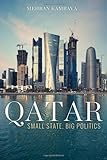
Mehran Kamrava. Qatar: Small State, Big Politics. Ithaca: Cornell University Press, 2013. 232 pp. $35.00 (cloth), ISBN 978-0-8014-5209-3.
Reviewed by Sultan Barakat (University of York)
Published on H-Diplo (February, 2014)
Commissioned by Seth Offenbach (Bronx Community College, The City University of New York)
Qatar’s emergence in the international limelight over the past few years signals its remarkable transformation from a sleepy Gulf peninsula to a regional superpower. Through high-profile foreign investments, mega infrastructural projects, humanitarian and charitable action, proactive mediation of conflicts including Lebanon and Gaza, sponsorship of the Al Jazeera network, and sporting and cultural activities epitomized by winning the rights to host the 2022 World Cup, Qatar has sought to project a brand image of a modern, progressive, and powerful state. The narrative of Qatar’s rise to prominence has been the subject of increasing media interest yet until now has received very little book-length academic analysis. Mehran Kamrava’s Qatar: Small State, Big Politics is notable for offering the most sustained analysis to date of Qatar’s unique position and its significance for regional and global politics.
The opening chapter provides the context that enabled Qatar’s emergence as a heavyweight power in the Middle East. Crucial to the argument is that the traditional regional big powers, such as Egypt, Iraq, Syria, and Iran, have declined in significance, in particular since the Gulf War, while power has shifted toward the Gulf states due to their vast energy reserves and financial resources and the increasing importance of money in the exercise of power. Furthermore, helped by its internal stability, the author argues that while the above mentioned states have experienced crises over the past few years, Qatar has rode the storm of the “Arab Spring” and is well placed to pursue proactive policies. It is argued that Qatar possesses four comparative advantages over its Gulf Cooperation Council (GCC) neighbors that provide conditions ripe for its playing a major global role: 1) the above noted changing regional and international landscape with the decline of traditional power centers coupled with Qatar’s strategic importance to the United States; 2) the high degree of state autonomy possessed by a small cohesive elite network coalesced around an ambitious vision; 3) the absence of internal fragmentation in terms of sectarian or ethnic divides that afflict Bahrain and Saudi Arabia; and 4) the vast financial resources available, even compared to the rich yet constrained GCC states, which enables the maintenance of patronage even in economic downturns and thus shelters the state from contestation. This mixture of factors is argued to have enabled the Qatari state to embark on ambitious domestic transformation and foreign policy projects that are analyzed in the subsequent chapters.
Small states are conventionally understood to play an insignificant role in international affairs, an assumption challenged in chapter 2, which begins with a theoretical analysis of the role of small states in foreign policy. Following this, Kamrava argues that varieties of power, primarily in its hard, soft, and smart forms, are insufficient to account for the influence wielded by Qatar. While it is clear that the country has negligible military power, relying on the presence of the al-Udeid U.S. military base, several analysts have recently framed Qatar’s rise in terms of soft power. Kamrava disagrees and argues instead that judged in terms of cultural influence and the desirability of Qatari values worldwide, the soft power of Qatar is minimal at best, despite the remarkable spread of Al Jazeera. Rather, in his words, “what Qatar has is a subtle form of power--a quiet, steadily accumulating type of power that has resulted from a combination of financial affluence, diplomatic activism, self-confident and cohesive leadership, effective self-advertizing, and a sense of indispensability to peace and stability when others busy themselves with conflicts” (p. 103). The concept of subtle power represents the most innovative contribution of the study and greatly advances the fast emerging literature on Qatar’s rise that has searched for a unified concept to describe the novelty and uniqueness of the country’s power resources.
Analysis of the various ways in which Qatar projects this subtle power on the global stage forms the subject of chapter 3. Firstly, due to various threats, in particular the proximity of Iran, concern with Qatar’s Shi’a minority, long-standing Saudi rivalry, and the reality of American power in the region, Qatar has embarked on an independent foreign policy in which ties are maintained with a wide variety of actors. Qatar is held to pursue a strategy of hedging, which refers to placing large bets one way, in cooperation with the United States, and smaller bets the other way, through maintaining cordial ties with Iran. Hedging is also manifested in the establishment of the Al Jazeera network, which has given Qatar a voice disproportionate to its size, and sponsorship of Islamist groups throughout the region and the Muslim Brotherhood in particular. A result of hedging, it is held that Qatar “has cultivated an image of evenhandedness and balance that few of the other states in the Middle East can claim to have” (p. 88). This is held to be an important source of power and an effective survival strategy that permits a flexible and adaptive approach to future crises in an unpredictable region.
Kamrava analyzes this concern with cultivation of Qatar’s image in terms of a strategy of state branding that is held to be central to the country’s power projection. This strategy has three main components: its ambitious sporting and cultural projects, including the Museum of Islamic Art, hosting of the 2006 Asian Games, and promotion of the Qatar Foundation, which all further an image of Qatar as a cultural leader; the Al Jazeera network, which promotes a brand of Qatar as an open and progressive Arab nation committed to dialogue and debate; and its hyperactive diplomacy in conflict mediation, which projects Qatar as a regional superpower with a neutral stance that is committed to peace. Overall the analysis offers a systematic and convincing treatment of Qatari foreign relations and policy. However, one shortcoming is that while it is recognized that Qatar offers a new and unique case, the analysis is guided largely by conventional international relations theory rather than more novel or fresh insights.
Qatar has been dubbed “the non-stop mediator” due to its role as a third-party mediator in Lebanon, Darfur, Gaza, Yemen, and other conflict settings, and while the book covers much material on the broad foreign policy approach that Qatar has followed, it contains relatively little on conflict mediation, which as noted above is addressed as a unique branding strategy. This is unfortunate because Qatar is unique in its approach to small-state mediation in that it combines the perceived neutrality often associated with small third party states with power mediation based on leverage through financial inducements, which is normally the preserve of “big” powers. The author provides analysis of Qatari conflict mediation elsewhere but greater inclusion of this material in the book would have enabled an integrated treatment of this important subject.[1]
Chapter 4 addresses the domestic level of Qatari history, society, and politics. It begins by examining Qatar’s political history and then analyzes the factors enabling political consolidation and regime stability, in particular under the rule of Sheikh Hamad (1995-2013), the father of the current emir. Kamrava argues that Qatar’s stable political rule is grounded in its unmatched patronage that enables direct rent distribution thus tying social groups to the state; an agile strategy of balancing between advancing the emir’s vision of high modernity and sensitivity to Qatari traditions and cultural heritage; and the powerful security state that through its advanced means of social control, including widespread surveillance and cyber monitoring, is so highly effective that unpublicized visits from security officials are sufficient to quell any signs of dissent, there are no political prisoners, and the visible markers of the Mukhabarat state so commonplace in the region are notable in their absence. This account of Qatar’s internal stability addresses several major factors underlying the domestic transformation from a small poor country with a fractious royal family to an oil-rich cohesive state. However, since the power transition in mid-2013, the position of Interior minister has been assumed by the prime minister and the state has announced compulsory military service to bolster the standing army. These are signs that the new regime is more concerned with domestic threats and that Qatar’s long-term internal stability cannot be taken for granted.
In chapter 5, Kamrava argues that Qatar’s high capacity and autonomy make it a developmental state. Central to the argument is that Qatar possesses high-state capacity in implementing its vision of high modernity due to its vast financial clout and small cohesive elite. Furthermore, he argues that the Qatari state has a high degree of autonomy from social forces. Crucially, the argument follows Peter Evans’s concept of embedded autonomy (Embedded Autonomy: States and Industrial Transformation [1995]), that the developmental project of the state is embedded in dense mutually reinforcing state-social relations through its provision of capital to social groups, in particular merchants, technocrats, and the business-owning middle class. The account offered is convincing in so far as it is clear that non-state actors in Qatar share in the state’s vision and are integrated into the ruling structures through business ties. However, Kamrava quotes Evans who states that embedded social ties “‘provide channels for continual negotiation and renegotiation of goals and policies’” (p. 148). What is not demonstrated is how non-state social forces have any meaningful input into the state’s single-minded and top-down developmental vision that could approximate this condition of embedded autonomy. While Qatar may resemble a developmental state in some areas, including its high and sustained growth rate, commitment to education, and high capacity, it does not meet the criteria on other fronts, in particular the presence of a meritocratic bureaucracy. Moreover, there is tension between the classification of Qatar as both a rentier state and a developmental state with other cases of the latter notable for transforming patron-client relations. In particular, the high level of patronage has created an unmotivated workforce that is a bottleneck to filling positions with Qatari nationals and differs markedly from the productivity gains under developmental regimes elsewhere. Following the debate over the applicability of the developmental state concept outside of its East Asian progeny, it can be concluded that Qatar must represent a deviant or outlier case.
In the final chapter, Kamrava analyzes the future prospects of the “Qatar model.” The book was published before the transition from Sheikh Hamad to Sheikh Tamim, a topic that has been subject to recent analysis. This is unfortunate in timing as it would be interesting to read about this remarkable development in a region where abdication by reigning monarchs is very rare. However, Kamrava does speculate about the possible impact of any future power transition on Qatar’s approach and trajectory. He argues that the benefits of a bold and proactive state branding strategy marked by high-profile projects and ambitious foreign policy that was pursued under Sheikh Hamad are likely to ensure that the next ruler will follow suit. By contrast, several analysts hold that the new young emir looks set to adopt a less ambitious strategy. The Financial Times holds that a “more consensual foreign policy” was expected under the new regime.[2] Whether the book’s prediction that Qatar’s innovative approach under Sheikh Hamad has become structural and will overcome the agency and personality of a future emir will be a development to watch out for over the coming months and years. Overall the book is a very strong, worthwhile, and intellectually rewarding contribution in an area of rapidly expanding interest, and comes highly recommended.
Notes
[1]. Mehran Kamrava, “Mediation and Qatari Foreign Policy,” The Middle East Journal 65, no. 4 (2011): 539-556.
[2]. Simeon Kerr, “Qatar Set to Adopt a More Consensual Foreign Policy,” The Financial Times, September 24, 2013.
If there is additional discussion of this review, you may access it through the network, at: https://networks.h-net.org/h-diplo.
Citation:
Sultan Barakat. Review of Kamrava, Mehran, Qatar: Small State, Big Politics.
H-Diplo, H-Net Reviews.
February, 2014.
URL: http://www.h-net.org/reviews/showrev.php?id=40097
 | This work is licensed under a Creative Commons Attribution-Noncommercial-No Derivative Works 3.0 United States License. |

