

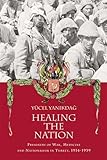
Yücel Yanikdağ. Healing the Nation: Prisoners of War, Medicine and Nationalism in Turkey, 1914-1939. Edinburgh: Edinburgh University Press, 2013. ix + 303 pp. $120.00 (cloth), ISBN 978-0-7486-6578-5; $40.00 (paper), ISBN 978-0-7486-9589-8.
Reviewed by Mesut Uyar (University of New South Wales)
Published on H-War (August, 2014)
Commissioned by Margaret Sankey (Air University)
Living Dead
When Ottoman prisoners of war were repatriated back to their hometowns long after the end of World War I between 1919 and 1923, they received a cold welcome and limited interest in their ordeal. The empire that they had fought for had been divided and new political entities replaced it. To make matters worse, most of them were seen as the “living dead” or as disease carriers. Former prisoners continually felt insecure, believing that people viewed them suspiciously and treated them differently than they treated other war veterans. Understandably the shame of final defeat combined with the humiliation of capture and cold welcome home prevailed. Many prisoners of war viewed the war as a dark chapter that they wanted to forget.
Recently there has been a major upsurge in historical studies, not only in Turkish but also in English, on the Ottoman war effort and the experiences of soldiers during the First World War, but unfortunately scholarly interest in Ottoman prisoners of war is minimal. Even basic information about them (such as the number of prisoners, places where they were held, conditions of captivity, and the number those who managed to return) is lacking. Although Yücel Yanıkdağ covers not only prisoners but also Ottoman-Turkish neuro-psychiatrists, nationalism, and a seach for identity during and after the Great War, this book is the best study to date on the fate of Ottoman prisoners of war.
The book is divided into six chapters, an introduction, and an epilogue. The first four chapters focus on the prisoners and their captivity in Russia and Egypt. Other prisoner-of-war camps in Mesopotamia, India, Burma, Malta, and other locations are not covered due to a lack of available sources and the immensity of the task of gathering information for all of these camps. Overall it is a grim read. Especially in Russia, overcrowding, poor sanitation, inadequate rations, lack of recreational facilities, epidemics, harsh discipline, and general neglect took a toll on prisoners both physically and mentally. The death rate of Ottoman prisoners was unnecessarily high in comparison to other prisoners in Russia and Egypt. Their dreadful experiences, shame, and humiliation, however, led to motivation for not only individual soul searching but also the development of strategies and methods for the salvation of their nation. Yanıkdağ uses personal narratives and prison camp newspapers effectively to explain the ordeal of prisoners and their mental transformation.
The remaining two chapters, based on medical articles, books, and memoirs, examine Ottoman-Turkish neuro-psychiatrists’ interpretations of repatriated prisoners in particular and the Turkish nation in general. Under the influence of the latest continental theories of eugenics and psychiatry, Turkish doctors discovered, to their horror, racial and national degeneration. Later they began to see degeneration everywhere and warned that degenerates would put the nation in danger by contaminating the gene pool. In direct opposition to their counterparts in Germany, Turkish doctors concluded that the war had been instrumental in revealing psycho-disorders and degeneracy from inner bodies and in causing the death of the best and brightest, making the weak and degenerate dominant. Instead of warmongering, the doctors actively supported the government’s decision to stay out of the Second World War. The epilogue emphasizes the importance of a long-neglected topic of remembrance and amnesia in Turkish historiography. Obviously there is a need to examine not only foundation myths of the Turkish Republic but also the roles of different segments of society in the creation of these myths.
There are two points of criticism worth noting. First, the book looks and reads like a fine collection of essays. By covering diverse topics—prisoners of war, neuro-psychiatrists, nationalism, identity, and related discourses—Yanıkdağ does not present them in a coherent way. Most chapters are self sufficient and even the epilogue can be treated as an essay in its own right. Second, although the book makes available in English a wide variety of prisoner literature, medical publications, and secondary bibliography that would otherwise have remained outside the reach of most scholars, access to more archival documents would certainly help clarify some of the riddles. These two points aside, Healing the Nation is a necessary book and will inspire others to conduct more research on Ottoman prisoners.
If there is additional discussion of this review, you may access it through the network, at: https://networks.h-net.org/h-war.
Citation:
Mesut Uyar. Review of Yanikdağ, Yücel, Healing the Nation: Prisoners of War, Medicine and Nationalism in Turkey, 1914-1939.
H-War, H-Net Reviews.
August, 2014.
URL: http://www.h-net.org/reviews/showrev.php?id=40067
 | This work is licensed under a Creative Commons Attribution-Noncommercial-No Derivative Works 3.0 United States License. |

