

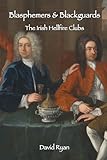
David Ryan. Blasphemers & Blackguards: The Irish Hellfire Clubs. Dublin: Merrion, 2012. 248 pp. $59.95 (cloth), ISBN 978-1-908928-03-0.
Reviewed by Padhraig Higgins
Published on H-Albion (September, 2013)
Commissioned by Nicholas M. Wolf (New York University)
A Drink to the Devil: Enlightenment and Sociability in Eighteenth-Century Ireland
Growing up in the foothills of the Dublin Mountains, a few miles from the burnt-out ruins of Mountpelier Lodge, one could not but help encountering the folklore of what was known locally as the Hellfire Club. Every child, it seemed, knew some tale of how eighteenth-century aristocrats and gentlemen had engaged in satanic rituals, sexual debauchery, and even murder at the lodge. Indeed, stories with similar themes were commonplace among local children from at least the 1930s, when the Irish Folklore Commission gathered material on the club. It is somewhat disappointing to learn, in this thoroughly researched and entertaining book, that no evidence exists that the club ever met in what was a hunting lodge on Mountpelier Hill. David Ryan shows that the club, when it emerged in the 1730s, probably met in Dublin City at the Eagle Tavern rather than in this rural retreat. Only in the nineteenth century did a mythology develop around Mountpelier that associated it with the diabolic activities of the Hellfire Club. This short book engages with the store of mythology and folklore associated with the culture of such clubs, while also examining the realities of associational life in eighteenth-century Ireland in an effort to place these clubs in their proper historical context.
There has recently been a revival of interest in Irish club life in the eighteenth century. The groundbreaking collection Clubs and Societies in Eighteenth-Century Ireland (to which Ryan contributed an essay on hellfire clubs), along with other recent studies, has redefined understandings of associational culture during this period.[1] While this research has included much on the convivial aspects of club culture, in the main it has been concerned with the polite, improving aspects of this culture and its relation to civil society. Many of these clubs and societies, such as the Dublin Society, were self-consciously dedicated to the economic and social improvement of Ireland through technological innovation, philanthropic projects, and forms of social engineering. In this book, Ryan presents the world of the so-called Irish hellfire clubs (along with comparable clubs that also flourished briefly over the course of the century) as a sort of mirror image of a polite improving world, driven not by the pious and paternalist rhetoric of the conservative Protestant elite, but by hedonism and irreligion.
Irish hellfire clubs were influenced by upper-class libertine clubs established in London in the early eighteenth century. Though the Dublin club is best known, between the 1730s and 1770s regional clubs emerged in Limerick, Kildare, and in the midlands. Less is known about these clubs, though the Limerick club is the subject of one of James Worsdale's well-known Hellfire Club paintings in the National Gallery of Ireland. As these paintings suggest, these clubs were committed mostly to heavy drinking and conviviality, but also supposedly to the lampooning of established religion. Irish clubs seem to have been even more committed to violence and disorder than their English counterparts, which Ryan argues can be explained by a culture of heavy drinking, a strict code of honor, and the insecurity of the Protestant settler ruling class.
Perhaps the most notorious of all the figures depicted in Worsdale's painting is Lord Santry, a leading figure in the Dublin club. After inheriting a considerable estate in the 1730s, Santry embraced a hedonistic and drink-fueled lifestyle and constantly courted public outrage. In his first major scandal, he was accused of murdering a sick sedan chairman, forcing him to drink a large quantity of brandy, and then setting fire to him. Probably due to his connections, Santry was never charged with any crime in that instance, but in 1738 he did stand trial for the murder of Laughlin Murphy, a porter he had stabbed in a drunken rage. He was found guilty, pardoned, and forced into exile in England. Ryan does a fine job of providing vignettes of the various colorful members of these clubs, from the murderous Santry to the balloonist and inventor Richard Crosbie, a member of the gentlemanly street gang, the Pinkindindies. If most of these men escaped justice for the violence, theft, rape, and mayhem they committed while young men, there was a poetic justice at least in that many came to sad and sorry ends in later life. Ryan provides such biographies and sketches the culture of these clubs and gangs without, for the most part, overly relying on retelling the tiresome anecdotes of practical jokes and other "amusing" incidences that seem to have delighted memorialists of the eighteenth and nineteenth centuries.
In some ways, Ryan's book reinvigorates an older historiography of the Irish Protestant elite, as part of a culture defined by hard-drinking, gambling, violence, and general debauchery. At the same time, he provides a sound analytical framework for understanding the culture of these clubs and the mostly young, elite men that formed them. He divides clubs associated with libertinism, rakishness, and violence into two categories. The first type, including the original Dublin Hellfire Club, were in part driven by a radical Enlightenment rejection of revealed religion, mocking and inverting Christianity and its rituals, and attacking traditional forms of morality through hedonistic excess. Such clubs were part of a libertine tradition and a reaction, Ryan suggests, to the conservative nature of the Protestant elite and the Established Church. The second type of club, including the Mohocks and the Pinkindindies, can be regarded as "rakish" clubs, part of a violent upper-class subculture, little troubled by philosophical reflection.
Originally conceived as a television documentary, Ryan's account is eminently readable. But what are we to make of these clubs? In recent years, historians have expended great energy in identifying and delineating an "Irish Enlightenment." While the polite world of coffeehouses, clubs, and societies has been seen as central to creating a culture of Enlightenment in Ireland, is it possible that the most radical expression of Irish Enlightenment ideas is to be found in elite male libertine clubs?[2] Certainly the behavior of these clubs outraged those concerned with upholding mortality and established religion, such as Bishop Berkeley. Indeed, much of the evidence suggesting radicalism or blasphemy comes from critics of the early hellfire clubs, including Berkeley and other moralists, and should perhaps be treated with some skepticism. There is to be sure anecdotal evidence that some club members, such as the Earl of Rosse,were strongly anticlerical (Rosse supposedly received Samuel Madden, clergyman and Dublin Society improver, while naked). Yet it often seems to have been outsiders from London, such as the portraitist James Worsdale and the miniaturist Peter Lens, who were most committed philosophically to libertinism. For members of the Irish elite who consorted with Lens and Worsdale, libertinism provided a philosophical gloss on their bad behavior but, Ryan suggests, should not be taken too seriously.
At the same time, Ryan does credit these clubs, with their attacks on established religion, as promoting something akin to the separation of church and state. This is certainly to go too far. While the earlier hellfire clubs might have had something close to a philosophical agenda, later clubs were little more than violent, gentlemanly street gangs. These were hardly vehicles of freethinking or natural religion. Nor can we regard these clubs as anti-establishment enterprises in any other sense. Social status and wealth gave such men license to engage in carnivalesque behavior. Yet unlike similar forms of disorderly behavior by the lower orders, which might have challenged social hierarchies, the actions of rakes and libertines reinforced them. The targets of their violence were more often than not those of a lower social status: footmen, servants, the helpless poor. Vulnerable women, particularly prostitutes, maids, and even single heiresses, were also the victims of their often vicious assaults. In some ways, the Irish hellfire clubs might be regarded as about as radical as the contemporary English Bullingdon Club, an elite drinking club that is hardly a bastion of anti-establishment values.
Whatever their radical credentials, popular interest in these clubs has persisted. A final chapter reflects upon the ways in which these clubs have been remembered in literature, art, and culture. Here, Ryan makes good use of the Irish Folklore Commission archives to look at stories told about these clubs in the 1930s. He also analyzes the surviving material culture of the clubs, arguing that the reemergence of relics, such as punchbowls and snuffboxes, connected to the clubs, along with James Worsdale's paintings and the ruins of the Mountpelier lodge, have kept interest alive in this transient and transgressive elite culture.
This book provides a much-needed scholarly account of the phenomenon of hellfire clubs. At the same time, Ryan might have done more to place his work within the historiography of libertinism and elite understandings of masculinity. A substantial literature has emerged on this subject in recent years, and the work of Karen Harvey on punch bowls and masculinity, along with recent attempts to provide a broader understanding of libertinism could have been addressed.[3] A comparative analysis of hellfire club culture might have addressed the question of whether the members of these Irish clubs were really more violent, more drunk, and more psychologically insecure than elites who formed similar clubs in other parts of the Atlantic world. Yet, given these criticisms, this is a well-researched book that challenges many of the popular misconceptions about Irish hellfire clubs. Ryan has not been content to simply reproduce the mythologies of this culture for a general audience, but has delved deep into the archives to produce a readable and convincing account on a subject of enduring popular interest.
Notes
[1]. James Kelly and Martyn J. Powell, eds., Clubs and Societies in Eighteenth-Century Ireland (Dublin: Four Courts Press, 2010); Jennifer Kelly and R. V. Comerford, eds., Associational Culture in Ireland and Abroad (Dublin: Irish Academic Press, 2010); Peter Clark, British Clubs and Societies, 1580-1800: The Origins of an Associational World (Oxford: Oxford University Press, 2000).
[2]. For a recent suggestion that the Irish Enlightenment may not have been as polite as its British or continental variants see Michael Brown, “The Biter Bitten: Ireland and the Rude Enlightenment,” Eighteenth-Century Studies 45, no. 3 (2012): 393-407.
[3]. Karen Harvey, “Ritual Encounters: Punch Parties and Masculinity in the Eighteenth Century,” Past and Present 214 (2012): 165-203; Peter Cryle and Lisa O'Connell, eds., Libertine Enlightenment: Sex, Liberty, and License in the Eighteenth Century (New York: Palgrave, 2004).
If there is additional discussion of this review, you may access it through the network, at: https://networks.h-net.org/h-albion.
Citation:
Padhraig Higgins. Review of David Ryan, Blasphemers & Blackguards: The Irish Hellfire Clubs.
H-Albion, H-Net Reviews.
September, 2013.
URL: http://www.h-net.org/reviews/showrev.php?id=39955
 | This work is licensed under a Creative Commons Attribution-Noncommercial-No Derivative Works 3.0 United States License. |

