

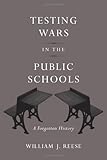
William J. Reese. Testing Wars in the Public Schools: A Forgotten History. Cambridge: Harvard University Press, 2013. 308 pp. $45.00 (cloth), ISBN 978-0-674-07304-3.
Reviewed by Gerry Giordano (University of North Florida)
Published on H-Childhood (December, 2013)
Commissioned by Patrick J. Ryan (University of Western Ontario)
Schools and Testing
When I browse through a monograph about the history of education, I invariably pose several questions. What is the organizational structure for the material? Who is the audience for which it is intended? What style of writing is employed? How sound is the scholarship?
I can answer these questions easily. I rarely need more than thirty minutes. I usually examine new books right before I retire for the evening. I climbed into bed with Reese’s book at 9 pm. I intended to do my thirty-minute overview. After reading the introduction, I continued reading the first chapter. I followed by reading the second chapter. When I looked at my nightstand clock, I was shocked; several hours had passed. On the following night, I read all of the remaining chapters.
Most history books use a chronological organization. Testing Wars uses this organization as well. However, this book still stands out from other books. Reese’s book has only seven chapters. The entire first chapter is devoted to the recitation method of instruction. It documents the extent to which this approach dominated the early American schools. The second chapter explains the profound and pervasive influence of religion on early schooling. Reese uses Horace Mann and his associates as the focal points for the narrative. He describes their efforts in great detail. He showcases their attempts to professionalize and secularize instruction in the schools of Boston. The first two chapters, even though they are inspired by the topic of testing, are related to it only in a peripheral fashion. The next three chapters concentrate heavily on testing. However, they still are confined largely to incidents involving Boston’s schools, politicians, and educational leaders.
Readers who do not share Reese’s enthusiasm for the early schools of Boston will be relieved when they read the final two chapters. In these sections, the author documents how the debates about testing, which had fascinated New England pedagogues for decades, began to occupy the attention of persons throughout the country. Reese adeptly recounts the skillful way in which proponents linked objective tests to statistics. The proponents argued that statistics-based testing was in the best interest of children. They added that it was a critical step that had to be taken for teaching and learning to become truly scientific. Some may be surprised by Reese’s contrarian perspective. Most readers view the standardized testing movement as a primary example of how social, cultural, scientific, economic, and even commercial forces altered the course of American education. They will be startled when Reese contends that nineteenth-century school administrators and politicians were behind that movement. They will be struck when he maintains that “this book revises the familiar narrative of the history of testing, insisting that competitive examinations were central to the very establishment of public school systems in the pre-Civil War era … [and that] reformers believed … [in] competitive testing, enlightened pedagogy, and humane form of disciple” (p. ??).
Readers who do not feel comfortable with the “Great Man” theory of history may bridle at Reese’s larger-than-life descriptions of nineteenth-century Bostonians. They will be especially uncomfortable when they realize that all the key Bostonians were males. Nonetheless, they still should discern the many positive features of this book.
I worry that teachers, school administrators, school board members, community leaders, politicians, parents, business leaders, and the general public may not be interested in this book. Although these groups are intrigued by standardized testing, they want to learn about its impact on students, workers, schools, and communities. They may dismiss this book as irrelevant to these critical issues. If they do respond in this fashion, it will be unfortunate.
Reese is a remarkable scholar who has carefully sifted through numerous documents. He takes a special joy in highlighting the newspaper editorials of that era. He clarifies these editorials by pairing them with records from public meetings.
Reese strengths as a scholar, although remarkable, are eclipsed by his abilities as a writer. No current educational historian writes with the excitement, erudition, and pizzazz that he displays on every page. He has created the rare educational history book that professors will wish to place on their office shelves but that numerous other persons will wish to place on their nightstands.
If there is additional discussion of this review, you may access it through the network, at: https://networks.h-net.org/h-childhood.
Citation:
Gerry Giordano. Review of Reese, William J., Testing Wars in the Public Schools: A Forgotten History.
H-Childhood, H-Net Reviews.
December, 2013.
URL: http://www.h-net.org/reviews/showrev.php?id=39825
 | This work is licensed under a Creative Commons Attribution-Noncommercial-No Derivative Works 3.0 United States License. |

