

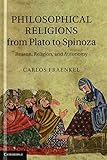
Carlos Fraenkel. Philosophical Religions from Plato to Spinoza: Reason, Religion, and Autonomy. Cambridge University Press, 2013. 351 pp. $99.00 (cloth), ISBN 978-0-521-19457-0.
Reviewed by Oliver Leaman (University of Kentucky)
Published on H-Judaic (October, 2013)
Commissioned by Jason Kalman (Hebrew Union College - Jewish Institute of Religion)
The Notion of a Philosophical Religion: Problems and Possibilities
This is an ambitious book and is the result of a major project attempting to link Plato with later thinkers on the issue of what the author calls philosophical religion. By this he means an intellectually acceptable form of religion that can be taken up by those capable of understanding the real nature of religious truth. It involves a theory of how religion is then to be made available to the public at large, who largely have to work without the logical resources of the more philosophically able. In this review I am going to concentrate on the Jewish thinkers he discusses, but before I do that I should make a few general comments.
Carlos Fraenkel is interested in how religions came to be regarded as a form of philosophy, and this often is taken to be equivalent to God being identical with reason in some sense. He begins with Plato’s ideas on this topic, followed by Aristotle’s and the issue of how happy and complete life can be without philosophy (not very, apparently), and then moves on to early Christian thinkers, Islamic philosophers, and their Jewish admirers, leading up to Spinoza. The book tails off with more modern thinkers dealing with this issue, but this is more of a casual aside than anything else; one might have thought that Hegel would get more of an airing, but he does not. There are some things in the book which are very plausible. Fraenkel is skeptical of the value of the approach of Leo Strauss and the latter’s conspiratorial reading of the idea of philosophical religion, and Fraenkel’s account of the significance of al-Farabi to the thought of later thinkers in both the Islamic and Jewish worlds who worked within the Peripatetic tradition is exhaustively described and defended.
I have some problems with the scope of the project as a whole. Is the meaning of religion from Plato onwards really the same? On p. 49 Fraenkel says that “the moral-political order proposed in the later dialogues can be described as theocratic: the goal is to establish the rule of Reason through beliefs, practices, and institutions that order the community to what is best.” Readers will wonder how this is theocratic, and the emphasis of the word in the quote is in the original. The answer comes in the next sentence, where we are told that for Plato, God is Reason. Well, yes, but does Plato mean by the divine what the later Christian, Jewish, and Muslim thinkers take to be the divine? This issue arises again when we get to Spinoza, who according to Fraenkel is not as opposed to traditional religion as is often thought. Spinoza is a defender of seeing traditional religion as really philosophical religion, Christianity in particular, we are told. What is behind the thesis is the idea that for Spinoza reason is equivalent to the divine, so a religion based on reason, like anything based on reason, is in that sense acceptable and indeed desirable. Readers might wonder at this stage whether the argument risks becoming disingenuous, since surely Spinoza makes some challenging comments on religion that suggest that much of what believers take to be true is false, and not only false, but could never be true. Certainly behind the allegory lies something rational, and reason is linked by Spinoza and many philosophers with the divine, but that does not in itself establish that Spinoza is defending traditional religion.
Here perhaps we reach the nub of the problem, and the basic issue that I had with the book. Plato seems far more similar to Spinoza here than the philosophers of the three monotheistic religions who come in between them, and although this is inconvenient for the account of how the notion of philosophical religion is supposed to have developed, it is nonetheless true. Neither Plato nor Spinoza have much time for the idea of a personal god, and for them the divine has a far more abstract and etiolated function. For Spinoza it is famously dissolved into nature. It is certainly true that he uses much of the language of Maimonides and so also al-Farabi, but it is not true that Spinoza follows on from them on this issue in any except a chronological sense. And that brings us up against the problem of the whole neo-Hegelian project of linking thinkers on this topic historically as though they are always connected and are always on the same subject. Philo and Clement have views on Moses that are certainly based on Plato (this is an excellent discussion), and Maimonides and Ibn Rushd are certainly dependent on al-Farabi, as is exhaustively established in this book (but who ever doubted it?). But the idea that many of the most significant thinkers in philosophy were all engaged in the same project is not made any more plausible by being constantly reiterated, as tends to happen in this book. Philosophy is not as neat as that, not even the history of philosophy, and the attempt at creating such a grand narrative here did not persuade this reader at least.
Having said that, the individual parts of the book are always very interesting, and Fraenkel writes throughout with a clear and attractive style. His comments on the thinkers in the book are often innovative and he rarely fails to make illuminating comments on those whom he discusses. Fortunately the general thesis that he tries to impose on his authors is often shrugged off in the actual detailed discussion and we can then enjoy seeing what he says about them. He also refreshingly treats Jewish philosophy quite rightly as philosophy and part of the attempt by thinkers from a variety of backgrounds to find their way around the theoretical world. Maimonides is criticized by Elijah del Medigo for having confused philosophy and theology, and Fraenkel seems to agree. But surely Maimonides often used theological language, dealing in particular with the nature of the divine attributes, to make general philosophical points, in this case about the theory of meaning, and there is no reason why one should not do this. On the contrary, the language of religion is the surface structure behind which demonstrative argument represents the deep grammar, to use an idea often defended by al-Farabi, a point not sufficiently emphasized by Fraenkel. In fact, one of the factors that all the thinkers he mentions really did have in common was a fascination and commitment to distinguishing between different forms of reasoning, whether they were used to discuss religion or something else, and what they took to be the appropriate nature of such variations in expression for the diversity in human ability and commitment to reasoning itself.
This brings me to what I think is another problematic issue in the book, the author’s determination to avoid the issue of the critique of religion. Given his general thesis, this is hardly surprising, since philosophical religion as a concept seems to sidestep this issue. Yet many of the thinkers Fraenkel discusses do say some challenging things about religion, and in particular how it relates to what they take to be the truth. We do not get much sense of this in the book, and this is a shame since it gives the impression of rather bloodless debates about abstract ideas having taken place over an extended period. Yet surely for many of these thinkers vitally significant issues were in play here, as is mentioned at the start of Maimonides’ Guide of the Perplexed. The issue is quite simple and is how an intellectual can be a believer. Answering this question was for many of the philosophers here both a theoretical and a personal issue. If Fraenkel is right, then the question may be dissolved in the concept of philosophical religion, but as readers of this review will by now appreciate, I am far from convinced that he is right.
I very much enjoyed reading this book and Carlos Fraenkel is to be congratulated for having produced a provocative and always intelligent argument. Like many good books it raises more questions than it settles, and is a constantly rewarding read.
If there is additional discussion of this review, you may access it through the network, at: https://networks.h-net.org/h-judaic.
Citation:
Oliver Leaman. Review of Fraenkel, Carlos, Philosophical Religions from Plato to Spinoza: Reason, Religion, and Autonomy.
H-Judaic, H-Net Reviews.
October, 2013.
URL: http://www.h-net.org/reviews/showrev.php?id=39787
 | This work is licensed under a Creative Commons Attribution-Noncommercial-No Derivative Works 3.0 United States License. |

