

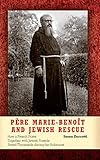
Susan Zuccotti. Père Marie-Benoît and Jewish Rescue: How a French Priest Together with Jewish Friends Saved Thousands during the Holocaust. Bloomington: Indiana University Press, 2013. xv + 276 pp. $35.00 (cloth), ISBN 978-0-253-00853-4.
Reviewed by Daniel Lee (Brasenose College, Oxford)
Published on H-Judaic (April, 2014)
Commissioned by Jason Kalman (Hebrew Union College - Jewish Institute of Religion)
A Transnational Study of Jewish Rescue during the Holocaust
Reading Susan Zuccotti’s latest work onboard a flight from Paris to Florence proved a fitting context for a book that charts the story of the rescue of Jews from southeast France across the Italian border during the Second World War. Looking down at the small towns and villages scattering the mountains through which Jews passed as they were shepherded across the Italian and Swiss borders, I am struck by the grueling physical dangers of the Alps, and begin to imagine the horrific reactions of Vichy or Nazi officials, that an unsuccessful attempt could yield. Though invisible from the sky, borders and borderlands lie at the heart of Zuccotti’s captivating study. We are shown their absolute presence, as points of legal or illegal transit, and also their porous nature. While for some rescuers of Jews, the act of rescue ended at the very moment that the Jews in their care crossed a national border, this was not the case for all protectors. These rescuers did not seek to limit their relief work to a particular national context. Instead, driven by ideological or religious reasons, they sought to extend their rescue efforts to new environments that posed multiple sociocultural, linguistic, and financial problems.
Rescue as resistance, to borrow the title of Lucien Lazare’s classic study, is not a recent addition to the historiography of the Holocaust in Western Europe. Indeed, the past five years have seen a flurry of publications revealing the national networks that rendered rescue possible.[1] Zuccotti’s study on the transnational dimension to Jewish rescue moves the focus in a new direction, and contributes to an emerging historiography on the Resistance that showcases it as part of a transnational anti-Fascist struggle.[2] Zuccotti’s outstanding reputation as a scholar of the Holocaust in France and Italy, and as an expert on the Catholic Church during the Second World War, places her in an ideal position to contribute to this historiographical shift, and she more than rises to the challenge. This is an insightful and beautifully written book that offers an original contribution to a longstanding debate concerning the factors that made rescue possible. Her choice to focus on an individual rescuer, Père Marie-Benoît/Padre Maria Benedetto, proves highly effective. Far from writing a biography of this remarkable man, Zuccotti sensitively guides the reader through the pivotal moments of his life, at once employing a micro and macro approach. This choice of method illuminates valuable historical context, concerning events over which Père Marie-Benoît may have had little knowledge or control. Zuccotti argues that Père Marie-Benoît, whom she interviewed in 1988 while conducting research for an earlier project, led a life that was exceptional, though also typical of other young Catholic men. Reminiscent of Georges Bernanos’s Diary of a Country Priest (1936), we are introduced to the daily fears and anxieties of a young clergyman, whose personal sacrifices, which were for Zuccotti representative of a generation, have been overlooked by scholars.
Père Marie-Benoît was a Capuchin priest born close to Angers in the west of France in 1895. He first left France in 1907 to study at a Catholic school in Belgium and voluntarily returned to his native land when he signed up to join the French Army in 1915, where he spent the war years as a stretcher-bearer. During the interwar years, Père Marie-Benoît lived in Rome, where as Padre Maria Benedetto, he was a formidable priest and teacher. By spending time in Le Bourg d’Iré, Père Marie-Benoît’s native village, Zuccotti was able to locate the priest’s living relatives and discover additional archival documents, all of which highlight the central place of local and family history as formative in his later rescue activity. While most histories of Christians in Vichy France have underscored the persecution of Protestants, as significant in their efforts to rescue Jews, surprisingly few have looked at the memory of Catholic persecution as a factor that prompted rescue work. On the contrary, a number of renowned antisemites who were also prominent Catholics, such as Xavier Vallat, blamed the growth of secularism and the 1905 law separating church and state firmly on the Jews. Yet it was precisely the memory of persecutions that immediately led Père Marie-Benoît toward Jewish rescue during the Second World War. He recalled not only the persecution that he had suffered as an aspiring priest, being forced to leave France for Belgium because of the ban on church schools in the 1902-1904 period, but also the persecution of his ancestors; at the end of the eighteenth century, revolutionary agents massacred tens of thousands of Catholics in the western regions, including thirty-seven people in Le Bourg d’Iré.
Like the rescue acts themselves, Zuccotti’s book is a fascinating tale that hinges on networks and constant motion. By gracefully narrating the complicated story of Jewish rescue in southeast France through the personal interactions of one man--as opposed to analyzing multiple individuals and organizations--Zuccotti successfully paints a vivid picture of the processes that went into rescue. From the passing of Vichy’s first racial laws, Père Marie-Benoît sought to help foreign Jews in Marseille to safety, at that time those most in danger of roundups and internment. His zeal in finding them new aliases, housing, and money quickly put him in touch with Jewish organizations that were working along the same lines. Throughout the book, Zuccotti charts the development of Vichy’s antisemitic legislation. This is far from superfluous. It offers a practical way of interweaving the daily life of Père Marie-Benoît into the narrative, using the priest as a case study to analyze how local populations reacted to the marginalization of France’s Jews. In the same vein, Zuccotti continues this method when analyzing Padre Maria Benedetto’s interaction with Jews and their rescuers in Rome, following his resettlement to that city in mid-1943.
As a Catholic priest and as a rescuer, Père Marie-Benoît was in a privileged position to notice the inner workings of the church and the various networks dedicated to Jewish rescue. By analyzing the priest’s relationship with Joseph Bass, Zuccotti introduces us to the private thoughts and insecurities of the head of the rescue organization, the Service André. While some rescue organizations sought to keep Jews together and obeyed strict legal channels, Bass’s group immediately sought to place Jews under assumed identities in remote parts of the French countryside. Although some scholars have focused on the divisions that plagued Jewish rescue organizations, few have continued their investigations to the postwar period. Zuccotti’s focus on Bass after the liberation, where he criticized his fellow rescuers for glorifying their wartime activities and for ignoring the rifts, is a welcome addition to the historiography. Similarly, a focus on Père Marie-Benoît invites the reader to ponder some of the broad questions that pervade Holocaust studies, such as the position of the Vatican and more specifically Pope Pius XII, over the question of Jewish rescue. Zuccotti charts the zeal with which Padre Maria Benedetto sought audiences with leading Vatican officials, and even an audience in July 1943 with the pope, where the priest explained in great detail to Pius XII the persecution of Jews in France. A case study of Padre Maria Benedetto lends credence to Zuccotti’s argument that the decision to assist Jews by church officials happened entirely at the local level, and despite numerous postwar assertions, neither the Vatican nor the pope ever directly encouraged the clergy to enter into rescue activity. Moreover, Zuccotti does not shy from asking tough questions. For example, she probes the notion that Père Marie-Benoît became interested in the Jewish cause in order to ensure their eventual conversion to the church; this is a theory that she rejects. Her vivid attention to the sensitive climate of the immediate postwar years, a comparative theme explored recently in impressive detail by Tara Zahra, Rebecca Clifford, and others, is compelling.[3] This book, thoroughly researched and highly readable, stands as a fitting monument to a man whose selfless acts in two countries had lifesaving consequences.
Notes
[1]. For Lazare’s classic study, see Lucien Lazare, Rescue as Resistance: How Jewish Organizations Fought the Holocaust in France, trans. Jeffrey M. Green (New York: Columbia University Press, 1996). More recent works include Suzanne Vromen, Hidden Children of the Holocaust: Belgian Nuns and Their Daring Rescue of Young Jews from the Nazis (Oxford: Oxford University Press, 2008); Jacques Sémelin, Persécution et Entraides dans la France Occupée: Comment 75% des Juifs de France ont Échapé à la Mort (Paris: Les Arènes, Éd. du Seuil, 2013); and Bo Lidegaard, Countrymen: The Untold Story of How Denmark’s Jews Escaped the Nazis (London: Atlantic Books, 2014).
[2]. See Robert Gildea, Fighters in the Shadows: The Lives of the French Resistance (London: Faber, forthcoming 2015).
[3]. Tara Zahra, The Lost Children: Reconstructing Europe’s Families after World War II (Cambridge: Harvard University Press, 2011); and Rebecca Clifford, Commemorating the Holocaust: The Dilemmas of Remembrance in France and Italy (Oxford: Oxford University Press, 2013).
If there is additional discussion of this review, you may access it through the network, at: https://networks.h-net.org/h-judaic.
Citation:
Daniel Lee. Review of Zuccotti, Susan, Père Marie-Benoît and Jewish Rescue: How a French Priest Together with Jewish Friends Saved Thousands during the Holocaust.
H-Judaic, H-Net Reviews.
April, 2014.
URL: http://www.h-net.org/reviews/showrev.php?id=39669
 | This work is licensed under a Creative Commons Attribution-Noncommercial-No Derivative Works 3.0 United States License. |

