

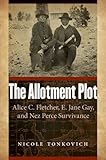
Nicole Tonkovich. The Allotment Plot: Alice C. Fletcher, E. Jane Gay, and Nez Perce Survivance. Lincoln: University of Nebraska Press, 2012. xviii + 418 pp. $65.00 (cloth), ISBN 978-0-8032-7137-1.
Reviewed by C. Joseph Genetin-Pilawa (Illinois College)
Published on H-AmIndian (January, 2014)
Commissioned by F. Evan Nooe (University of South Carolina Lancaster)
Memory Palaces and Nez Perce Survivance
In The Allotment Plot, Nicole Tonkovich offers “a multivocal counter-narrative” that demonstrates how the Nez Perces were able to shape the implementation of allotment policies in their homelands, and despite the concerted assault from settlers and policymakers “continued to exist as a sovereign body” (pp. 5-6). The General Allotment law, enacted in 1887 following a successful lobbying campaign by predominantly white, Protestant, and eastern reformers and philanthropists, promised to accelerate the pace of assimilation by breaking communally held tribal lands into individual family-owned farms, attacking Native culture and sovereignty in the process. Focusing on a single case study--the Nez Perce reservation in Idaho; the work of anthropologist Alice C. Fletcher, one of the architects of the policy; and her cook/assistant/photographer, E. Jane Gay--the author asserts that Indian Office administrators quickly learned they could not apply allotment in its abstract form; instead, Nez Perces intervened and modified the policy, forcing adaptations that acknowledged their own history and culture.
As a scholar of American literature, Tonkovich employs a useful methodology for constructing a counter-narrative. Specifically, she reads the official records of allotment--materials produced for and by policymakers at the federal and state levels, reformers, and academics, and held in an archival complex of state-, museum-, and university-affiliated collections she refers to as “memory palaces”--against Nez Perce texts as well as Fletcher’s and Gay’s private writings. She reminds readers of the importance of the latter, noting that “Gay was not a government employee, [therefore] her letters contained highly personalized and often acerbic critiques of allotment’s more blatant failures” (p. 32). This approach, one of the strengths of the book, allows the author to offer powerful critiques of previous scholarship that minimized the political role the Nez Perce played in the years following the 1877 Nez Perce War (extending, as she notes, the work of scholars like J. Diane Pearson in The Nez Perces in the Indian Territory: Nimiipuu Survival [2008]). It also allows her to complicate and critique “manifest domesticity,” a concept developed by Amy Kaplan, Laura Wexler, and Ann Laura Stoler, among others, that the author defines as the “technologies of benevolent conquest that expose the ‘spatial and political interdependence of home and empire’” (p. 13). By placing gender at the foreground of the local context in the administration of allotment policies on the Nez Perce reservation and by focusing on the ways that both Fletcher and Gay separated themselves from domestic roles, she demonstrates that “manifest domesticity’s effect was constrained and at best, limited” (p. 18).
Tonkovich’s meticulous and thorough primary source research is a model of archival practice. She deploys these sources with a deft touch, especially in her reexamination of Fletcher. The anthropologist and lead Indian Office allotting agent among the Nez Perce, like most of the self-styled “Friends of the Indians,” has been interpreted in the existing literature as well meaning, if overbearing and at times arrogant. Tonkovich’s Fletcher, though, who comes to life through the author’s comparative reading of her official and private writing, is a true believer in the abstract theories undergirding the allotment program making her naïve and at times unprepared for the on-the-ground work her position required. For example, in her effort to create a register of Nez Perce kinship, Fletcher conceptualized a tribe as “a discrete and self-evident entity,” presumed heteronormativity, and ignored those who practiced polygamy or those who had intermarried with people of other tribal or ethnic groups. Tonkovich concluded that like some of Fletcher’s other “similarly abstracted procedures, this apparently capacious set of procedures was flawed” (p. 186). At other points, the author demonstrates that Fletcher was self-interested and manipulative.
The Allotment Plot is organized in four parts, each offering its own introduction and two chapters. By organizing her book this way, Tonkovich also critiques “linear history” with its “teleological, causal, and progressive story forms.” Noting that plot, both in real estate and texts, is a modern idea used to divide both land and stories into parts, she instead describes her work as “a collection of place-based stories about the first years of allotment” (pp. 36-37). The final part of the book, composed of textual and visual representations of Nez Perce sovereign cultural identities is especially important. Across these two chapters, Tonkovich uses Nez Perce written and spoken texts, scrapbooks, and family picture albums to demonstrate “survivance,” Gerald Vizenor’s term (Survivance: Narratives of Native Presence [2008]) that means “an active sense of presence ... not a mere reaction, or a survivable name” (p. 30). It is here that she drives home her assertion about the continuing significance of Nez Perce history and culture. These sources, Tonkovich notes, are often viewed skeptically by archivists and historians because they “cannot easily be connected to the larger abstract narratives supported and produced by state-sponsored archives.” In her skilled hands, though, they “offer an antidisciplinary corrective and demand new interpretative frames to account for the counterintuitive but crucial information they represent” (p. 333).
Tonkovich’s close reading of the primary source material is remarkably successful. She demonstrates clearly the stories that her various main characters, the Nez Perce among them, developed during the early years of the allotment era. Her overarching conclusions and primary arguments, though, are not especially surprising. Historians, anthropologists, and others working in Native and settler colonial studies have argued for some time now about the importance of understanding on-the-ground negotiations in policy administration. That Nez Perces resisted, cooperated, adapted to, challenged, persisted against, and forced changes to the allotment program is a story that has been told in other contexts and at other times, although this should not lessen the significance of this study. Tonkovich’s grasp of the recent scholarship on federal Indian policy is weaker than some readers might like. For example, both Cathleen Cahill’s Federal Fathers and Mothers: A Social History of the United States Indian Service, 1869-1933 (2011) and Rose Stremlau’s Sustaining the Cherokee Family: Kinship and the Allotment of an Indigenous Nation (2011) would have offered useful insights and helped Tonkovich situate her stories within a broader framework. That said, The Allotment Plot is a good addition to the field and offers readers much to consider.
If there is additional discussion of this review, you may access it through the network, at: https://networks.h-net.org/h-amindian.
Citation:
C. Joseph Genetin-Pilawa. Review of Tonkovich, Nicole, The Allotment Plot: Alice C. Fletcher, E. Jane Gay, and Nez Perce Survivance.
H-AmIndian, H-Net Reviews.
January, 2014.
URL: http://www.h-net.org/reviews/showrev.php?id=39666
 | This work is licensed under a Creative Commons Attribution-Noncommercial-No Derivative Works 3.0 United States License. |

