

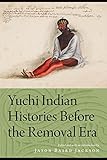
Jason Baird Jackson, ed. Yuchi Indian Histories before the Removal Era. Lincoln: University of Nebraska Press, 2012. xxxiv + 246 pp. $30.00 (paper), ISBN 978-0-8032-4041-4.
Reviewed by Tyler Boulware (West Virginia University)
Published on H-AmIndian (December, 2013)
Commissioned by F. Evan Nooe (University of South Carolina Lancaster)
We Are Not the Muscogee
Calling all scholars of the Native South: someone please write a systematic book-length study of Yuchi history! This plea represents a starting point for a volume that seeks to provide a foundation for “what might eventually become a robust Yuchi national historiography” (p. xvi). Producing such a historiography will not be easy. An ambitious and intrepid scholar would need to overcome many obstacles, including deficiencies in source materials, misconceptions propagated by earlier scholarship, and the limitations of current conceptual frameworks. But some “talented researcher” need not fret; he or she would have the benefit of this volume (p. xxi).
Interdisciplinary to its core, this collection of essays is not a definitive study of Yuchi history before removal but rather a useful introduction to a people that have received scant attention. It challenges earlier frameworks. It asks penetrating questions. And it reminds us that the Yuchi are not Creek. Although many Yuchi today live among the Muscogee, as did their ancestors, the Yuchi were and are a distinct people. The volume’s introduction and the essays that follow reinforce this notion, but they often do so in different ways, while at the same time adding much nuance to discussions of Yuchi identity and their interethnic relations in the Native South.
Editor Jason Baird Jackson stresses in the introduction that historic and current Yuchi connections to the Creek Nation is one of many reasons why Yuchi history has been misrepresented and marginalized. In particular, these connections have encouraged scholars to either ignore Yuchi existence or to subsume their story into a larger Creek narrative. But “the Yuchi and Creek are quite different peoples,” writes Jackson, and the linguistic, archaeological, documentary, and contemporary record bears this out (p. xxv).
Yuchi ethnic distinctiveness derives in part from their unique language. Mary Linn’s recap of Yuchi linguistic history begins with the understanding that Yuchi is a language isolate, which means it is unrelated to other languages. Attempts to locate its linguistic origins--and thus “the most remote history of the Yuchi people”--have largely been unsuccessful, and it is likely such questions will never be fully answered (p. 1). Jump ahead to the Spanish entradas of the sixteenth century, when the Yuchi people were first mentioned in the documentary record. This was the time of Mississippian chiefdoms, some paramount, like Coosa, and others lesser and more local, like Uchi/Huchi. John Worth speculates that Uchi may have been a local chiefdom within the Coosa paramountcy, or its inhabitants may have been “a separate people, allied but not subordinate to Coosa” (p. 37). While the precise relationship of these progenitors of later Yuchi (Uchi) and Creek (Coosa) peoples is currently unknown, it is important to recognize that such a relationship existed. Indeed, Yuchi-Creek interactions would be a defining feature of interethnic relations in the colonial South.
As Brett Riggs demonstrates in his essay on the Chestowee incident, Yuchi-Creek relations became even more entangled following the Cherokee attack on the Yuchi town of Chestowee in 1713. The Indian slave trade and the “shatter zone” that emerged from this virulent trade offered both danger and opportunity to dispersed Yuchi communities. Some, like the inhabitants of Chestowee in the Hiwassee River Valley, fell victim to aggressive neighbors. Other Yuchi became active slavers in their own right as they terrorized peoples in the Ohio Valley and French Louisiana. What this tells Riggs is that the Yuchi were a militarily potent, highly mobile nation who protected themselves in an unstable world of frequently shifting alliances by strengthening connections with powerful neighbors. In particular, many Yuchi allied with the Lower Creeks, especially the town of Cussita.
Yuchi-Cussita relations are likewise documented in Josh Piker’s essay (a relationship also discussed by Steven Hahn). Some Yuchi formed close personal ties to the powerful Cussita leader Aleck (Ellick), which helped foster an enduring Yuchi-Cussita alliance. Other Yuchi peoples created bonds of friendship and alliance with influential colonists in Carolina and Georgia. Piker writes that these relationships were neither free from strife nor based on ethnic and national considerations. Instead, Yuchi communities used the localized, decentralized nature of nations, colonies, and empires in the Southeast to maintain their linguistic, cultural, and social distinctiveness, as well as their political independence and relevance.
Other essays highlight this Yuchi distinctiveness, which was often reinforced by their relationships with outsiders, particularly the Creeks. Steven Hahn argues that a distinct Yuchi ethnic identity is best revealed by examining Yuchi-Creek political relations. Challenging the view that the Yuchi were simply Creek subordinates, he instead paints a complicated picture of this evolving political relationship, one that “oscillated between friendship and hostility and between political isolation and inclusion” (p. 124). A nuanced understanding of Yuchi-Creek political connections is needed, as the eighteenth century was a time of dramatic social, political, and demographic upheaval largely caused by disease, warfare, enslavement, and trade. Scholars have argued that Native peoples responded politically to these disruptions by coalescing into powerful multiethnic confederacies. Stephen Warren aims to reconsider coalescence by showing how two small societies, the Yuchi and Shawnee, avoided coalescence (and ethnogenesis, for they did not become “Creek”). The Yuchi and Shawnee carved out space on the periphery of larger Indian confederacies and European colonies. They were able to do so, writes Warren, because the Native South was a village-based world; even the multiethnic confederacies that usually occupy scholarly attention consisted of “strikingly autonomous towns” (p. 157). In the end, Warren compares Yuchi and Shawnee experiences to show how “small societies survived, and sometimes thrived, even as emergent Indian confederacies encouraged coalescence” (p. 158).
While Yuchi distinctiveness is evident in the written sources, it is less visible in the archaeological record. H. Thomas Foster’s synthesis of Yuchi settlement along the Chattachoochee and Flint Rivers notes that archaeologists have yet to identify “highly distinctive [Yuchi] material culture” that differs from their Muscogee and Hitchiti neighbors (p. 117). Daniel Elliot agrees that it is difficult to find evidence of Yuchi cultural autonomy from extant archaeological data at the Mount Pleasant site in South Carolina. Archaeological confirmation of Yuchi ethnic identity likewise remains hidden in Florida, where a number of Yuchi lived among the Seminole during the nineteenth century. Brent Weisman writes that materially “the Yuchis seem to have been indistinguishable from their Seminole counterparts” (p. 218). The above three essays do not simply highlight archaeological limitations, of course. Future scholars will be particularly interested in the insights they offer for overcoming these shortcomings.
So, what to make of this volume’s call for some “talented researcher” to take up the mantle and write a pre-removal history of the Yuchi people? The rewards of being the first to do so are certainly tempting. But buyer beware. It will be an undertaking of immense proportion. Not only is the archaeological record and documentary evidence thin, but such a book must be written by someone with substantial interdisciplinary expertise--in linguistics, archaeology, anthropology, and history. These traits will be hard to find in a young researcher, and a more seasoned scholar will have reservations about tackling such an involved project. I do not doubt that it can be accomplished, but what is more likely is that Yuchi history will be furthered by collaborative efforts, such as those found in this volume.
If there is additional discussion of this review, you may access it through the network, at: https://networks.h-net.org/h-amindian.
Citation:
Tyler Boulware. Review of Jackson, Jason Baird, ed., Yuchi Indian Histories before the Removal Era.
H-AmIndian, H-Net Reviews.
December, 2013.
URL: http://www.h-net.org/reviews/showrev.php?id=39665
 | This work is licensed under a Creative Commons Attribution-Noncommercial-No Derivative Works 3.0 United States License. |

