

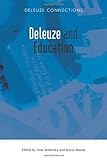
Inna Semetsky, Diana Masny, eds. Deleuze and Education. Edinburgh: Edinburgh University Press, 2013. 288 pp. $40.00 (paper), ISBN 978-0-7486-4302-8; $125.00 (cloth), ISBN 978-0-7486-4303-5.
Reviewed by Johan Dahlbeck (Malmö University)
Published on H-Childhood (October, 2013)
Commissioned by Patrick J. Ryan (University of Western Ontario)
Learning to Swim with Deleuze
There is no doubt that in the last few years there has been a renewed interest in the philosophical oeuvre of Gilles Deleuze (and Deleuze and Félix Guattari). The edited book series Deleuze Connections (of which Deleuze and Education is the twenty-third installment) proves the continued currency of his thought. This is the case partly because the complex and comprehensive conceptual apparatus of Deleuze (and Guattari) holds a lot of attraction for contemporary social scientists as well as for scholars in the humanities. This may very well owe to the fact that, in recent years, social scientists have appeared to be in need of new concepts--less bound up with the heavy (dualist) machinery of modernity--through which the workings of contemporary societies can be understood in new ways. Besides this, however, it appears that in the last few years we have also seen a heightened interest in the classical philosophical questions (questions that Deleuze dedicated much of his own writings to dealing with, not least through monographs on other philosophers such as Spinoza, Leibniz, Hume, Kant, and Nietzsche), not only in philosophy proper but in the social sciences and humanities at large. It appears that the fundamental metaphysical questions that Deleuze was interested in addressing are now back in vogue. This, I believe, would be an appropriate context in which to place the book Deleuze and Education.
The most significant contributions to the renewed commentary on Deleuze within this book are those offered by Ronald Bogue, David Holdsworth, Rocco Gangle, Joshua Ramey, and James Williams. All of these, I would argue, represent original takes on Deleuze’s work that set up (in different ways and to different degrees) creative encounters between Deleuze’s philosophy and key aspects of educational theory and practice.
Bogue’s chapter “The Master Apprentice” makes for an investigation into Deleuze himself as a teacher and learner, seeking to draw out some educational implications from this singular life of teaching and learning. Learning, for Deleuze, may be understood in terms of an ongoing apprenticeship where knowledge is never fully formed since an encounter makes for a singular event, which means that one needs to learn to respond in different ways to different encounters. This is reflected in Deleuze’s much-referred-to example of learning to swim, something that will inevitably turn out to be a very different experience for different bodies in different waters. As Bogue shows by way of Deleuze’s own development as philosopher, however, to be able to respond creatively to new encounters presupposes a well-founded knowledge in the history of one’s subject so as to be able to create new things relative to the dogmas of one’s designated field of knowledge as it were. In this context, the teacher is conceptualized as an “emitter of signs” who “does not provide apprentices with answers, but guides them in the art of discovering problems, an art that can only be mastered by practicing it” (p. 31).
In Holdsworth’s chapter, entitled “Philosophical Problematisation and Mathematical Solution,” Deleuze’s conception of the construction of problems as central for philosophy is brought to bear on the solution-oriented focus of mathematical education in a creative and intriguing way. In particular, Holdsworth troubles the notion that mathematics, in what he calls “orthodox mathematical education,” is about something (e.g., numbers and geometry) in a representational sense. In contrast, mathematical education may be conceived--from a Deleuzian point of view--as the process of exposing students to “the problematic field” of mathematics, allowing them to take on the question of Being as it is actualized in and through mathematical problems. In the subsequent chapter, Rocco Gangle continues to investigate what he labels “the Deleuzian pedagogy of mathematics” by relating two rival theories of mathematics (set theory and category theory) to two rival images of thought as outlined by Deleuze in Difference and Repetition (1968). In set theory, Gangle identifies an orientation toward general representations where the object is to arrive at the recognition of an already established identity by gathering “dispersed individuals into the unity of a single collection” (p. 160). In category theory, however, “mathematics itself becomes relational” as it “reveals the effectively relational essence of all mathematics by providing a purely relational milieu for examining structural mappings and translations across various mathematical terrains” (p. 159). Arguing for the benefits of a categorical-theoretical approach, Gangle concludes that as category theory is “intrinsically a conceptual mathematics,” it offers trajectories beyond those of “[t]he usual restriction of mathematical study and knowledge to mere quantification” (p. 171).
In his chapter “Learning the Uncanny,” Ramey outlines some interesting ethical consequences of learning from the uncanny, where the uncanny is defined as “the familiar suddenly made strange, the everyday when it takes on the numinous aura of the otherworldly” (p. 181). Using Alfred Hitchcock’s The Birds (1963) as an example, Ramey explores the educational consequences of suggesting that “[t]he experience of the uncanny might not be a regression but a genuinely communicative action, an irreducible yet completely natural event” (p. 188). To this end, he argues that opening up to learning from the uncanny might bring about a radical redefinition of “human well-being in broader terms” (p. 192), where instead of automatically withdrawing from that which is perceived as uncanny, education would be embedded in “an ethos where we might find ourselves at home in the unheimlich” (p. 193).
Williams’s contribution makes for an impressive appropriation of Deleuze’s philosophy of time, drawing out some noteworthy implications for educational theory and for the pedagogical understanding of the relationship between teaching and time. In Williams’s chapter, teaching is hinged on different types of temporal syntheses, where “Deleuze’s multiple nexus of dimensions of time” (p. 248) opens up for the art of teaching and learning as a matter of practical selection where “[t]he apprentice to signs must learn to select and to select well, in relation to all of the past and all of the future, where time is never a perfect whole but rather a series of parts or non-communicating vases” (p. 237). In this sense, the process of learning in the present involves “a reassignment of the past in degrees of significance and a recombination of the future through a change in probabilities” (p. 237). In practical terms, then, teaching is bound up with the problem of dosage, understood in terms of “the experimental practice of weighing out what an individual body can do and take as it evolves with novel events, in relation to all the other bodies its life connects it to under a certain perspective” (p. 245). Learning, taken from this point of view, is about finding and maintaining a sense of balance between knowledge and apprenticeship, where “these degrees cannot be known at the time of learning, rather, they are discovered at a later time when the learning is put into practice again, tested anew, set in a different situation” (p. 247).
Readers of Deleuze will benefit from some very interesting contributions to educational philosophy and theory in this volume. Unfortunately, however, parts of the book are rather obscured by what seems to me an excessive use of Deleuzian jargon. What sometimes happens is that rather than engaging critically with Deleuze’s (and Deleuze and Guattari’s) writings so as to find new and perhaps unexpected ways of putting Deleuzian concepts and notions to work, some of the contributions in this book appear to simply reiterate the concepts without actually doing much beyond linking them together. For example, in the introduction, editors Inna Semetsky and Diana Masny describe the scope of the book as follows: “Encompassing both the formal and informal modes, the book reterritorialises the field of education in terms of experimental and experiential nomadic processes of multiple encounters embedded in life, and represents the very becoming-other of Deleuze’s original philosophical thought” (p. 2). Packed together in one sentence, these Deleuzian concepts (“reterritorialises,” “nomadic processes,” “multiple encounters,” and “becoming-other”) become very difficult to decipher and, as a result, they add little to the reader’s specific understanding of them in this context.
A more serious flaw, however, is the unfortunate tendency--as Deleuze scholar (and series editor of Deleuze Connections) Ian Buchanan has pointed out with regard to some relevant practical problems that Deleuze studies are faced with--to sometimes “extrapolate ‘ought’ from ‘is,’ which as Hume showed is a category mistake” (p. 7).[1] For example, I would argue that in the chapter “Affective Literacies,” David R. Cole makes this mistake when he attempts to extrapolate an “ought” from the Deleuzian take on the Spinozan concept of “affectus.” Cole writes: “He or she [the teacher] must not attempt to quash or nullify ‘affectus,’ but should try to understand, articulate and work with the presence of affects in the classroom--like moving with an energy field or taking part in a dance” (p. 97).
The question is, however--given that the Spinozan concept of “affectus” simply denotes an active or passive change in a body’s ratio of motion and rest--whether it is meaningful to use this concept in any sort of normative sense. To undergo an affect for Spinoza--and arguably, for Deleuze, since he proposes a similar definition himself--is not a matter of a conscious choice but something that we inevitably do, all the time, as a result of encountering other bodies. The only conceivable way of nullifying “affectus” would seem to be to die, as this would put an end to the body, at least in its animated composition. To influence the degree to which affects are active or passive on the part of the affected body would be another matter altogether, but the actual nullifying of “affectus” seems to me to be beyond the influence of the individual body.
Another example would be Julie Allan’s chapter “Staged Interventions,” where Deleuze’s philosophy is called upon to help “address the inequalities produced by an education system that insists that ‘everyone do better than everyone else’” (p. 50). Given Deleuze’s overall hesitant attitude toward any comprehensive evaluative systems (such as human rights, for instance), I very much doubt that his philosophy would do much good in a normative agenda such as this. To be able to successfully combat inequalities it would seem that one would first need a stable conception of equality (presumably hinged on some form of standard or metric that every expression may be measured against), something that, arguably, Deleuze’s philosophy of difference does not allow for.[2] The problem is that Deleuze’s philosophy does not seem to lend itself to normative interventions of this sort since, as Williams notes in his chapter of the book, for Deleuze, “[n]o answer is final. No answer is universally valid. It all depends on the relation between the situation, the events, the individuals and the effects” (p. 243).
Despite these objections, I can very much recommend this book, as it offers valuable contributions to the emerging field of Deleuze studies in education and to educational studies at large.
Notes
[1]. Ian Buchanan, “Desire and Ethics,” Deleuze Studies 5 (supplement) (2011): 7-20.
[2]. For an interesting discussion on Deleuze’s critique of the notion of human rights, I would recommend Alexsandre Lefebvre, “Human Rights in Deleuze and Bergson’s Later Philosophy,” Theory & Event 14, no. 3 (2011).
If there is additional discussion of this review, you may access it through the network, at: https://networks.h-net.org/h-childhood.
Citation:
Johan Dahlbeck. Review of Semetsky, Inna; Masny, Diana, eds., Deleuze and Education.
H-Childhood, H-Net Reviews.
October, 2013.
URL: http://www.h-net.org/reviews/showrev.php?id=39657
 | This work is licensed under a Creative Commons Attribution-Noncommercial-No Derivative Works 3.0 United States License. |

