

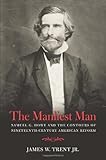
James W. Trent Jr. The Manliest Man: Samuel G. Howe and the Contours of Nineteenth-Century American Reform. Amherst: University of Massachusetts Press, 2012. ix + 325 pp. $80.00 (cloth), ISBN 978-1-55849-958-4; $28.95 (paper), ISBN 978-1-55849-959-1.
Reviewed by Allison Carey (Shippensburg University)
Published on H-Disability (April, 2014)
Commissioned by Iain C. Hutchison (University of Glasgow)
Exploring the Legacy of Samuel G. Howe
In The Manliest Man,James W. Trent Jr. explores the life and politics of Samuel Gridley Howe (1801-76), one of the most prominent American social reformers of the nineteenth century. Perhaps best known as a pioneer of education for the blind and people diagnosed as “idiots,” Howe was also prominent in American reform efforts related to the abolition of slavery, prison reform, poverty policy, and the protection of animals. Additionally, he helped build American support for the Greek fight for freedom against Turkish domination and for the Polish struggle against Russian control. In many ways, Howe’s call for freedom, respect, and opportunities for participation and independence created an enduring legacy in American social reform. A complex man in a tumultuous era though, Howe’s legacy is tarnished, as we look back with modern values and more than one hundred years of hindsight. Trent reveals how racism, ableism, classism, and sexism influenced Howe’s reform agenda. Trent wishes to neither laud nor disparage Howe, but rather to explore the ways that Howe simultaneously advanced social justice across multiple bases of stratification, yet at times failed to fully critique the American system of power in place.
The Manliest Man is arranged chronologically and covers Howe’s lifespan. Trent provides fascinating sections on Howe’s involvement in the Greek rebellion; his role as a leading progressive educator for the blind; his friendships with key nineteenth-century figures, such as Horace Mann, Henry Wadsworth Longfellow, and Charles Sumner; his tenuous marriage to Julia Ward, best known as the author of the “Battle Hymn of the Republic”; and his abolitionist activities, including involvement with the Free Soil movement and as a supporter of John Brown. Rather than summarize Howe’s life, I will focus on themes that may be of particular interest to historians of disability, including the intersectionality of oppression and Howe’s advocacy of education and inclusion.
Scholarship today is replete with calls to consider the dynamic intersection of oppression. Howe’s work encompassed disability, incarceration, poverty, the abolition of slavery, and the protection of animals, and provides a window into the ways that these intersections were understood and treated in the nineteenth century. Trent argues that underlying his work across these areas was Howe’s belief in the perfectability of man and the concomitant moral imperative to provide opportunities for education, spiritual growth, work, and citizenship. The denial of such opportunities, according to Howe, led to brutish dependence. For example, although Howe often discussed idiocy as caused by a violation of God’s natural laws as he perceived them, such as intemperance and masturbation, he also included in his discussion the connection between the exploitation of the poor and disability. Due to working long hours in horrid conditions and the more general squalor in which the working class lived, their children were denied opportunities for health or stimulation and as result suffered disproportionately from mental deficiency. Poverty caused disability, but the stigma against people with disabilities also caused poverty. Howe boldly proclaimed, “‘Nothing but prejudice has or will prevent the blind from becoming first-rate teachers of music, of the dead and living languages, or mathematics, and many other sciences’” if given education (p. 73); however, due to prejudice, the blind were too often forced into a state of helplessness, poverty, and idiocy. While Howe highlighted such intersections, he often failed to critique the broader social structure of capitalism. His policies reflect a firm belief that individuals, given education and opportunity, could succeed, and he opposed policies that created union bargaining rights or limited the work day. He vehemently condemned the provision of direct aid to the poor, regardless of the availability and conditions of work. He also failed to reflect critically on how his own gendered and heteronormative assumptions played into his views on oppression. For example, Howe believed that gender and sexual norms were instituted through God’s natural laws. Therefore, for Howe sexual deviance was both a cause of and an indicator of idiocy, and his regime of education reinforced the priority of mainstream morality.
Howe’s focus on inclusion and citizenship is particularly noteworthy. Howe sought to end dependence through the provision of education and opportunities for participation in mainstream society. As the first director of the Perkins Institution and New England School for the Blind, Howe insisted that it function as a school, not a custodial asylum, in which all students learned academics, a trade, and the skills to become functioning citizens. He required his students to leave the school for vacations in order to retain their ties to the community, going so far as to send some students to the local almshouse during vacation break if they did not have family to host them. Adults with disabilities who attended, or worked at, his school were encouraged to find housing in the community. Howe was a strident critic of mass institutionalization. He fervently argued against the creation of a girls’ reformatory school. In a congregate setting, girls would learn deviance from each other, have labels imposed on them, and be denied opportunities to develop skills as upright women; therefore congregate facilities encouraged, rather than discouraged, deviance. Instead, Howe proposed that wayward girls should be placed with foster families widely dispersed throughout the community. Howe similarly opposed the building of a large-scale home for disabled Union veterans, again arguing that institutional solutions created segregation and dependence rather than inclusion, participation, and self-support. Howe disparaged the exhibition of disability in the context of freak shows and charity benefits, and tried to ensure his students were displayed only to showcase their skills and the benefits of education. His warnings against custodial warehousing and congregate services unfortunately went largely unheeded, but nonetheless he consistently protested the growing dominance of large institutions and instead advanced the cause of education and inclusion. Trent notes that Howe’s perspectives are precursors to labeling theory, the philosophy of “normalization,” and the call for creating decentralized, dispersed social services.
In Howe’s support for inclusion too, there are sharp limitations. Trent’s analysis reveals that Howe promoted an assimilationist model for people with disabilities which assumed that they should, to the degree possible, erase the markers of their disability and take on the values and mannerisms of the able-bodied. Howe opposed the use of sign language and supported oralism. Similarly he preferred a system of raised lettering for the blind rather than Braille. He particularly disliked when people with disabilities earned pay or fame by speaking about their disability or drawing attention to their disability, as this contradicted his goal of minimizing disability. Thus, Howe believed one should not simply earn a living, but earn it in a particular moral, ableist framework. Moreover, while Howe was staunchly integrationist in his disability policy, his race politics diverged. Howe abhorred the system of slavery, and Trent delves deeply into his role in the Free Soil movement and his involvement with Brown. Despite his antislavery stance, for a long time Howe promoted the idea that freed Africans would be best channeled toward African colonies rather than integrated into American society. He also believed that men and women served divinely demarcated roles that should not be challenged. Women were the moral heart of the household and nation, but ill-suited for the actual work of politics. These views were particularly frustrating for his wife, Julia Ward Howe, who was an accomplished author and intellectual yet rarely felt encouraged by her husband. Thus, Howe’s model of integration preserved, rather than challenged, the American power structure and the morality that justified it.
While this review focuses on disability, it is important to note that this is not a book primarily about disability; rather Trent’s coverage is broad, diverse, and reflective of Howe’s breadth of interests and range of people encompassed within his reform agenda. Due to the range of issues covered and my personal interest in disability, I longed for more attention to the broader politics of disability. There is little discussion of eugenics, the development of other schools for people with disabilities, Howe’s involvement or lack thereof with professional associations related to disability, or the factors causing the trend toward custodialism despite Howe’s critical stance toward it. Trent offers fascinating insight into the Perkins Institution, including some information about the students and their post-educational success, but offers much less information on the school for “idiots.” The coverage of the broad issues of race politics in Howe’s era receives more in-depth treatment than the broad issues of disability politics reflective of the era.
That said, Trent should be commended for refusing to isolate disability and instead providing a complex historical analysis that reveals the intersections across an array of social issues. Through this book, the reader learns deeply about a man who shaped American politics to this day. More broadly, we are immersed in the politics and morality of nineteenth-century America and gain insight into the landscape of social reform. Historians of race, disability, gender, class, social reform, and the politics of nineteenth-century America in general will enjoy and benefit from The Manliest Man.
If there is additional discussion of this review, you may access it through the network, at: https://networks.h-net.org/h-disability.
Citation:
Allison Carey. Review of Trent Jr., James W., The Manliest Man: Samuel G. Howe and the Contours of Nineteenth-Century American Reform.
H-Disability, H-Net Reviews.
April, 2014.
URL: http://www.h-net.org/reviews/showrev.php?id=39625
 | This work is licensed under a Creative Commons Attribution-Noncommercial-No Derivative Works 3.0 United States License. |

