



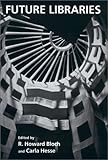
R. Howard Bloch, Carla Hesse, eds. Future Libraries. Berkeley: University of California Press, 1995. vi + 159 pp. $17.95 (paper), ISBN 978-0-520-08811-5.
Reviewed by Heinrich C. Kuhn (Max-Planck-Gesellschaft)
Published on H-Review (April, 1996)
Kuhn on Bloch and Hesse: Future Libraries
How to review a book on the future?: By boring the readership of this review with the question of whether the authors are viewing the same thing in their crystal balls as the reviewer sees in his? Fortunately there are other things to tell about the texts in this volume than just this.
A great part of the contents of this book, Future libraries was, according to the title page, originally published as a special issue of Representations (Spring 1993, No. 42)--and thus stems from the more or less recent past. At least part of the contributions were occasioned by "a conference held at the University of California, Berkeley, on the Tres Grande Bibliotheque [i.e. the new National Library of France [cloth]] and the Future of the Library'" (p. 1). Three years have now passed since this first publication came into print. When I entered in my present job in autumn 1993, "going electronic" meant that a library would be switching to new (or in any case different) information storage and access. Now the main focus has changed to the discussion of (again: relatively) new means of scientific communication and publication. Though discussions on storage and access remain important, my impression is that those taking part in academic communication are seen as having powerful alternatives to "conventional" communication means--such that "going electronic" is today a mere conditio sine qua non, no longer the essence of what might happen in the next decades. The context of discussions on the future of libraries thus is no longer the same it was in 1993. This should be kept in mind when reading the following 1996 remarks on 1993/1995 texts.
The book in its 1995 form now contains an introduction, followed by ten texts, five of which are labeled as documents. The contributions (except for the introduction) are grouped in three sections with the headings "concepts," "practices" and "spaces."
The editors' "Introduction" (pp. 1-12)--not the least interesting part of the whole volume--tries to give a sort of review a parte ante of different contributions, trying to present them as a part of a common argument: We are living in a "threshold moment" for libraries, comparable to the transition from papyrus to parchment:
One should note, that the changes mentioned here are keyed to the material of the artifacts used, not to the social context in which these changes happened: the change from papyrus to parchment in a situation were the knowledge of a worldly learned elite was waning away and preserved by learned clerics to a time when prints where used to inform (and agitate) many parts of the populace (and not necessarily only learned elite ones). This centering on material instead of social context and dynamics is something to be observed in more than one contribution to the volume.
This change--according to the introduction--is on its way, and it matters little whether we like it or not (p. 1s). This was the focus of the new French National Library debate, and the future of the library in general (p. 2). There are people who worry about the fate of the book as a physical object--and they might be right, although part of the users of learned information prove much affection for the form of the printed book. Modern libraries' buildings reflect this uncertainty about the future of the medium of the printed book (pp. 3, 11), which is not only threatened by new media but also by old acid in the decaying paper (p. 4). Copyrights will also probably be transformed (pp. 4-5, 8, 9s). Bloch and Hesse suggest that Electronic texts might soon be reduced to "propositional atoms," which reassemble printed material in ways not currently possible (p. 4s)--a prediction that seems to me to take into little account what was and is done by the means of florilegia and conventional Zettelkaesten (snips and bits of paper arrangeable in quite a number of ways in card indexes).
Now the new electronic media permit "a return to the Enlightenment ideal of encylopedism" hitherto impossible (pp. 5-7). But there is a loss of control of information which becomes more apparent because of the electronic media (p. 6) and the risk of a loss of the role of librarians as we know them (p.7-8, 11s). The authors claim (in my view without giving much evidence) that the new means imply "a loss of both the concept of the author and of originality" (p. 8). They then quote (for the first of many times) Hugo's Ceci tuera cela, and the nation state is mentioned as at least one of the things threatened (p. 9). The gap between "professional researchers" and "amateur readers" will vanish in the library of the future, and in the new French National Library in concreto, "the electronic library holds the promise of restoring a fuller body politic" (p.10).
Claiming that "the library projects discussed in the present volume all offer some version of a return to earlier concepts of the relation between library and state" the eitors build a bridge to the last appraisal of the project of the new French National Library. With this the introduction ends, and a text which valiantly (no irony intended here!) attempts to present the reader an intrinsic sense of unity among the articles (which the reader might not gather from reading the single texts) begins.
Geoffrey Nunberg on the subject of books in the age of electronic production (pp. 13-37): Some people predict the "the end of books," and some lament this. (p. 13s). Nunberg predicts: "most books are likely to be replaced by electronic representations in the near future" and adds, that lots of things printed now are documentations of some sort, and are neither journalistic nor scholarly literature (p. 14s). The new electronic media offer new chances, and it is up to us how we use them for change (p. 15s). Nunberg is rather optimistic about what the quality of future computer displays will be like, but nevertheless he tells us that he thinks "it is very unlikely that the computer will replace the book as a reading tool in the way it has replaced the typewriter as a writing tool" (p. 16), because books have manifold functions and reading is a complex process, "The bookless library is a very unlikely prospect, just like the paperless office that a number of people were enthusiastically predicting around fifteen years ago" (p. 19).
There is more than one type of electronic document: Scanned images of printed books can be used for conservational purposes, and there are genuinely electronic publications that no longer need a publisher as a middle man; there remain, however, quite a number of technical, legal and economic questions to be posed and answered. Analogies to medieval scriptoria are drawn and a certain modularization of texts is expected. (p. 19-23). This modularization, together with new possibilities for the arrangement and retrieval of texts will have effects on the future of electronic "journals," but Nunberg sees no way that purely electronic publications could fulfill all the functions of traditionally printed journals when it comes to the aspect of the prestige conferred on an author by the acceptance of a text of his in a prestigious journal like Nature (p. 23-25)
What Nunberg addresses here is a very important point: In the scholarly context publishing for an author has a dual function: Communicating his thoughts and results *and* adding to his prestige and promoting his career. Up to now for most (if not all) fields of research there are no means of electronic publication that would provide an author with exactly the sort of prestige that a publication in one of the most renowned conventional journals gives... But on the other hand it should not be overlooked, that there are ways to prominence for an author in the world of electronic publication that are not available via print publications: To have more than 50 readers for an electronic contribution to a rather esoteric field within a few days after mentioning its existence to colleagues in an listserv-list[1] ... the ability to access a text without having to go to your library or resorting to ILL evidently considerably lowers the threshold relevant for inciting somebody to read something), to be invited by somebody whom you never talked before to read a paper at an important conference on the fringe of your professional field just because of some remarks made in another electronic discussion list, to be able to know (at least in the many cases where no proxy-server caching the files demanded by a number of users is used) who is *reading* your text (and not just who is quoting it in a journal indexed by the ISI) and thus having the opportunity to better adapt your output to the interests of your readership... e-publishing offers some advantages to the authors even when it is prestige and not just communication that is at stage, but it is not yet obvious how authors from different fields of research will assess these advantages.
That there are some functions of printed periodicals that would be difficult or impossible for electronic publications to fulfill holds true as well for some--but not all--types of non-scholarly publishing (pp. 25-30). The social effects of switching discourses from printed media to electronic media can not yet be assessed, and how public and publishers will act and react is still unknown.
Roger Chartier on "Libraries Without Walls" (pp. 38-52): Chartier investigates several uses for the word "bibliotheque" in present and past French (libraries, collections of texts, inventories of books) and the ways of organizing such inventories that are compared to nowadays.
Jane C. Ginsburg, "Copyright without walls? Speculations on literary property in the library of the future" (pp. 53-73): Ginsburg gives an overview of U.S. copyright laws as applied to printed books, and considers how controversies surrounding the issue of photocopying might be applicable to electronic publications. He provides suggestions on how copyrights might be changed and how libraries and especially publishers might act to protect intellectual property in the electronic context. Ginsburg's main suggestion is that today's regulations might be replaced by direct contracts between libraries and publishers.
Dominique Jamet and Helene Waysbord, "History, philosophy, and ambitions of the Bibliotheque de France" (pp. 74-79): A report (in a sometimes rather poetic language) on some of the decisions leading to the construction of the new French national Library and its intended functions. Most of the latter decisions are not very specific for this one library--perhaps with the exception of the use of mass-digitizing of printed books (mainly for conservational purposes).
Gerald Grunberg and Alain Giffard, "New orders of knowledge, new technologies of reading" (pp. 80-93): This text gives further information on the means through which the new French National Library strives to fulfill its functions. The authors state that they "are planning a study and research library with two tiers: one for precise short-term projects such as reference checking, the other for long-term scholarly undertakings" (p. 87). I am, however, not convinced whether this separation will prove to be a good idea, as in my experience most "long-term scholarly undertakings" involve a considerable amount of actions "such as reference checking."
Robert C. Berring, "Future librarians" (pp. 94-115): Berring argues that librarian-ship is in a crisis, and that "as information is becoming a more central topic in society, the profession of librarian-ship, the information profession is in decline" (p. 96). I can, however not quite follow him, in his argument that preserving the material available in a certain library is no longer important, nor that there is no longer "the problem of finding the information itself" (p. 100). Berring heavily relies on the example of legal full-text databases in which he apparently sees paradigms for how the future of the access to electronic information will be organized. In such a future he sees no future for librarians in preserving (digital) information.
Emmanuel Le Roy Ladurie, "My everydays" (document, pp. 116-121): This text informs us how the director of the French National Library spends his working days, how he tried to achieve better service to patrons (by providing access to working telephones and by permitting access to material irrespective of its shelf-mark, introducing OPACs), and discusses charges for patrons of the library.
Posser Gifford, "The libraries of Eastern Europe. Information and democracy" (p. 122-128): There is some information on such things as plans for a common bibliography on Slavic and East European studies, and there is a number of statements (without any material to support them) for which "patronising" might very well be to mild a word (e.g., "the East European populations in general do not value information [p. 124]), "[Eastern European] citizens must re-learn a willingness to stand behind one's word, to inquire into options, to value informed choice" (p. 125).
Cathy Simon, "A civic library for San Francisco," (pp. 129-138): A text on the aesthetics of the design of a new main library for San Francisco.
Vidler, Anthony, "Books in space. Tradition and transparency in the Bibliotheque de France" (pp. 137-156): A study in the rhetorics underlying the architecture of the new French National Library and of the other options provided by other entries for the competition for this building. Vidler's is a text that is so concise and fascinating (even for a non-architect like myself), that giving an abstract for it is too difficult a task for a non-expert in the field like me.
In spite of the editors' efforts, this volume appears to the reader as a collection of texts that have not very much in common besides the use of the word "library." Although most of the texts assembled will be worthwhile reading for somebody, it is not very likely, that there will be anybody for whom all of these contributions will be of interest. Thus, in order to make these articles and documents available to those who (like the author of this review) did not know before about the existence of most of them in the above mentioned volume of Representations, it might have been more sensible to republish the single texts in electronic form instead of assembling them again to a physical unit without intrinsic unity.
Copyright (c) 1997 by H-Net, all rights reserved. This work may be copied for non-profit educational use if proper credit is given to the author and the list. For other permission, please contact H-Net@H-Net.MSU.EDU.
If there is additional discussion of this review, you may access it through the network, at: /reviews.
Citation:
Heinrich C. Kuhn. Review of Bloch, R. Howard; Hesse, Carla, eds., Future Libraries.
H-Review, H-Net Reviews.
April, 1996.
URL: http://www.h-net.org/reviews/showrev.php?id=395
Copyright © 1996 by H-Net, all rights reserved. H-Net permits the redistribution and reprinting of this work for nonprofit, educational purposes, with full and accurate attribution to the author, web location, date of publication, originating list, and H-Net: Humanities & Social Sciences Online. For any other proposed use, contact the Reviews editorial staff at hbooks@mail.h-net.org.

