

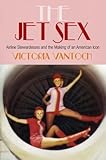
Victoria Vantoch. Jet Sex: Airline Stewardesses and the Making of an American Icon. Philadelphia: University of Pennsylvania Press, 2013. 287 pp. $34.95 (cloth), ISBN 978-0-8122-4481-6.
Reviewed by Jessica Lancia (University of Florida)
Published on H-1960s (February, 2014)
Commissioned by Zachary J. Lechner (Centenary College of Louisiana)
Blues Skies and Beautiful Women
In Jet Sex, Victoria Vantoch presents an accessible cultural history of U.S. airline flight attendants situated within a broader context of globalization, international politics, and consumer culture from the 1910s to the 1970s. Focusing mainly on the golden era of flying from 1945 to 1970, her broadest historiographical claim is that the “stewardess” (her term) “serves as a link for understanding the critical gender transition in America from the dominant domestic ideal of the 1950s to the gender rebellion and sexual revolution of the 1960s” (p. 3).
Organizing her work both chronologically and thematically, Vantoch provides a historical overview of changes in flight attendant archetypes, airline policies, working conditions, and public perceptions. Her later chapters situate these concerns within an international Cold War context. Vantoch makes her claims through an impressive use of interviews, personal papers, airline correspondence, and visual evidence gathered in a wide range of national and international archives.
Vantoch’s book traces a broad shift in flight attendant personification from the birth of commercial aviation in the 1920s to the deregulation of the airline industry in the late 1970s. During this span, flight attendants shifted from being conceived of as “warm hearted hostesses to in-flight strippers” (p. 154). This change was a result of the demands of the airline industry and a response to shifting American gender norms.
Within this broad shift, Vantoch’s book also identifies several smaller shifts. She argues that flight attendants changed from being perceived as respectable, professional, and desexualized nurse-stewardesses in the 1930s, to adventurous, wholesome, reassuringly feminine girls next door in the postwar era. During the Cold War era, this image morphed again, and she was represented as a sophisticated, jet-setting American glamour girl, promoting a “potent image [that] would be central to America’s international propaganda campaign” (p. 3). The flight attendant’s final incarnation emerged in the mid-1960s, partly in response to the counterculture movement, increasing competition among airlines, and a desire to lure young travelers to the sky. During this time, she started being represented as a youthful, flirtatious vixen; her sexualization was an example of American marketing strategies.
Understanding these archetypes is significant, according to Vantoch, because they simultaneously reflected and challenged traditional ideas about gender. Not only did the flight attendant profession provide a rare opportunity for a fraction of women to find a well-paying career that was engaging and afforded an opportunity to see the world, but it also sanctioned and perpetuated some of the twentieth century’s most constricting (and ever-shifting) archetypes of femininity. Vantoch’s book deftly plays up this intriguing paradox.
As the author demonstrates, the opportunities for women to become flight attendants were limited by a variety of factors, including physical appearance, education, demeanor, and race. In the single chapter on race relations in the airline industry--presented through vignettes of the first two black flight attendants in the United States--Vantoch discusses racism in the airline industry and legal efforts to challenge it. These challenges, spearheaded by the National Association for the Advancement of Colored People (NAACP) in the 1950s, resulted in a partial integration of the industry by the mid-1960s. In addition to legal pressures, technical and economic issues helped lift the racial restrictions of the airline industry, specifically, the introduction of jets in the late 1950s and the development of advertising strategies that targeted an expanding mass market of individuals with disposable income, including women, youth, and a growing African American middle class. Unfortunately, other than bringing up the exoticization of nonwhite airline hostesses on international routes, race does not figure as closely as an analytical category in other parts of the book as one would hope, even though whiteness is clearly a prominent marker of the airline hostess profession. For instance, one missed opportunity is Vantoch's discussion of Trans World Airline’s (TWA) ad campaign featuring “foreign accent” flights, which presented a menu of hostesses in four “styles” meant to provide passengers with “the best the world has to offer,” while only providing offerings from Western Europe (pp. 180-181).
Strengths of the book include a clear writing style and easy-to-follow chronological organization, which would make this a good undergraduate level work to assign for a special topics class or appropriate general audience reading for people interested in the airline industry. Scholars interested in transnational issues might find themselves especially engrossed in the chapter addressing U.S.-Soviet relations and Cold War politics. This is arguably Vantoch’s strongest chapter, developed using Russian archival sources new to U.S. historians. In it, she argues that stewardesses “became front-line icons in the global culture war and represented competing visions of ideal womanhood on the world stage” (p. 127). Beyond demonstrating that beauty became an increasingly important marker of American foreign policy, Vantoch shows that ideas about gender had important transnational implications, arguing that the “American media dialogue about Soviet women in the workforce sparked feminist arguments for women’s workforce equality during the 1960s” (p. 152).
One of the hallmarks of a good book is how long its ideas continue to engage with a reader after the last page is turned. There is a complexity to Vantoch’s work that is not initially apparent; framed by a paradox and developed with depth and dexterity, Jet Sex succeeds in encouraging readers to entertain contradictory positions simultaneously. It challenges its readers to consider the airline hostess as a complex and intriguing symbol of social conformity and gender rebellion, as a feminist hero and a victim of American commercialization, and as an important participant in and pawn of global U.S. politics. Those who need convincing that “beauty, gender, and sex are not frivolous sidebars to ‘real history’” will find that Vantoch makes a strong case (p. 7).
If there is additional discussion of this review, you may access it through the network, at: https://networks.h-net.org/h-1960s.
Citation:
Jessica Lancia. Review of Vantoch, Victoria, Jet Sex: Airline Stewardesses and the Making of an American Icon.
H-1960s, H-Net Reviews.
February, 2014.
URL: http://www.h-net.org/reviews/showrev.php?id=39445
 | This work is licensed under a Creative Commons Attribution-Noncommercial-No Derivative Works 3.0 United States License. |

