

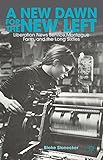
Blake Slonecker. A New Dawn for the New Left: Liberation News Service, Montague Farm, and the Long Sixties. New York: Palgrave Macmillan, 2012. xiii + 267 pp. $85.00 (cloth), ISBN 978-1-137-28082-4.
Reviewed by Jeremy Varon (The New School)
Published on H-1960s (October, 2013)
Commissioned by Zachary J. Lechner (Centenary College of Louisiana)
Rethinking the Underground Press and New Left Declension
Whether experience or history is one’s teacher, political schism can appear a certain herald of decline. The New Left notoriously suffered this affliction, with its stormy divisions in the late 1960s dominating familiar tales of a movement going bust.
Blake Slonecker, in A New Dawn for the New Left: Liberation News Service, Montague Farm, and the Long Sixties, could have told such a story. In the summer of 1968, one wing of the Liberation News Service (LNS), “a news outfit akin to the Associated Press of the New Left underground press,” heisted the printing presses from the LNS headquarters in New York City, secreting them to the newly established Montague Farm in western Massachusetts (p. 3). Much like the two-headed Students for a Democratic Society emerging from the disastrous June 1969 National Convention, LNS published briefly out of two locales, with each claiming to be the “true” LNS.
Avoiding the equation of division with decline, Slonecker weaves from LNS’s doubling an inspiring story of dual trajectories, each of which represented a different way of both “living the movement” and extending the animating spirit of the New Left into the struggles of the 1970s and beyond. With the eye of novelist, he wrings historical meaning from the particulars of character and scene. And with a humility rare among revisionists, Slonecker makes us think anew about schism, in the 1960s and in general.
A New Dawn is an extended juxtaposition, in alternating sections, of the two cultures birthed by LNS. The more intriguing is the crowd--led by the charismatic Movement figures Marshall Bloom and Ray Mungo--which decamped to rural America. Quickly abandoning the press operation, Montague became a cutting-edge commune among the thousands of intentional communities the counterculture spawned.
Challenged first by raw, physical survival, the communards became accomplished agriculturalists, pioneering organic cultivation and embracing Yankee self-reliance within a radical, anticommercial ethic. Intent on revolutionizing everyday life, they explored the intimacies of cramped quarters, complex divisions of homestead labor, and a group process subjecting countless decisions to conscientious debate. Indeed, A New Dawn’s more touching moments are when Slonecker explains how the communards embraced a Thoreauvian ideal of deep friendship rooted in “sincerity, accountability, and equality,” and constructed themselves as a “family,” given their alienation from both their parents and much of the Movement itself (p. 71).
To the communards, Montague Farm represented less a retreat from politics than an effort to reinvent work, play, and interpersonal relationships in the framework of new values, and thus serve as a potential seedbed for deeper transformations in American society. Even so, it was not long before they reengaged politics in more traditional senses, taking leadership roles in the budding movement against nuclear energy. Montague residents brought civil disobedience to environmental activism, helped organize the massive Clamshell Alliance opposing a proposed nuclear plant in Seabrook, New Hampshire, and served as chief instigators of the 1979 No Nukes benefit concert. Their considerable legacy lies in the whole ethos of sustainability (with its Epicurean delights), contemporary preferences for the small and the local over impersonal corporate power, and evolving efforts to harmonize the political and the personal.
The group continuing LNS arguably had the greater burden: to keep alive an institution that formed the backbone of the far-flung “underground press,” which itself gave the New Left a sense of national cohesion. They largely succeeded, distributing for a decade weekly packets of originally authored content to hundreds of subscribers, reaching hundreds of thousands of readers (pp. 207-208). Especially impressive was the foreign coverage, for which LNS journalists reported from revolutionary hotspots around the world.
Equally important, and harkening back to the New Left’s roots, LNS functioned as a collective committed to participatory decision making and strict equality in its ranks. In this way it too sought to bear a revolution in values. Pursuing its ideals, LNS struggled, like so many leftist organizations, with male chauvinism and a feminist insurgency that threatened in 1970 to blow it apart. Slonecker documents the success of what might seem a doomed solution: the requirement that two women for every man work at LNS. Yet this measure ultimately empowered women to learn new skills and assert leadership, with “the ratio,” so named, relaxed as the role of women grew. LNS was made stronger.
In Slonecker’s deft telling, internal conflict on multiple axes repeatedly contributed to, rather than inhibited, political and personal growth and group solidarity. Among the most pressing divisions, just now gaining attention in New Left historiography, was the gay/straight binary, which played itself out in fascinating ways in the two milieu. Especially after the suicide in 1969 of Marshall Bloom, whose anxieties over his sexuality fueled his despair, Montague Farm became greatly more hospitable to gay relationships. In the winter of 1970-71, LNS agonized over whether to print an anonymous letter from gay Cubans alleging state persecution. Publishing it would underscore LNS’s commitment to individual freedom while potentially undermining support for socialism. The compromise--to print the letter, excising its most damning charges--may have been inadequate, but the episode was occasion for the collective to work through important tensions in its worldview, especially as new groups and struggles stepped to the fore.
Slonecker has a knack for bringing to life the dynamics and ambiance of historically distant scenes. But this gift becomes an occasional liability as it crowds out attention to the manifest politics of those scenes. We hear a lot about LNS journalism and the characters producing it but are treated to precious little of LNS writing itself. The sensation was that of listening to an erudite fan describing a band without permitting you to hear any of the music yourself and come to your own impressions of it. Similarly, what prompted Montague communards, long immersed in their semi-secluded Utopia, to enter the fray of environmental activism remains somewhat unclear.
At root, Slonecker offers more a cultural than a conventional political history of American radicals, locating their politics largely in their internecine dealings. In this approach, it succeeds brilliantly, reminding us that hard and patient work to change self and society both may produce new dawns, with wider vistas of freedom and justice.
If there is additional discussion of this review, you may access it through the network, at: https://networks.h-net.org/h-1960s.
Citation:
Jeremy Varon. Review of Slonecker, Blake, A New Dawn for the New Left: Liberation News Service, Montague Farm, and the Long Sixties.
H-1960s, H-Net Reviews.
October, 2013.
URL: http://www.h-net.org/reviews/showrev.php?id=39374
 | This work is licensed under a Creative Commons Attribution-Noncommercial-No Derivative Works 3.0 United States License. |

