

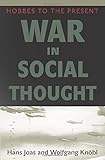
Hans Joas, Wolfgang Knöbl. War in Social Thought: Hobbes to the Present. Princeton: Princeton University Press, 2013. 338 pp. $35.00 (cloth), ISBN 978-0-691-15084-0.
Reviewed by Michael Bonura
Published on H-War (October, 2013)
Commissioned by Margaret Sankey (Air University)
Warfare has engendered almost as much military thought and theories as combatants, and military historians are no strangers to the writings of these theorists.However, sociologists and sociology is not known for a large body of thought pertaining to war. The reason for this lack of interest in war is the historical question that Hans Joas and Wolfgang Knöbl address in War in Social Thought: Hobbes to the Present. Joas is a professor of sociology and social thought at the University of Chicago and Knöbl is a professor of sociology at Göttingen University, and both have published numerous books on various topics in sociology. Their study of sociology has led them to conclude that the vast majority of sociological theories and theorists ignore war and violence between states. They believe that no truly comprehensive theory can dismiss war, and including war and large-scale violence in a sociological theory would make that theory more complete and internally consistent. Joas and Knöbl wrote War in Social Thought as a way to set the stage for the creation of such an all-inclusive theory. As sociologists have ignored war and mass violence, Joas and Knöbl have written an intellectual history of the great European and American thinkers and philosophers who discussed and analyzed war in relationship to society. These thinkers then formed the basis for the inclusion of war into sociological discourse.
War in Social Thought, organized chronologically into six chapters, begins with the publication of Leviathan in 1651 by Thomas Hobbes and continues to the present with an introduction and conclusion adding a chapter to the beginning and the end of the book. Chapter 2 examines thought from Hobbes to the Napoleonic Wars, chapter 3 focuses on the rest of the nineteenth century, and chapter 4 looks at the twentieth century through the First World War. Chapter 5 moves from the end of the First World War to the 1970s, chapter 6 examines the period from 1970 through the end of the Cold War, and chapter 7 begins at the end of the Cold War and continues to the present.
Joas and Knöbl examine the thinking and writing of the most important philosophers who have dealt at all with issues of war and violence. These include a litany of the greatest thinkers of Western civilization, including Hobbes, Montesquieu, Adam Smith, Jean-Jacques Rousseau, Immanuel Kant, Alexis de Tocqueville, Herbert Spencer, Georg Wilhelm Friedrich Hegel, Vladimir Lenin, Friedrich Engles, Max Weber, Gunnar Schmidt, Raymond Aron, Reinhard Bendix, and Michael Mann, to name only a few. They also include a large number of more obscure thinkers who had a more direct influence on the development of sociology. Most of these will not be familiar to military historians, but there are several names that will ring a bell, such as Carl von Clausewitz, Ernst Jünger, Morris Janowitz, Samuel Huntington, and Martin van Creveld.
For the period before the advent of sociology as a social science, the analysis is focused principally on the thinkers and their writings. When sociology emerges, the authors do an excellent job of introducing the thinkers in the context of the sociological theories prevalent at the time. The vast majority of the footnotes are not primary citations but more of a historiography. In other words, when Joas and Knöbl introduce a philosopher and begin to analyze their thoughts on war, the notes they provide are from what appear to be the most current sociological analyses of that thinker and the time period. While it is difficult to truly assess whether or not the authors have achieved their purpose in setting the stage for new debates in sociology, War in Social Thought is an excellent intellectual history of thinkers concerned with war who usually fall outside of the purview of military history.
War in Social Thought is not a work of military history, nor was it written with military historians in mind. In fact, there is very little actual war in this book. There are no details of battles, armies, or even responses to wars on the home front. This means that the social thought presented by Joas and Knöbl has no real military context. However, the book is a valuable resource to military historians, especially to those writing with a war and culture or war and society argument. Joas and Knöbl include descriptions of the prevalent sociological theories, making those theories accessible to the military historian. With notes focused on the secondary sociological literature, it is easy to research social thought and the current analysis of that thought from 1651 to the present. These sources will add a more intellectual social and cultural context to almost any military history, especially as the sociological references are difficult for most military historians to access. With its focus on war as a theme, this intellectual history of European and American thought is far more useful to the military historian than any of the more standard European intellectual histories that usually avoid the topic of war and violence. My only real criticism is that the authors use a tremendous amount of vocabulary that is almost incomprehensible to the non-sociological reader, making the book difficult to get through. However, this criticism is also one of the book’s strengths as it presents in a concise manner sociological and philosophical writings on war.
If there is additional discussion of this review, you may access it through the network, at: https://networks.h-net.org/h-war.
Citation:
Michael Bonura. Review of Joas, Hans; Knöbl, Wolfgang, War in Social Thought: Hobbes to the Present.
H-War, H-Net Reviews.
October, 2013.
URL: http://www.h-net.org/reviews/showrev.php?id=39262
 | This work is licensed under a Creative Commons Attribution-Noncommercial-No Derivative Works 3.0 United States License. |

