



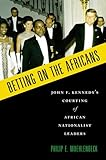
Philip E. Muehlenbeck. Betting on the Africans: John F. Kennedy's Courting of African Nationalist Leaders. Oxford: Oxford University Press, 2012. 334 pp. $55.00 (cloth), ISBN 978-0-19-539609-6.
Reviewed by Javan D. Frazier (Middle Georgia College)
Published on H-War (January, 2015)
Commissioned by Margaret Sankey (Air University)
In this book, Philip E. Muehlenbeck challenges the common historical judgment that John F. Kennedy’s policies toward Africa caused no significant changes between the United States and most African nations. Muehlenbeck argues that Kennedy’s focus on developing personal relationships with African leaders significantly improved America’s relationship with various African nations. In addition, Kennedy’s work to improve relations with African nations that were neutral or leaning toward allying with the Soviet Union helped to bring these nations toward a more neutral stance and, at times, caused these nations to favor the United States over the Soviet Union.
Muehlenbeck’s driving theme throughout the book is the personal connections that Kennedy made with African leaders and how these connections improved relations. The author reiterates how different this approach was from the Eisenhower administration’s approach of minimal interaction with African nations and deference to America’s European allies regarding African policies. Muehlenbeck describes the efforts made by Kennedy and members of his administration, notably, G. Mennen Williams, to effectively work with and sometimes befriend African leaders, such as Sékou Touré, Kwame Nkrumah, Julius Nyerere, Ben Bella, Felix Houphouët-Boigny, William Tubman, and even Gamal Abdel Nasser. Though America sometimes did not achieve everything it wished from these leaders—for example, distancing Nkrumah from the Soviet Union—these personal interactions paid dividends when the United States requested from several African nations that they refuse Soviet requests for use of their air space during the Cuban Missile Crisis as the Soviets worked to circumvent the naval blockade the United States imposed.
Muehlenbeck acknowledges that Kennedy’s African policy had its limits, such as pressuring South Africa for majority rule and Portugal for independence of its African colonies. Yet the Kennedy administration’s approach of treating African nations with respect and as equals in and of itself significantly improved America’s standing in Africa. Though American aid to Africa was not as great as to Europe or Asia, the aid during the Kennedy administration was greater than during previous and, in most cases, subsequent administrations. Perhaps above all, the personal attitude of President Kennedy of interest and caring caused the aid African nations received to feel greater than the actual dollar value.
Muehlenbeck also discusses the ramifications (for US allies) of trying to improve America’s relationship with African nations. US attempts to draw closer to Africa caused European nations, especially France, to become nervous. France did not want America to supplant it from its former colonies in West Africa. Though the Kennedy administration felt it could act as a more honest broker than France in some instances, France was not interested in this and its president, Charles DeGaulle, was especially leery of America. The personality and age differences between the two presidents further cooled the relationship between DeGaulle and Kennedy but American policy toward Africa was at the heart of their tense relationship.
Muehlenbeck’s book is a wonderful addition to the historiography of the Cold War, diplomatic history, and African history. The author effectively argues that Kennedy’s contribution to improving US-African relations has been downplayed too much and is more important than scholars usually acknowledge. Though it may have only been for a short time, the Kennedy administration made significant inroads that lasted for many years but could not be sustained due to lack of interest by many subsequent administrations.
If there is additional discussion of this review, you may access it through the network, at: https://networks.h-net.org/h-war.
Citation:
Javan D. Frazier. Review of Muehlenbeck, Philip E., Betting on the Africans: John F. Kennedy's Courting of African Nationalist Leaders.
H-War, H-Net Reviews.
January, 2015.
URL: http://www.h-net.org/reviews/showrev.php?id=39212
 | This work is licensed under a Creative Commons Attribution-Noncommercial-No Derivative Works 3.0 United States License. |

