



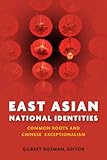
Gilbert Rozman, ed. East Asian National Identities: Common Roots and Chinese Exceptionalism. Stanford: Stanford University Press, 2012. 256 pp. $50.00 (cloth), ISBN 978-0-8047-8117-6.
Reviewed by Sarah Mak (University of California, Santa Cruz)
Published on H-Nationalism (June, 2013)
Commissioned by Eric H. Limbach (University of Rochester (from Fall 2015))
The National Roots of Foreign Policy: A six-dimensional comparison of the roots of Japanese, South Korean, and Chinese Foreign Policy
Gilbert Rozman’s most recent edited volume, East Asian National Identities, is an ambitious attempt to bridge the disciplines of nationalism studies, comparative politics, and international relations. The book is the first in a series of two that aims to understand the ways in which national identities shape Japanese, South Korean, and Chinese foreign policies, and also how these foreign policies, in turn, lead to a reshaping of national identities. In this first book, Rozman studies the way in which national identities are shaped via a six-dimensional framework. The planned second book will take the findings from this edited volume to show how an East Asian National Identity Syndrome (EANIS) shapes bilateral relations.
The book itself is likewise separated into two parts. Part 1, written by Rozman, introduces readers to the six-dimensional framework and applies the framework to the three countries. Briefly, the six dimensions are ideological, temporal, sectoral, vertical, horizontal, and intensity dimensions. Rozman concludes part 1 by arguing that while these dimensions shape the three nations’ identities differently, they all share a commonality in that they maintain an EANIS. EANIS, as Rozman describes, can be seen as an amalgamation of the countries’ shared Confucian legacy, a “desperate catch-up mentality,” a shared experience of isolationism, the triumph of economic growth, and periods of optimism and letdown (p. 10). The second part of the book is a compilation of essays written by various scholars from Japan, South Korea, China, and the United States. These essays focus on one of the six dimensions and provide a richer and more in-depth analysis to the case studies. For example, Kazuhiko Togo’s chapter examines nation building in Japan at three very different time periods: the premodern era, the height of Japanese imperialism in Asia, and the period following Japan’s defeat in World War II. Yuichi Hosoya’s chapter provides a detailed account of Japanese foreign policy following World War II through the lens of Japan’s diplomatic relations with the United Nations and the United States, and its place in Asia.
The book’s overall premise is admirable: the fields of comparative politics, international relations, and nationalism studies ought to be commensurate with each other. However, the usefulness of the six-dimensional approach is not entirely clear. Through this framework, readers are certainly given a primer on the three case studies’ foreign policy approaches and a quick overview of the countries’ history, political changes and developments, and demographics. China studies, Japanese studies, and South Korean studies scholars may find these chapters contributing little to their respective fields. Furthermore, given the book’s heavy emphasis on Cold War diplomacy, the role of the United States looms over the entirety of the book, so much so that one wonders whether the United States could be an additional seventh dimension to this project. Lastly, the six-dimensional approach may prove unsatisfying for nationalism scholars who demand a more theoretically driven and historical framework. In particular, part 1 of the book glosses over a number of theoretical opportunities that nationalism scholars might find useful. For example, scholars such as Tessa Morris-Suzuki have written extensively on how conceptions of space and time can shape nation-building projects (Re-Inventing Japan: Time Space Nation [1998]).
The book’s object of study, national identities, can also be questioned. Concepts such as the “nation,” “nationalism,” and “national identities”--terms that have garnered much debate and a body of literature dedicated to shedding light on usage of the terms--are sometimes taken for granted in this book. Moreover, at times, the book refers to “national identity” in the sense that it refers to the collective identity of those within a nation; a good example of this is chapter 7 by Rozman and Andrew Kim. And yet, for the majority of the book, the term “national identity” seems to conflate with the way some nationalism scholars might define “nationalism.” One example is in chapter 9 where Jin Linbo traces Chinese national identity formation from premodern China (the Qin and Han dynasties) to the present. Not only does Jin conflate the term “national identity” with “nationalism,” but he also sometimes uses the term “dynasty” to refer to the nation. The idea of a premodern China will also likely fire up the debate between modernist scholars, who argue that nations are a modern phenomenon, and primordialist scholars--with Rozman and the contributors of this book falling into the latter camp. Lastly, one of the stated aims of this book is to demonstrate how the framework’s six dimensions shape national identities. The way in which the framework is employed, however, is through a top-down approach. That is, beyond the vertical dimension of the framework (which looks briefly at family communities, group identities, and social movements) little is said about the people within the nation and how they are influenced by the state’s actions, or how they might even be responsible for shaping national identities.
As I suggested earlier in this review, Rozman’s edited volume is an ambitious project. To cover the historical and political developments of nation building and nations’ responses to foreign policy since before the twentieth century within a few chapters is quite the challenge, and I suspect that much detail is sacrificed. Additionally, theoretical analysis also is left out; this book may leave the more theoretically grounded scholars desiring more. International relations scholars (specifically those with an interest in foreign policy) will find this book, and hopefully the second book, a useful addition to the literature on East Asian politics and foreign policy decision making. Likewise, scholars with an emphasis on comparative politics may find the six-dimensional framework appealing in multi-country studies.
If there is additional discussion of this review, you may access it through the network, at: https://networks.h-net.org/h-nationalism.
Citation:
Sarah Mak. Review of Rozman, Gilbert, ed., East Asian National Identities: Common Roots and Chinese Exceptionalism.
H-Nationalism, H-Net Reviews.
June, 2013.
URL: http://www.h-net.org/reviews/showrev.php?id=39173
 | This work is licensed under a Creative Commons Attribution-Noncommercial-No Derivative Works 3.0 United States License. |

