



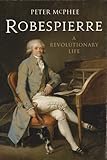
Peter McPhee. Robespierre: A Revolutionary Life. New Haven: Yale University Press, 2012. 352 pp. $40.00 (cloth), ISBN 978-0-300-11811-7.
Reviewed by Jordan Hayworth (Air University, Air Command and Staff College)
Published on H-War (April, 2017)
Commissioned by Margaret Sankey (Air University)
Unlike many other significant figures of the French Revolution who remain largely unconsidered by Anglophone biographers, Maximilien Robespierre has never wanted for biographical attention. Recent decades have seen numerous studies of this preeminent revolutionary, including such important works as David P. Jordan’s The Revolutionary Career of Maximilien Robespierre (1985) and Ruth Scurr’s Fatal Purity: Robespierre and the French Revolution (2007). Peter McPhee’s biography, therefore, enters an already crowded field. For that reason alone, he must be congratulated for succeeding in making a new contribution to our understanding of Robespierre, shedding valuable new light on the early life of the French Revolution’s “incorruptible” leader.
McPhee’s central challenge is to explain “how it could be that someone who articulated the highest principles of 1789 could come to be seen as the personification of ‘the reign of Terror’ in 1793-1794” (p. xi). McPhee confronts two traditional interpretations that dominate attempts to explain Robespierre’s behavior. First, one school of thought emerging from many of his contemporary detractors and remaining prominent in popular conceptions into the twenty-first century views him as a pathological monster. Second, a twentieth-century interpretation emerging from François Furet’s concern with politics and culture portrays Robespierre as a tragic embodiment of revolutionary ideology as shown in Furet’s Revolutionary France, 1770-1880 (1995). While McPhee engages with both of these perspectives in interesting ways, he offers a third interpretation: Robespierre was a fairly normal albeit an amazingly intelligent and ambitious human being who was shaped by the society and culture into which he was born and raised.
McPhee is most interested in Robespierre’s personal responses to the upheavals that brought down the Old Regime in France and to the challenges of creating a new order. This book, as McPhee states, is “as much about the ‘making’ of Maximilien Robespierre as about his revolutionary career” (p. xix). In emphasizing Robespierre’s personal development, McPhee follows an approach similar to that of Timothy Tackett’s collective biography of the deputies to the Estates General in Becoming a Revolutionary: The Deputies of the French National Assembly and the Emergence of a Revolutionary Culture (1789–1790) (1996). The major difference is that whereas Tackett focuses on the transformative process in 1789 and at the Estates General and more broadly in the environs of the French capital, McPhee shifts attention to the provinces, specifically Robespierre’s hometown of Arras, the capital of the province of Artois. McPhee examines Robespierre’s revolutionary personality, which he claims existed prior to 1789: “Well before Louis announced that he was convening a meeting of the Estates-General, Robespierre had become thoroughly alienated from and had alienated those who occupied the highest positions in the complex, aristocratic hierarchies in the Church, judiciary, and administration.” Not only did experiences in Arras and Paris reduce Robespierre’s support for the Old Regime, but he also “had identified the codes of honor of monarchical and noble society as the root cause of prejudice against the unfortunate. Broadening this into an indictment of the poverty endemic in his society” (p. 60). Thus, McPhee makes an important contribution to the historiography by asserting that historians who focus on Robespierre’s revolutionary career without considering his childhood and early adulthood miss the crucial period of his development.
While McPhee’s approach provides welcome insight on a relatively understudied aspect of Robespierre’s biography, he is only partially successful in his attempt to bring the young Robespierre to life. The main problems result from a dearth of sources on Robespierre’s early life before 1789. Certainly, McPhee cannot be blamed for not using sources that do not exist; however, his approach inevitably suffers from attempting to discuss topics that one can only access via supposition and inference. Certainly, McPhee is able to show that previous biographies like Max Gallo’s L’Homme Robespierre (1968) and J. M. Thompson’s Robespierre (1936) based their depictions of the young Robespierre as a pathological personality on flimsy evidence. Yet his more positive interpretation is based mainly on the published memoirs of Robespierre’s sister, Charlotte; published in 1835 and titled Mémoires de Charlotte Robespierre sur ses deux frères, this proves an interesting yet hardly unbiased account. McPhee visited the departmental archives of Arras, yet it remains unclear how much evidence he actually derived from them. His analysis of Artois is based primarily on secondary sources. Nonetheless, he admits many of these problems and generally handles the sources judiciously while using multiple works by such leading scholars as Daniel Roche, Richard Andrews, David Bell, and R. R. Palmer to contextualize his analysis.
Although McPhee’s major historiographical contribution concerns Robespierre’s prerevolutionary life, he has much to say about events after 1789. He demonstrates that Robespierre was an active member of the Third Estate and an especially vocal advocate for social programs to benefit the poor. Nonetheless, Robespierre was not the earliest proponent of republicanism. Although he personally favored that form of government, he believed in France’s constitutional monarchy until after the king’s flight in 1791. McPhee consults a large array of secondary sources and makes excellent use of Robespierre’s major speeches. He concurs with a growing number of historians who stress the importance of conspiracy and paranoia in revolutionary political culture.
McPhee does not shy away from the uglier aspects of Robespierre’s career. He shows the Revolution’s tragic yet seemingly inevitable slide into fratricide in excellent detail, documenting Robespierre’s friendship with Georges Jacques Danton and Camille Desmoulins and his eventual persecution of them. Although already a well-known story, McPhee’s telling of it makes for riveting reading and adds little-known nuances and insights along the way. One strength of McPhee’s account is the attention he devotes to Robespierre’s health, which he shows was poor throughout the period of the Terror. Readers of H-War will be interested in Robespierre’s thoughts on the Brissotin campaign for war in 1791-92 and his influence on the French war effort between 1792 and 1794.
McPhee does not provide a detailed analysis of the War of the First Coalition, yet he does at least provide a basic narration of the key military events. More important, he asserts that the military operations had a significant impact on the course of the Revolution and Robespierre’s life, even if he refrains from actually assessing the impact through a detailed analysis and reconstruction of battles and campaigns. He perhaps underestimates the importance of ideology in Robespierre’s opposition to war in 1792, yet he makes important points concerning Robespierre’s failure to understand that the improvement of France’s military fortunes in 1794 doomed his policy during the Reign of Terror. McPhee makes clear that Robespierre’s miscalculation of the relationship between war and politics ultimately led to his demise on 9 Thermidor.
Overall, this biography cannot be recommended enough for those interested in the French Revolution, French history, and European military history broadly. Robespierre’s life is an important part of understanding the French Revolution and McPhee joins the top ranks of many esteemed historians of the Revolution who have attempted to comprehend one of its most polarizing characters. As with Napoleon Bonaparte, no historian will ever write the definitive biography of Robespierre. But McPhee has set a high bar for a concise biography that combines original research with a synthesis of modern scholarship. Unlike Napoleon, the French have done little to memorialize Robespierre: McPhee’s biography suggests that perhaps the time is right for a reevaluation. Finally, military historians will find the book a valuable overview of the man who was the closest that France had to a dictator during an important period of the French Revolutionary Wars. In addition, it makes meaningful observations about the need for civilian leaders to better understand the nexus of politics and war.
If there is additional discussion of this review, you may access it through the network, at: https://networks.h-net.org/h-war.
Citation:
Jordan Hayworth. Review of McPhee, Peter, Robespierre: A Revolutionary Life.
H-War, H-Net Reviews.
April, 2017.
URL: http://www.h-net.org/reviews/showrev.php?id=39113
 | This work is licensed under a Creative Commons Attribution-Noncommercial-No Derivative Works 3.0 United States License. |

