



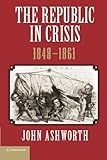
John Ashworth. The Republic in Crisis, 1848-1861. New York: Cambridge University Press, 2012. 217 pp. $75.00 (cloth), ISBN 978-1-107-02408-3; $22.99 (paper), ISBN 978-1-107-63923-2.
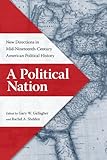
Gary W. Gallagher, Rachel A. Shelden, eds. A Political Nation: New Directions in Mid-Nineteenth-Century American Political History. Charlottesville: University of Virginia Press, 2012. 272 pp. $40.00 (cloth), ISBN 978-0-8139-3282-8.
Reviewed by Matthew E. Mason (Brigham Young University)
Published on H-CivWar (August, 2013)
Commissioned by Bonnie Laughlin-Schultz (Eastern Illinois University)
Reading these two books together with an eye to Civil War scholarship is in a way an exercise in déjà vu. For these volumes offer versions, if attenuated and nuanced ones, of the old historiographical debate between those who held that the Civil War was an "irrepressible conflict" and those who argued that it was a "blundering generation"--not underlying sectional differences or grand forces--that caused the war. But besides the persistence of this debate, there is no way in which reading these two volumes feels like being caught in a time warp. For all their appreciation for traditional political history, both books, especially Gary W. Gallagher and Rachel A. Shelden's edited collection, draw productively on and model the latest developments in American political history.
John Ashworth comes right out of the gate by stating flatly that the Civil War "was the almost inevitable product not of chance or 'contingency,' but of the profound differences between North and South" (p. 1). Those differences were rooted in class conflict and economic change: while the antebellum South wrestled with the consequences of slave resistance, the antebellum North experienced dislocating but promising change as its economy came increasingly to rely on wage labor. This volume thus distills key elements of his argument in his much longer two-volume scholarly treatise on the coming of the Civil War, Slavery, Capitalism, and Politics in the Antebellum Republic (volume 1, Commerce and Compromise, 1820-1850 [1995] and volume 2, The Coming of the Civil War, 1850-1861 [2007]). The task he has set for himself here seems to be not only to present his bracing interpretations in a briefer (and presumably thus friendlier for classrooms and general readers) work, but also "to integrate these causal processes with a narrative of the events of the 1850s" (p. 2).
Gallagher and Shelden's volume does not offer so open and unified an interpretation of the coming of the Civil War. But its central section, dubbed "The Politics of the Secession Crisis," features essays not on underlying, inexorable processes, but on individual politicians and groups of voters and the choices they made in what was to them a bewildering rather than a predictable time. In particular, William J. Cooper's chapter focusing on Abraham Lincoln's refusal to compromise on the central issue of slavery in the territories during the secession winter provides a soft version of the blundering generation school. His portrait of a Lincoln who was a party leader and committed antislavery ideologue who misunderstood the South rather than a statesman may be more about a misguided individual than a blundering generation, but the contrast with Ashworth's interpretation remains sharp.
Although they have flaws, both books have much to recommend readers' attention in a crowded field. Even in this abridged format, Ashworth demonstrates his mastery of historical analysis. While translation to this shorter work lost some of his last book's best insights on the Whigs and slavery, the essence of his careful interpretation of the place of slavery in the Democratic Party--that from Thomas Jefferson's day through the dawn of the 1850s it was functionally and not randomly, but not centrally or purposefully, proslavery--enriches this book. He not only states forcefully one of his great contributions to the literature, the argument that "slave resistance was a fundamental, perhaps the most fundamental, cause of the Civil War" (p. 2), but also richly supports that argument throughout the book.
But the interpretive vigor of Ashworth's book fits uncomfortably with the goal of providing a narrative of key events, for several reasons. For one thing, Ashworth's strength is much more in analysis than narrative, and his heart seems to be with his strength. The events get shorter shrift than the processes, and instead of being truly integrated these two elements of the book are almost always treated in separate sections, without many good transitions between the sections. More fundamentally, a narrative in which events truly matter is at odds with the logic of the argument that it was processes working "beneath the surface" of these events that truly furthered "the process of national disintegration" (p. 82); why do the events matter if they are simply the surface and the economic forces at work are the true cause? Did, for instance, Stephen Douglas's agency and the passage of the Kansas-Nebraska Act have causal significance, or would things have turned out the same way in the absence of both person and event? The closest Ashworth comes to reconciling this logical contradiction in this book is in a passage in which he contrasts "the longer-term causes of the political upheaval" with "the immediate precipitating factors" and seeks to show how they "converged" (p. 102). But this promising rumination is buried in the middle of the narrative, and is insufficient to harmonize the two tracks on which this book proceeds.
If Gallagher and Shelden's collection makes a statement anywhere near as bold as Ashworth's "almost inevitable" phrase, it is their stated intention to aid in the ongoing "revival of traditional American political history" (p. 3). But the book is not nearly as cranky or old-fashioned as that statement might seem to some readers. For the book benefits from some of the latest scholarly trends in political history, including the integration of gender and state formation as questions. Nowhere is this more true than in various essays' productive attention to political culture. Shelden's chapter, for instance, reads congressmen's boardinghouse arrangements and overall sociability to illuminate a bisectional, strongly partisan political culture in Washington at the height of the controversy over Texas annexation. And Mark E. Neely's essay probes the murder of a party operative in the 1850s as part of his exploration of the central place of institutionalized violence in the Second Party System.
Edited collections are notorious for the traditionally uneven quality of their chapters, and this one is no exception, although the high quality of the mix of established and up-and-coming scholars here narrows the range of variation and skewed it toward the high end. Festschrift volumes also too often lack thematic unity, held together by a person but not any set of ideas. Although this one is a tribute to Michael Holt, it avoids that pitfall entirely. The editors clearly worked hard to unify the volume by making Holt's work the touchstone of every essay, and the contributors followed their lead. Every chapter is right in its author's wheelhouse but those authors show their debt to Holt; this, and the fact that few of these distinguished authors need an introduction, is an excellent way to demonstrate Holt's long-running and continuing impact on the field. For instance, Daniel A. Crofts's essay on late antebellum Southern opponents to the Democratic Party falls squarely within his accomplished research on the subject, but applies Holt's important interpretive point that parties who allowed their "core message" to be "blurred" lost in the long run (p. 94). And Crofts's, Sean Nalty's, and J. Mills Thornton's contributions all underscore the value of analysis at the level of the states, another key theme in Holt's scholarship. Various essays in this collection also share something else that has distinguished Holt's corpus, in their willingness to subject shibboleths to scrutiny rather than accept them at face value.
Though very different in origins, purpose, and nature, these two books will in their own way provide current and future scholars of the politics of the Civil War era with plenty to consider and discuss.
If there is additional discussion of this review, you may access it through the network, at: https://networks.h-net.org/h-civwar.
Citation:
Matthew E. Mason. Review of Ashworth, John, The Republic in Crisis, 1848-1861 and
Gallagher, Gary W.; Shelden, Rachel A., eds., A Political Nation: New Directions in Mid-Nineteenth-Century American Political History.
H-CivWar, H-Net Reviews.
August, 2013.
URL: http://www.h-net.org/reviews/showrev.php?id=39093
 | This work is licensed under a Creative Commons Attribution-Noncommercial-No Derivative Works 3.0 United States License. |

