

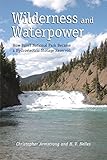
Christopher Armstrong, H. V. Nelles. Wilderness and Waterpower: How Banff National Park Became a Hydroelectric Storage Reservoir. Calgary: University of Calgary Press, 2013. 272 pp. $41.95 (paper), ISBN 978-1-55238-634-7.
Reviewed by Brittany Luby (York University)
Published on H-Environment (October, 2013)
Commissioned by Dolly Jørgensen (University of Stavanger)
Hydroelectric Groove: How Energy Demands (Re)Shaped Rocky Mountain National Park
Christopher Armstrong and H. V. Nelles’s Wilderness and Waterpower: How Banff National Park Became a Hydroelectric Storage Reservoir is a skilful merger of economic theory, particularly the notion of “path dependence,” with historical narrative. Armstrong and Nelles utilize path dependence, which they define as “a familiar predicament [wherein] early choices in system design virtually determine downstream incremental change” to argue that Banff National Park became a hydroelectric storage reservoir, in part, because Calgary Power Company struggled to develop alternatives to water power generation to meet ever-increasing urban energy demands (p. viii). Much like in other “path-dependent” circumstances, such as the selection of railroad gauges or the contest between VHS tape formats, the initial choices made by hydroelectric developers constrained later potential for energy diversification. After developing Horseshoe Falls in 1911, Calgary Power insisted on increased access to the Bow River. Company officials believed that it would be “easier, faster, and possibly cheaper” to re-engineer Bow River, and, ultimately, the boundaries of Rocky Mountain National Park, than to develop alternative methods of energy production (p. 205). According to Armstrong and Nelles, it was a lack of corporate imagination that tore apart Rocky Mountain National Park and created the conservation areas we know today: Banff, Jasper, Yoho, and Glacier. It was, the authors argue, the path-dependent choices of Calgary Power (combined with rising urban demand) that turned Banff National Park into a hydroelectric storage reservoir despite a policy contest between conservation and energy groups.
Readers follow the Bow River over the course of almost a century. In chapter 1, “Water Falls,” readers discover that corporate and government officials alike understood Bow River in relation to its capital potential. While there is a passing nod toward the “first human habitation” of indigenous peoples along the Bow, Wilderness and Waterpower really begins in 1883 with the identification of the hot springs in present-day Banff, Alberta, as a potential tourist site by the Canadian Pacific Railway (CPR). By 1886, the government of Canada had responded to the CPR’s call to reserve the hot springs and established Rocky Mountain National Park as a health retreat. The prime minister, Sir John A. Macdonald, however, had larger aspirations than spas and sanatoria, and hoped that Rocky Mountain National Park would become a “great resort” (p. 12). Armstrong and Nelles make clear that Bow River lacked (and, indeed, lacks) intrinsic or obvious value; over time, different schemes emerged to monetize the river. Bow Falls was first conserved for its natural beauty and its potential as a tourist site. Years later, as Bow Falls was revalued for its energy potential, the perceived capital reward of conservation declined. This short chapter builds on texts like Matthew Evenden’s Fish vs. Power: An Environmental History of the Fraser River (2007) by furthering the point that “the river is defined and remade by the cultures which surround and use the river.”[1]
Chapter 2, “Power Struggles,” introduces the theme of bungled development. Calgary Power wrangled Horseshoe Falls from both Indian Affairs and the Interior Department under the illusion of its industrial potential, but “nobody appears to have bothered to take systematic and detailed streamflow measurements” (p. 28). Water levels varied from season to season and fell extremely low during the winter months. As the temperature dropped, water froze at higher altitudes and Calgary Power was left with a trickle to turn its anticipated turbines. Horseshoe Falls Generating Station thus began operation in 1911 despite the unsuitability of Horseshoe Falls for hydroelectric power production. The path dependency framework selected by Armstrong and Nelles proves useful for assessing why Calgary Power seemed to be locked into a visibly irrational course of action. As the text develops, readers are reminded that hydroelectric production in Alberta sometimes resulted more from folly than careful engineering.
This theme is furthered in chapter 6, “Political Logic,” in which readers discover that the National Parks Act of 1930 removed “630 miles of the Spray watershed” from Rocky Mountain National Park (p. 115). The park was broken into four smaller reserves--Banff, Jasper, Yoho, and Glacier--effectively separating valuable water resources from park lands. Armstrong and Nelles argue that the prime minister, Mackenzie King, utilized Bow River as a “useful bargaining counter” to protect Liberal Party standing (p. 115). In 1925, the Conservative Party briefly regained office in federal elections. Members of the Liberal Party realized that they required the backing of Progressive members of Parliament from Alberta to retain power, and so, King proposed the transfer of Alberta’s natural resource control to the provincial government. By detailing how federal and provincial officials jockeyed for power, this chapter also develops the theme of power struggle between various levels of government. The boundaries of Rocky Mountain National Park were redrawn to ensure that King won the political support of John Brownlese, the premier. Readers are encouraged to understand the transfer of water resources as the result of self-interest and political will rather than utilitarian logic. This chapter may interest educators looking for seminar readings on Canadian government and policy development by offering a launching pad for complex discussion about policymaking.
Chapter 3, “Doubling Down,” and chapter 5, “Selling Scenery,” both examine resistance to hydroelectric development by vested interest groups. In chapter 3, readers are introduced to the struggle between Calgary Power and Nakoda Indian Reserve. To meet rising electric demands, Calgary Power sought permission to develop Kananaskis Falls in 1911, which required over two hundred acres of Nakoda land. Band members actively rejected corporate rights of expropriation and threatened violence upon trespass. The Department of Indian Affairs undermined Nakoda resistance, however, when Acting Deputy Superintendent J. D. McLean granted Calgary Power permission to develop Kananaskis Falls provided that the company reached a compensation agreement with the Nakoda in the future. Armstrong and Nelles here reveal the state as a “handmaiden to capitalist development” (p. 50). The importance of this chapter lies in the identification of competing territorial claims and of their (potentially) violent defense by indigenous peoples. There was nothing “natural” about the development of Kananaskis Falls; it was a contest of vision and interests. And it seems that insider dealings, rather than a lack of initiative, limited the effectiveness of indigenous territorial claims. A cynic might use this chapter to point out that firms are very good at waving the “utilitarian logic” card when they stand to benefit from overcoming indigenous territorial claims. Armstrong and Nelles thus provide fodder for students to think critically about industrial development in Canada more generally: fodder to debate the development of the James Bay Project; to question the nature of development that occurred during their lifetimes (e.g., Mackenzie Valley Pipeline); and to develop an informed position on the Ring of Fire (planned chromite mining and smeltering in northern Ontario).
Chapter 5, “Selling Scenery,” examines the successful lobbying efforts of outdoors enthusiasts, revealing the power of public interest in shaping industrial Canada. The same demand for power that drove development at Kananaskis Falls sparked Calgary Power’s interest in the Spray Lakes. In 1923, however, mountaineering and conservation groups coalesced into the Canadian National Parks Association (CNPA). As a unified voice, these diverse groups decried “the spoilation of wilderness preserves” (p. 74). The CNPA provided park bureaucrats with sufficient backing to help quash Calgary Power’s proposal for the development of Spray Lakes. Here, readers are reminded that public demand can literally (re)shape--or, in this case, preserve--public spaces. For me this chapter raised a question about Armstrong and Nelles’s earlier treatment of Nakoda advocates: how might an analysis of the uneven sociopolitical power of the Nakoda and members of the CNPA have (re)shaped, if at all, discussions of public resistance? We must remember that the Canadian government prohibited “status Indians” from voting in federal elections until March 1960. Nelles and Armstrong avoided victimizing their indigenous actors, and yet, a legal inability to vote--to formulate a comparable lobby group--I believe, makes the Nakoda struggle to mold corporate policy more extraordinary and the success of the CNPA less so.
Chapter 8, “War Measures,” and chapter 9, “Public Power,” both place Albertan power development in an international context. Calgary Power used World War II, particularly the language of war need, to access more land in Banff National Park. The company claimed that Lake Minnewanka offered “the cheapest and speediest means of producing additional power needed for the war effort” (p. 133). By pitching power development as an issue of national security, Armstrong and Nelles argue that Calgary Power deployed war rhetoric to subdue public resistance to corporate expansion. It also benefited from Canada’s Red Scare. While the Hydro-Electric Power Commission of Ontario had paved the way for cost-effective provincial management years earlier, Armstrong and Nelles maintain, “Calgary Power survived the post-war era by virtue of Premier [Ernest] Manning’s Cold War ideological abhorrence of state enterprise” (p. 206).
Wilderness and Waterpower is a cyclical story. Chapter 11, “Leaving the Bow,” and the conclusion lead readers away from riverine development. As in the beginning, Bow River was no longer valued primarily for its hydroelectric potential by the mid-twentieth century, by which time Calgary Power was running out of falling water; urban electric demands, however, continued to grow. As a result, the company sought alternative energy sources to “keep pace with the growth of southern Alberta” (p. 183). Coal caught the eye of Calgary Power and by 1980 TransAlta Resources was born. TransAlta relied largely on thermal electric stations. Hydroelectric generating stations along Bow River fell into relative disuse, as TransAlta used dams to meet peak--not general--power demand. Readers are left to question the cycle of development as “the story continues to unfold” (p. 222).
Stylistically, Wilderness and Waterpower is a pleasure to read. The prose is effective and clear. Armstrong and Nelles clearly define their terms--“path dependence,” “wilderness,” and even “water power”--making the text accessible to those new to the topic. Despite the strength of Armstrong and Nelles’s prose, I recommend that educators review Canada’s parliamentary structures with their classroom before assigning Wilderness and Waterpower. In revealing the “internal pluralism of the state” (p. 215), by exposing the tension between First Nations, lobby groups, and Calgary Power, readers are left to cipher the power flow between interested parties.
Record Group 84 from Library and Archives Canada forms an important evidentiary base for the text. Archival material from Glenbow Archives (e.g., Calgary Power Company Fonds), the House of Lords Record Office, and the Provincial Archives of Alberta also feature prominently. Students may be provoked to map other federal and provincial records onto a path dependency framework to further question narratives of utilitarian development. Armstrong and Nelles provide readers with an alternative look at national growth, one that emphasizes irrational decision making over careful long-term planning. Here is a nonlinear history. It is a story with bumps and dead ends that may encourage students to think about the “Five Ws”--who, what, when, where, and especially why--differently. More specifically, the intellectual framework of this book might encourage students to ask whether a given development project came about for purely utilitarian reasons, or if a detailed examination of the historical record might reveal that competing interests, visions, and social groups might have done as much to shape development as pure utility.
The framework of path dependence is especially great news for historians. It suggests that to explain any given industrial development, you cannot appeal only to economic theories like “supply and demand”--you have to consider the constraints imposed by previous decisions, which themselves may have been taken for historically contingent reasons (e.g., the particularities of an election), rather than purely utilitarian ones. At the same time, path dependence gives economists a sensible way to talk about historical contingency in their models, since it examines the costs imposed by inefficient decisions. In sum, I believe that Wilderness and Waterpower has the power to energize both academic and classroom debate about the history of Canada’s development and related environmental changes.
Note
[1]. Jeff Crane, “Saving the Fraser River: A Shifting Dynamic between Culture and Nature,” review of Fish versus Power: An Environmental History of the Fraser River, by Matthew Evenden, H-Environment (June 2005), http://www.h-net.org/reviews/showrev.php?id=10601.
If there is additional discussion of this review, you may access it through the network, at: https://networks.h-net.org/h-environment.
Citation:
Brittany Luby. Review of Armstrong, Christopher; Nelles, H. V., Wilderness and Waterpower: How Banff National Park Became a Hydroelectric Storage Reservoir.
H-Environment, H-Net Reviews.
October, 2013.
URL: http://www.h-net.org/reviews/showrev.php?id=39040
 | This work is licensed under a Creative Commons Attribution-Noncommercial-No Derivative Works 3.0 United States License. |

