

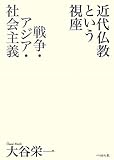
Eiichi Ōtani. Kindai Bukkyō to iu shiza: sensō, Ajia, shakai shugi. Tōkyō: Perikansha, 2012. 294 pp. ISBN 978-4-8315-1318-2.
Reviewed by Orion Klautau (Heidelberg University)
Published on H-Shukyo (January, 2014)
Commissioned by Jolyon B. Thomas (University of Pennsylvania)
Modern Buddhism as a Perspective
In Japanese academia in recent years, it has become quite common to hear people mention the flourishing of studies on modern Japanese Buddhism. The field has made rapid progress from the mid-1990s, when conferences would gather no more than a dozen researchers, to the present, with the field being a popular arena for researchers, especially younger ones.[1] The numbers are clear: over ten monographs, edited volumes, and journal issues have been published in Japanese on the subject since 2001, and there are a few more on the way.[2] This is already almost as much as everything else published on the subject in the five decades prior to the millennium. Ōtani Eiichi, the author of the work under review, is indisputably one of the central figures responsible for the popularization of modern Buddhism as a research topic. For instance, Ōtani’s first book, Kindai Nihon no Nichiren shugi undō (2001), is a detailed study of nationalistic movements led by the likes of Tanaka Chigaku (1861–1939) and Honda Nisshō (1867–1931). Published twelve years ago, this work can be regarded as one of the first instances of the “new wave” of research on modern Japanese Buddhism.
Kindai bukkyō to iu shiza is divided into three parts: “Kindai Bukkyō kenkyū o toi naosu” (Questioning the Study of Modern Buddhism, Part 1), “Kokumin kokka to kindai Bukkyō” (The Nation State and Modern Buddhism, Part 2), and “Ekkyō suru kindai Bukkyō” (Modern Buddhism Beyond Borders, Part 3). Each of these parts is, in turn, subdivided into three chapters.
In the first chapter of part 1, Ōtani’s goal is, in his words, to “critically reevaluate the historical research on modern Japanese Buddhism produced since World War II,” while (re)problematizing the issue of the “modernization of Buddhism” (Bukkyō no kindaika) (p. 13). According to the author, previous research on modern Buddhism, specifically that of Ikeda Eishun (1929–2004), Yoshida Kyūichi (1915–2005), and Kashiwahara Yūsen (1916–2003)--who are now referred to as the “big three” (biggu san) in the field--has tended to approach Buddhism from a “modernist” (kindai-shugiteki) perspective.[3] In contrast, Ōtani suggests we begin our scholarship on Buddhism by considering how the concept of Buddhism itself was created. Drawing on the work of scholars such as Isomae Jun’ichi, he argues that historical research on modern Japanese Buddhism needs to be pursued in light of the recent studies on the concept of “religion” (shūkyō), and also emphasizes the considerable role played by the concept of Buddhism in the establishment of the discourse on religion in modern Japan.[4]
Isomae, whose work serves as the framework for Ōtani’s criticism of previous research on modern Japanese Buddhism, explicates the development of the discourse surrounding the concept of religion using the binary of “practice” and “belief.”[5] While the boundaries between these two aspects in what came to be called religious life were ever-shifting, according to Isomae in traditional Edo-period society there was a clear tendency to engage in nonverbal ritual acts (that is, an emphasis on practical “religious activities”). In modern Japan, however, with the (re)invention of religion brought on by the country’s encounter with the Christian West, a “belief-centered” (birīfu chūshin-shugi) view of Buddhism, which valued doctrine and individual faith over formalized rituals, became the norm. This notion, which Sueki Fumihiko has called “Protestant Buddhism” (purotesutanto Bukkyō), also became, as Ōtani goes on to show, the discursive ground for the subsequent academic study of Buddhism.[6] While most previous scholarship (from the more established narratives put forward by the “big three” to the relatively recent works of Sueki Fumihiko) has taken this “belief-centered” Buddhism as its main focus, Ōtani provocatively hints at all the other histories of modern Japanese Buddhism that could be written should scholars focus instead, for instance, on the practice-centered elements contained therein. According to Ōtani, one can speak, then, of modern Buddhism in both a “narrow” and “broad” sense: while the former overlaps with the above-mentioned category of “Protestant Buddhism,” the latter would also combine factors such as ancestor worship among lay believers and the ritual aspects of traditional Buddhist sects. However, for the remainder of the book, Ōtani does not focus on these heretofore largely ignored “broad” aspects of modern Buddhism, but instead dedicates himself to reconsidering, under different light, the same “belief-centered” elements which have so far been the axis of histories of modern Japanese Buddhism.
In chapters 2 and 3 of part 1, Ōtani focuses on the idea of “new Buddhism,” a recurrent trope in several Buddhist movements between the late 1880s and the 1930s (p. 44). In the second chapter, he shows how the binary of “old Buddhism” (kyūbukkyō) and “new Buddhism” (shinbukkyō), which was already a strong motif in the early works of Inoue Enryō (1858–1919), went on to become further systematized through the writings of yet another Buddhist reformer, Nakanishi Ushirō (1859–1930). Ōtani further discusses how this same opposition was utilized around the turn of the century as the intellectual framework for Sakaino Kōyō’s (1871–1933) Shin Bukkyō movement and the journal with the same name, which were part of what Ōtani calls the “youth culture” of the time. In chapter 3, he focuses on the discursive framework of the Shinkō Bukkyō Seinen Dōmei (New Buddhist Youth Alliance), established in the early 1930s by socialist activist Seno'o Girō (1889–1961). In part 1, Ōtani thus considers the formation and political context of Buddhists employing the term “new Buddhism” between the 1880s and 1930s, giving the reader valuable information to understand the broader intellectual and social background against which the “belief-centered” type of modern Buddhism developed.
In part 2, Ōtani aims to reconsider the relationship between the Japanese nation-state and modern Buddhism. In the first chapter, through a historical overview focusing on four specific aspects (or moments) of Buddhism’s relationship with the Japanese state between the Meiji restoration (1868) and early Shōwa period (1926–89), he attempts to further clarify the public role of several lay Buddhist movements during this time. Drawing from José Casanova’s 1994 study Public Religions in the Modern World,[7] Ōtani focuses on examples such as Tanaka Chigaku’s Nichirenism and Seno'o Girō’s New Buddhist Youth Alliance, if only to conclude that, despite their obvious contemporary social role, it is difficult to identify these movements as “public religion” (p. 114). He does, however, manage to show through these and other examples that modern Japanese Buddhism was far less subservient to the state than previous scholarship depicts it as having been. In chapter 2, Ōtani is in familiar territory, focusing specifically on Tanaka Chigaku’s Kokuchūkai (National Pillar Society), one of the main topics of his 2001 monograph. However, this time Ōtani focuses thereon in order to consider the contemporary limitations, vis-à-vis nationalism, of this institution with regard to the formation of a transnational “sacred religious community” (sei naru shūkyō kyōdōtai). In chapter 3, he considers pacifist discourses put forward by Buddhist intellectuals in the context of Japan’s modern wars. He focuses, for instance, on the impact in the Buddhist world of the Japanese translation of Leo Tolstoy’s criticisms of the Russo-Japanese War, and on the ideas of Shin priest Takenaka Shōgen (1867–1945), one of the few Buddhist voices explicitly critical of the Second Sino-Japanese War.
In the third and final part, Ōtani discusses the “transnational” endeavors of modern Japanese Buddhists. In chapter 1, he introduces the concept of “Buddhist Asianism” (Bukkyō Ajia shugi), defined as “the philosophy and logic oriented towards the communality [kyōdōsei] and unity of the various Asian countries that is either based on or given meaning by universal Buddhist thought” (p. 181). Ōtani utilizes this concept in order to consider the activities of Nichiren priest Takanabe Nittō (1879–1953), both as a prolific pan-Asian ideologue in early twentieth-century Japan and then as a missionary in Inner Mongolia from 1939. In chapter 2, he focuses on the Ketsumeidan (Blood-Pledge Corps) and its founder, Inoue Nisshō (1887–1967). Here, Ōtani traces the religious trajectory of Nisshō from Christianity to Marxism and then into Buddhism, and places him within an overall context of modern Nichirenism. While most studies on the Ketsumeidan have focused mainly on the thought and activities of Nisshō, the author broadens his scope to include disciple groups formed, for instance, by college students and the rural youth, thus shedding new light on the structure of the movement. In chapter 3, Ōtani returns to Seno'o and his Shinkō Bukkyō Seinen Dōmei, considering his thought (as expressed in the diaries he wrote throughout his life) vis-à-vis his daily activities. The resulting contrast between Seno'o’s ideas and the course of the Nichirenist movement in general serve to help Ōtani rethink not only the nature of “new Buddhism” itself but also, ultimately, the connection between “Buddhism and the state.”
Despite the above-mentioned contributions, I have, however, to mention one personal reservation about Kindai Bukkyō to iu shiza: it has no concluding chapter. Of course, as a collection of previously presented articles, each chapter reads well as a stand-alone piece, but those who have been following his work thus far cannot help but wish for Ōtani’s own overall perspective on his findings.
One of the most pronounced characteristics of Kindai Bukkyō to iu shiza, and perhaps that which sets it apart from previous and more traditional works on the topic, is Ōtani’s semantic approach. While the likes of Yoshida Kyūichi, for instance, saw the history of modern Japanese Buddhism as the process of realization of their own postwar ideal of modernism--and criticized everything that was not part thereof as “feudal”--Ōtani focuses on historical actors’ strategic self-styling as “new Buddhists,” and on their different understandings of their religion’s role vis-à-vis the Japanese state. Also, unlike many of the works of the aforementioned “big three,” it does not seem that Ōtani intends Kindai Bukkyō to iu shiza to be read as a historical introduction to modern Japanese Buddhism. It may, nonetheless, be read as such by scholars who are already familiar at some level with the religious history of modern Japan. It will also surely be useful for scholars of modern Japan who focus on areas other than religion, and wish to become acquainted with current scholarship in the field. Indeed, Ōtani’s work not only brings a new perspective to the study of modern Japanese Buddhism, but also teaches us much concerning how one may use Buddhism as a perspective for considering broader questions in the context of modern Japan.
Notes
*This review is partly based on “Ōtani shūkyō shakai gaku to kindai Bukkyō kenkyū” (published as part 1 of “Ōtani Eiichi, Kindai Bukkyō to iu shiza o yomu,” ed. Yoshinaga Shin’ichi and Ōtani Eiichi, Nanzan shūkyō bunka kenkyūjo kenkyū shohō 23 (2013): 14–17.
[1]. Besides the Kanto-based Society for the Study of Modern Japanese Buddhist History (Nihon Kindai Bukkyōshi Kenkyūkai, headed by Hayashi Makoto), the main hub for scholars in the field, and the Kansai-based “Buddhism and Modernity” Research Society (“Bukkyō to Kindai” Kenkyūkai, headed by Yoshinaga Shin’ichi), there are also three other active research groups focusing on the topic: the Modern Religion and Archival Research Group (Kindai Shūkyō Ākaivu Kenkyūkai, led by Ōtani Eiichi); the Chikazumi Jōkan Research Group (Chikazumi Jōkan Kenkyūkai, led by Iwata Fumiaki), and the Research Group on Buddhist Apologetic Discourses in Mid-Nineteenth-Century Japan (Bakumatsu Ishinki Gohō Shisō Kenkyūkai, led by Kirihara Kenshin). I should also mention the “Shinbukkyō” Research Group (“Shinbukkyō” Kenkyūkai, led by Yoshinaga Shin’ichi), and the Nichibunken Research Group “Buddhist Perspectives on the Modern and Pre-modern” (Bukkyō kara Mita Zenkindai to Kindai, led by Sueki Fumihiko), both of which were active until very recently.
[2]. A tentative list would include, for instance, the following works. Single-author volumes: Ōtani Eiichi, Kindai nihon no Nichiren shugi undō (Kyoto: Hōzōkan, 2001); Moriya Tomoe, Amerika Bukkyō no tanjō: nijū seiki shotō nikkei shūkyō no bunka hen’yō (Tokyo: Gendai shiryō shuppan, 2001); Chen Jidong, Shinmatsu Bukkyō no kenkyū: Yang Wenhui o chūshin to shite (Tokyo: Sankibō busshorin, 2003); Fukushima Eiju, Shisōshi to shite no “seishin-shugi” (Kyoto: Hōzōkan, 2003); Sueki Fumihiko, Kindai Nihon no shisō, saikō, 2 vols. (Tokyo: Toransubyū, 2004); Ogawara Masamichi, Daikyōin no kenkyū: Meiji shoki shūkyō gyōsei no tenkai to zasetsu (Tokyo: Keiō gijuku daigaku shuppankai, 2004); Ranjana Mukhopadhyaya, Nihon no shakai sanka Bukkyō (Tokyo: Tōshindō, 2005); Satō Tetsurō, Dai Ajia shisō katsugeki: Bukkyō ga musunda, mou hitotsu no kindaishi (Tokyo: Sanga, 2008); Tanigawa Yutaka, Meiji zenki no kyōiku, kyōka, Bukkyō (Kyoto: Shibunkaku, 2008); Okada Masahiko, Wasurerareta Bukkyō tenmongaku (Nagoya: V2 Solution, 2010); Yamamoto Nobuhiro, Seishin-shugi wa dare no shisō ka (Kyoto: Hōzōkan, 2011); Ōtani Eiichi, Kindai Bukkyō to iu shiza (Tokyo: Perikansha, 2012); Orion Klautau, Kindai Nihon shisō to shite no Bukkyō shigaku (Kyoto: Hōzōkan, 2012); Kondō Shuntarō, Tennōsei kokka to “seishin-shugi”: Kiyozawa Manshi to sono monka (Kyoto: Hōzōkan, 2013); and Shinbori Kanno, Kindai Bukkyō kyōdan to goeika (Tokyo: Bensei shuppan, 2013). Edited volumes: Kiba Akeshi and Cheng Shuwei, eds., Shokuminchi ki Manshū no shūkyō (Tokyo: Kashiwa Shobō, 2007); Ogawara Masamichi, ed., Kindai Nihon no Bukkyōsha (Tokyo: Keiō gijuku daigaku shuppankai, 2010); Sueki Fumihiko, ed., Kindai kokka to Bukkyō, vol. 14 of Shin ajia Bukkyō shi (Tokyo: Kōsei Shuppansha, 2011); and Sueki Fumihiko et al., eds., Henbō suru Budda: kōsaku suru kindai Bukkyō (Kyoto: Hōzōkan, in press). Special issues of journals: Sueki Fumihiko, ed., “Bukkyō/Kindai/Ajia,” special issue, Shisō 943 (2002); and Hayashi Makoto and Ōtani Eiichi, eds., “Kindai Bukkyō,” special issue, Kikan Nihon Shisōshi 75 (2009). There is also Kindai Bukkyō, a yearly peer-reviewed journal already in its twentieth year published by the Society for the Study of Modern Japanese Buddhist History. Unpublished doctoral dissertations (dates indicate the Japanese academic year of submission): Ōsawa Kōji, “Shōwa zenki ni okeru Ajia shoshūkyō no chōsa kenkyū katsudō ni kansuru bunsekiteki kenkyū” (PhD diss., Taisho University, 2007); Je Jum-Suk, “Higashi Ajia shokuminchi ni okeru Nihon shūkyō no ‘kindai’: shokuminchi chōsen ni okeru Nihon Bukkyō no shakai jigyō o chūshin to shite” (PhD diss., Ritsumeikan University, 2008); Ejima Naotoshi, “Kindai nihon ni okeru ‘Bukkyō’ kan no ichi kenkyū” (PhD diss., Taisho University, 2008); Erik Schicketanz, “Kindai Chūgoku Bukkyō no rekishi ninshiki to Nicchū Bukkyō kōryū” (PhD diss., University of Tokyo, 2011); Iwata Mami, “Bakumatsu ishinki ni okeru Shinshū gohōron no kenkyū: Chōnen to Gesshō no Haiyaron o chūshin ni” (PhD diss., Ryukoku University, 2011); and Ōmi Toshihiro, “Kindai Nihon ni okeru Bukkyō no hen’yō ni kansuru kenkyū” (PhD diss., Keio University, 2011). Japanese versions of Brian Victoria’s Zen at War (New York/Tokyo: Weatherhill, 1997, translated by Aimee L. Tsujimoto as Zen to sensō [Tokyo: Kōjinsha, 2001]) and James E. Ketelaar’s Of Heretics and Martyrs in Meiji Japan (Princeton, NJ: Princeton University Press, 1990, translated by Okada Masahiko as Jakyō/Junkyō no Meiji [Tokyo: Perikansha, 2006]) were also highly influential. Of course, there are the works by Yamaguchi Teruomi (Meiji kokka to shūkyō [Tokyo: Tōkyō daigaku shuppankai, 1999]), Isomae Jun’ichi (Kindai Nihon no shūkyō gensetsu to sono keifu [Tokyo: Iwanami Shoten, 2003]), and Hoshino Seiji (Kindai Nihon no shūkyō gainen: shūkyōsha no kotoba to kindai [Tokyo: Yūshisha, 2012]), which focus on the concept of religion and also deal, to a great extent, with modern Buddhism. It is also worth noting that scholars focusing on Edo-period Buddhism such as Hikino Kyōsuke, Hōzawa Naohide, Matsukane Naomi, Nishimura Ryō, and Ueno Daisuke are increasingly applying to their work the theoretical findings of research on modern Japanese Buddhism, and envisaging their research in a framework which includes, and intends to dialogue with, post-Meiji Buddhism.
[3]. Hayashi Makoto, “Henshū kōki,” Kindai Bukkyō 16 (2009).
[4]. See the above-mentioned work by Isomae, Kindai Nihon ni okeru shūkyō gensetu to sono keifu.
[5]. While in this particular case Ōtani refers solely to Isomae’s work, in presenting the ideas of “belief” and “practice” the latter refers, in turn, to articles by Winston L. King (“Religion,” in The Encyclopedia of Religion, vol. 11, edited by Mircea Eliade. New York, N.Y.: MacMillan Publishing Company, 1987: 283) and Seki Kazutoshi (“Nihon kindai to shūkyō”, Shunjū 393 [1997]: 35).
[6]. Sueki Fumihiko, “Bukkyōshi o koete,” in Kindai Nihon no shisō, saikō, vol. 2: Kindai Nihon to Bukkyō, Toransubyū [2004]: 175; chapter originally published in 2000). Sueki focuses on Japan and does not seem to relate his ideas to the concept of “Protestant Buddhism” proposed, for instance, by Richard Gombrich and Gananath Obeyesekere in Buddhism Transformed: Religious Change in Sri Lanka (Princeton, NJ: Princeton University Press, 1988), xi and 202 ff. Ōtani himself considers this term further in a more recent paper, “‘Purotesutanto bukkyō’ gainen o saikō suru,” Kindai Bukkyō 20 (2013).
[7]. José Casanova, Public Religions in the Modern World (Chicago: University of Chicago Press, 1994).
If there is additional discussion of this review, you may access it through the network, at: https://networks.h-net.org/h-shukyo.
Citation:
Orion Klautau. Review of Ōtani, Eiichi, Kindai Bukkyō to iu shiza: sensō, Ajia, shakai shugi.
H-Shukyo, H-Net Reviews.
January, 2014.
URL: http://www.h-net.org/reviews/showrev.php?id=38987
 | This work is licensed under a Creative Commons Attribution-Noncommercial-No Derivative Works 3.0 United States License. |

