



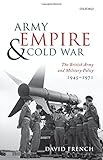
David French. Army, Empire, and Cold War: The British Army and Military Policy, 1945-1971. Oxford: Oxford University Press, 2012. x + 335 pp. $150.00 (cloth), ISBN 978-0-19-954823-1.
Reviewed by Brian Drohan (University of North Carolina Chapel Hill)
Published on H-Empire (May, 2013)
Commissioned by Charles V. Reed (Elizabeth City State University)
Caught in the Middle: The British Army between Cold War and Imperial Priorities
According to Winston Churchill’s memorable metaphor, British foreign affairs after the Second World War sat at the intersection of “three overlapping circles” of influential relationships--the United States, the British Empire, and Europe. As a component of foreign affairs, military policy and practice also fell into these three spheres. In the context of the current wars in Iraq and Afghanistan, as well as high profile court proceedings, such as the Mau Mau torture case, recent scholarship on post-1945 British military history has emphasized the second of Churchill’s “circles”--empire. Such studies as Caroline Elkins’s Imperial Reckoning: The Untold Story of Britain’s Gulag in Kenya (2005), David Anderson’s Histories of the Hanged: The Dirty War in Kenya and the End of Empire (2006), and Christopher Bayly and Tim Harper’s Forgotten Wars: Freedom and Revolution in Southeast Asia (2007) link the subfields of imperial and military history by exploring the brutal violence and bitter legacy of British counterinsurgency campaigns during decolonization. In 2011, David French, one of Britain’s most distinguished military historians, contributed to this literature with a comprehensive and richly detailed account entitled The British Way in Counter-Insurgency, 1945-1967. But French did not stop there. In Army, Empire, and Cold War, he pursues a more ambitious aim--producing a comprehensive study of British military policy and army composition in the context of both the Cold War and decolonization.
For French, the postwar British military experience involved more than colonial counterinsurgency. He sees postwar military history as fragmented--some studies discuss counterinsurgency, or the Suez Crisis, or nuclear weapons, but none truly combine these elements into a holistic account of the British army after World War II. Combining Cold War and decolonization perspectives, French finds that from 1945 to 1971 the British maintained a “Potemkin army” in which combating colonial insurgencies, maintaining large North Atlantic Treaty Organization (NATO) garrisons in Europe, and conducting expeditionary operations in such locations as Korea and Suez stretched the army beyond its capacity. He argues that in an era of declining defense budgets and recurrent economic crises, Britain found it increasingly difficult to afford its imperial and NATO commitments. Ultimately, French writes, policymakers “decided that maintaining a large and permanent military presence east of Suez was a game that was no longer worth the candle” (p. 307). By the late 1960s, the British army, reflecting broader social and political trends, prioritized European developments--including the Northern Ireland “Troubles”--rather than its former global empire.
To develop his analysis, French combines a state-oriented, political history approach with a broader social history focus on army recruitment, retention, organization, and soldiers’ experiences. French’s blend of “war and society” and “high policy” models allows him to explore the diversity of army experiences, ranging from the statesman’s decision-making context to the private soldier’s perception of army life. This also facilitates connections between Britain’s position in international affairs and its impact on individuals. For example, for much of the period French examines, the army relied on National Service--Britain’s first use of peacetime conscription--to fill the ranks. Conscription generated important social implications, eventually leading some members of Parliament to assert that the army was “dangerously out of touch with the realities of British life” and in dire need of reforming its pay scales, refurbishing accommodations, and improving its overall treatment of soldiers (p. 69). National Service was itself the product of Britain’s international environment. Cold War defense planning identified the challenge that in the event of war against the Soviets, Britain would not have time to raise and train new forces--it would have to create a pool of readily available, trained manpower. British planners intended for National Service to fill Territorial Army reserve formations. But the unanticipated scale of Britain’s postwar commitments overseas required the use of many National Servicemen in active operations in Malaya, Korea, and Kenya, for example. French’s combination of social and political history reveals connections between policy decisions, individual experiences, and their combined social implications that would have otherwise remained obscure.
Through this approach, French provides a revealing look at the British army’s role in foreign and defense policy as well as its relationship with postwar British society. Scholarly studies of decolonization have explored issues as wide ranging as settler colonialism, counterinsurgency violence, surveillance regimes and social control, intimate relationships in the formation of colonial identity, and the roles of race and class in forming imperial hierarchies. But few studies have examined the broad concerns of imperial and colonial history within the context of the constrained policy environment in which the British both fought to retain their empire and prepared to fight in Europe against the Soviet Union. Historians of empire will find the most value in his discussion of the resource constraints and policy trade-offs faced at the imperial center, but with reverberations felt throughout the empire. For a postwar policymaker, declining defense budgets and proliferating commitments influenced decolonization decisions at a “high policy” level. For the individual British soldier fighting colonial insurgents, poor training or poor equipment could result in the unnecessary death of a fellow soldier or innocent civilian. Ultimately, Army, Empire, and Cold War introduces a new perspective to imperial history by illuminating the extent to which the military’s changing relationship with society and enduring Cold War commitments influenced colonial circumstances.
If there is additional discussion of this review, you may access it through the network, at: https://networks.h-net.org/h-empire.
Citation:
Brian Drohan. Review of French, David, Army, Empire, and Cold War: The British Army and Military Policy, 1945-1971.
H-Empire, H-Net Reviews.
May, 2013.
URL: http://www.h-net.org/reviews/showrev.php?id=38973
 | This work is licensed under a Creative Commons Attribution-Noncommercial-No Derivative Works 3.0 United States License. |

