

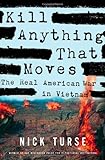
Nick Turse. Kill Anything That Moves: The Real American War in Vietnam. New York: Henry Holt and Company, 2013. 370 S. $30.00 (cloth), ISBN 978-0-8050-8691-1.
Reviewed by Heather M. Stur (University of Southern Mississippi)
Published on H-War (August, 2013)
Commissioned by Margaret Sankey (Air University)
“An Operation, Not an Aberration”: Atrocities in the Vietnam War
Among the objectives of the national Vietnam War fiftieth anniversaries commemoration series is to highlight advancements in military technology that developed from the American war effort in Vietnam.[1] Drones may very well be the legacy of Vietnam-era technological development, and reports of errant missiles that miss their targets remind us of war’s impact on civilians. Nick Turse has written a book that places the killing of Vietnamese civilians at the center of the Vietnam War story and argues that atrocities committed by U.S. troops against noncombatants were not isolated incidents; they were fundamental to the American way of war in Vietnam. It was not that random servicemen occasionally snapped and unloaded on a village; killing civilians was a routine order that came from on high, Turse contends. By writing this book, he hopes to compel readers to come to grips with the centrality of civilian suffering to the Vietnam War experience.
When Americans think about atrocities and the Vietnam War, what typically comes to mind is the My Lai massacre, which Americans have remembered as an anomaly. Turse argues that My Lai was one of many civilian massacres that American troops committed during the war--“an operation, not an aberration,” to quote Ron Ridenhour, the Vietnam veteran who helped expose My Lai. Combining research in the Vietnam War Crimes Working Group files, which are held at the National Archives, with interviews and a wide variety of published books and articles, Turse offers a disturbing blow-by-blow account of senseless murders of women, children, and elderly men. In Turse’s portrayal, the killing was methodical, and combat stress was not necessarily to blame. Turse notes that “rear-echelon guards operating under confusing orders or nonexistent rules of engagement” were those primarily responsible for the slaughter of children who sifted through garbage dumps near U.S. bases looking for food or things they could sell (p. 159). An anecdote that demonstrates the absurdity of the killing particularly well describes how a helicopter pilot lunged toward some Vietnamese women on bicycles and killed them with the skids for no apparent reason (p. 160). Although air power and technology allowed some servicemen a sense of detachment from the carnage, the brutality was usually up close and personal, and Turse includes more than one story of American men beating Vietnamese civilians to death with their bare hands. The points that Turse tries to get across are that atrocities were widespread during the Vietnam War, and not only were they known by military authorities, but they were also sanctioned by a strategy that relied on body counts as one of the measures of success.
In some ways, Turse has done us an important service. If there ever was a time in which we need a reminder of the destruction the United States caused in Vietnam, it is now. Until recently, the Vietnam War has served as a painful reminder of what happens when misguided policy decisions, lack of a clear goal, and racist contempt for both ally and enemy define a military engagement, but time seems to be causing that memory to fade. The fiftieth commemorations seek to portray U.S. intervention in Vietnam as noble and American military efforts as worthy of appreciation. Turse’s book forces us to acknowledge the revolting truth about what some American troops did to civilians in Vietnam. The book’s endnotes are thick with citations for the violence Turse describes, although a bibliography would have provided a helpful overview of the research that went into the project.
There are two significant problems, however, with this book. First, what Turse is presenting as “hidden history” has been public since before the war ended. From the Winter Soldier Investigation of 1972 to all of the published sources Turse uses to make his case, atrocities have been part of the public record on Vietnam for decades. There is something dishonest about Turse’s work because he positions it as groundbreaking even though it offers very little that is new. Even his discussion of why American servicemen slaughtered Vietnamese civilians is old news; Christian Appy described the dehumanizing experience of basic training on Vietnam War combat troops twenty years ago, and James Gibson explored the detached nature of technological warfare more than a decade ago. Susan Brownmiller, I, and others have examined the links between military machismo and sexual assault by U.S. troops against Vietnamese--and American--women. Turse cites some of these authors in his endnotes, so it is curious that he describes his findings as new when he relies heavily on published work.
The second overarching problem with the book is that Turse provides no context or analysis of the broader implications of the atrocities he details. What does the violence tell us about the American ways of war and diplomacy, American identity, and America’s place in the world? Turse bludgeons readers with shocking stories but offers no take-home message, which limits the book’s impact. It is a missed opportunity to guide readers in a frank conversation about what U.S. troops have done abroad. This is unfortunate in a time when the United States continues to engage in unending wars and develop military technology that makes civilian casualties less visible to those doing the killing.
Note
[1]. The United States of America Vietnam War Commemoration, http://www.vietnamwar50th.com/about/ (accessed July 2, 2013).
If there is additional discussion of this review, you may access it through the network, at: https://networks.h-net.org/h-war.
Citation:
Heather M. Stur. Review of Turse, Nick, Kill Anything That Moves: The Real American War in Vietnam.
H-War, H-Net Reviews.
August, 2013.
URL: http://www.h-net.org/reviews/showrev.php?id=38908
 | This work is licensed under a Creative Commons Attribution-Noncommercial-No Derivative Works 3.0 United States License. |

