

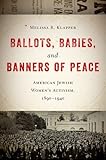
Melissa R. Klapper. Ballots, Babies, and Banners of Peace: American Jewish Women's Activism, 1890-1940. New York: New York University Press, 2013. xi + 290 pp. $39.00 (cloth), ISBN 978-0-8147-4894-7.
Reviewed by Caroline Light (Harvard University)
Published on H-Judaic (February, 2014)
Commissioned by Jason Kalman (Hebrew Union College - Jewish Institute of Religion)
What Is Jewish about American Jewish Women’s Activism?
In Ballots, Babies, and Banners of Peace, Melissa R. Klapper explores the activist trajectories of American Jewish women who “believed in [their] responsibility and power to make a difference not only to [their] own Jewish family and community but also to the wider world” (p. 2). Focusing on progressive movements for woman suffrage, birth control, and peace, Klapper provides a compelling portrait of Jewish women’s late nineteenth- and early twentieth-century efforts to navigate the intricate terrain of identity politics and to reconcile their religious, ethnic, national, and communal identities with their activist commitments during a time of significant change. In addition to her richly detailed narrative of the lives of activist heroines both famous and formerly unsung, Klapper, a scholar of U.S. history and author of Jewish Girls Coming of Age in America, 1860-1920 (2005) and Small Strangers: The Experiences of Immigrant Children in America, 1880-1925 (2007), also provides a broadly contextualized backdrop for the activists’ efforts. In their struggles for social justice, “Jewishness mattered” to these activists (p. 3), and they perceived their political efforts as a natural extension of their Jewishness, even in the face of the escalating anti-Semitism of the 1920s and 1930s. Klapper’s nuanced grasp of turn-of-the-century social movements frames her study of Jewish women’s involvement in the “cluster of feminist activity” that transformed the nation’s political terrain while simultaneously inflecting the character of Jewish gender norms (p. 4).
Ballots, Babies, and Banners of Peace provides an important view onto the interconnectedness of various movements that placed women’s citizenship and political empowerment at the center of broader struggles for social justice. The book proceeds chronologically as well as thematically, each chapter devoted to a particular activist field, with close attention to the ways in which each of the three were ideologically implicated in the others. Klapper begins with a general history of U.S. woman suffrage, weaving in the stories of individual Jewish women who made essential contributions to the movement. Efforts to win the right to vote provided the ideological foundation on which other feminist movements were positioned. Chapters 2 and 4 address reproductive rights and chapters 3 and 5 focus on the early twentieth-century peace movement. This organizational frame allows the author to illustrate change over time, tracing, for example, how birth control discourses shifted from a turn-of-the-century emphasis on grassroots mobilization around family planning and reproductive education, to a 1930s focus on legislative reform. Klapper reveals just how much cross-pollination there was between movements as activists participated simultaneously in multiple efforts for social justice.
The book is painstakingly researched, and the narrative is rendered in engaging detail. Useful subheadings differentiate and categorize the various intersections of identity and help signpost the larger historical context in which activist mobilizations took place. Klapper has consulted an extensive and dynamic combination of institutional records, such as documents from the National Council of Jewish Women (NCJW) and the Women’s International League for Peace and Freedom, as well as individual papers of activists both famous and less well known. She details many of the major political and social innovations of Jewish women’s organizing, such as the NCJW, “the major Jewish women’s organization in an era of American women’s large-scale organizing” (p. 8). She also provides a treasure trove of insights into the lives of relatively unsung activist heroines, like the immigrant mother of six, Rose Heiman Halpern, whose fiery spirit and multilingual eloquence made her an exemplary poster child for family planning, and Sarah Weil of North Carolina, who used her social clout and diplomacy to promote woman suffrage in the South.
An inclusive definition of Jewishness allows Klapper to address the contributions of a variety of women, some--like Lillian Wald and Emma Goldman--whose Jewish identification was minimal, and others--like Maud Nathan and Fanny Brin--for whom being Jewish comprised a principal feature of their political and private lives. The rich portraits of individual activists left me wondering where religious identity starts and ethnicity ends in the time period under study, and the extent to which an individual’s gender, class, and national origins influenced the process of ethnic identity formation. While Klapper highlights the lives of Jewish activists who could “hide their ethnic, religious, and cultural difference, [but] rarely chose to do so” (p. 3), I wondered about instances in which women subtly downplayed their differences while highlighting their universality--their similarity to other white, middle-class female progressive activists--in the interest of political efficacy. For example, to what extent might regional politics, such as the southern color line, influence Jewish women’s performances of ethnic difference, particularly when they found themselves among activist allies who espoused nativist sentiments that were popular in the early twentieth century? Similarly, I would have welcomed more of the author’s insights on the complex relationship between early twentieth-century feminism and eugenics. Klapper highlights the efforts of Hull House physician, Dr. Rachelle Yarros, to disentangle reproductive justice from scientific racism in the 1930s, but I wonder if activists in the earlier decades of the birth control movement were as critical of the ways in which discourses of selective breeding proved foundational to prevailing claims for women’s reproductive rights. The marriage of what we in the twenty-first century might call liberal politics with conservative or reactionary ideologies provides another vital quandary for the scholar of American women’s history.
The book might more accurately be titled “Ballots, Birth Control, and Banners of Peace,” as the actual title gives the impression that the book addresses Jewish women’s roles in passage of child-protective legislation, such as the Sheppard Towner Act and mothers’ pensions, or in the “better baby” crusades of the early twentieth century. But while the book’s emphasis on actual babies is scant, its focus on maternalist ideology, and the ways in which its reaffirmation of traditional gender roles “offered Jewish women a way to acculturate within a familiar framework” provides a crucial dimension that enhances the book’s contribution to histories of American women’s activism (p. 124).
By illuminating Jewish women’s contributions to mainstream social and political activism, the book fills an important scholarly gap. Just as Annelise Orleck’s Common Sense and a Little Fire: Women and Working-Class Politics in the United States, 1900-1965 (1995) contextualized four Jewish women’s radical activism in the broader labor movement, Klapper’s work provides a window onto the broader topography of turn-of-the-century progressive reform. This variegated lens on the way gender and ethnicity inflected Jewish women’s progressive reform stands as a major contribution to the historical record, providing a compelling view on a broad constellation of activist foci and the manifold ways in which they were connected ideologically. That Klapper contextualizes her stories of individual activists with rich big-picture analysis makes this book an excellent choice for teaching. I can imagine the book will find its place in college classrooms devoted to the study of American Jewish women, as well as courses more broadly addressed to women’s history and feminist activism. The author ultimately provides an eloquent and detailed set of answers not only to the question, “what’s Jewish about American Jewish women’s activism?” but also “how are struggles for social justice forged in the politics of identity?” In other words, Klapper provides yet more eloquent historical proof that the personal has always been political.
If there is additional discussion of this review, you may access it through the network, at: https://networks.h-net.org/h-judaic.
Citation:
Caroline Light. Review of Klapper, Melissa R., Ballots, Babies, and Banners of Peace: American Jewish Women's Activism, 1890-1940.
H-Judaic, H-Net Reviews.
February, 2014.
URL: http://www.h-net.org/reviews/showrev.php?id=38877
 | This work is licensed under a Creative Commons Attribution-Noncommercial-No Derivative Works 3.0 United States License. |

