

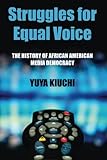
Yuya Kiuchi. Struggles for Equal Voice: The History of African American Media Democracy. Albany: SUNY Press, 2012. xviii + 324 pp. $85.00 (cloth), ISBN 978-1-4384-4479-6; $29.95 (paper), ISBN 978-1-4384-4478-9.
Reviewed by Kimberley Mangun (University of Utah)
Published on Jhistory (May, 2013)
Commissioned by Heidi Tworek (University of British Columbia)
A History of Cable Television in Boston and Detroit
Pop culture fans of a certain age may find it difficult to believe that Wayne’s World (1992) was released in theaters more than two decades ago. Based on a popular Saturday Night Live sketch that starred Mike Myers and Dana Carvey as characters Wayne Campbell and Garth Algar, the film popularized catchphrases (does “That’s what she said!” sound familiar?), helped resurrect Rob Lowe’s career, and made basement living seem cool. The plot was simple, but funny: “When a sleazy TV exec (Rob Lowe) offers Wayne and Garth a fat contract to tape their late-night cable-access show at his network, the two can’t believe their good fortune (‘No way.’ ‘WAY!’). But they soon discover the road from basement to big time is a gnarly one.”[1]
At the other end of the lowbrow/highbrow spectrum is C-SPAN (Cable-Satellite Public Affairs Network), the private, nonprofit company “created in 1979 by the cable television industry as a public service.” The stated mission “is to provide public access to the political process.”[2] But the company now offers broader programming to try to appeal to various demographics. For example, an original thirty-five-part historical series, “First Ladies: Influence and Image,” debuted on Feb. 18, 2013, and C-SPAN Classroom features a wide range of primary-source materials and videos, including a tour of the National Civil Rights Museum in Memphis.
The theme connecting these disparate examples is public access to cable. That was a key issue for the cities of Detroit and Boston in the 1970s and 1980s, when planners and organizers explored the feasibility of cable television. Yuya Kiuchi, an assistant professor in the Department of Writing, Rhetoric, and American Cultures at Michigan State University, discusses in his 2012 book the “extensive and city-specific studies” that were conducted to evaluate “how residents could benefit from the new technology” (p. 62). He writes that cable was seen as “something beneficial for African Americans” and other minorities living in Boston and Detroit due to training and employment opportunities and localized programming (p. 8). City officials and nonprofit groups believed that original shows focused on topics such as culture, religion, and history could help with community building, something that was sorely needed in both cities.
Kiuchi writes in Struggles for Equal Voice: The History of African American Media Democracy, that Detroit had become “one of the most segregated American urban areas” by the 1970s (p. 85). It also was in the throes of “social decay” due to poverty, deindustrialization, high unemployment rates, and lack of education (p. 85). Cable television was seen both as “a potential locus of African American social uplift” and a “solution to negative Black images on television” (p. 87).
Meanwhile, Boston had its own problems. Kiuchi writes that the city experienced an economic downturn in the 1950s, when people moved from the city to the suburbs and mills and manufacturing industries closed or moved elsewhere. Two decades later, the city “show[ed] little, or no, evidence of approaching economic recovery,” and “suffered from lingering racial problems such as school segregation and boycotting” (p. 65). As in Detroit, cable television was seen as a way to rectify problems in communities of color. Kiuchi writes that city officials and community organizers decided to “identify how exactly the public could take advantage of the community-based media format and invert the relationship between producers and consumers” (p. 69).
Kiuchi chose Boston and Detroit for his comparative analysis due to the cities’ similarities as well as differences. For example, he describes the former as “a major hub of intellectualism with numerous universities and hospitals”; Detroit, on the other hand, “is a representative case of African American self-sufficiency” (p. 13).
The brief histories are offered as contextualization for the cities’ desire to use cable television as a tool for revitalizing their economies. For example, Kiuchi discusses how Detroit’s officials envisioned new employment opportunities: the selected franchise would be required to hire minorities and women “to the maximum extent possible in the construction and management of the system” (p. 101). Officials in Detroit as well as Boston also desired community involvement. Boston Cablevision Systems in its application pledged to reserve as many as fourteen channels for public access, which would enable “minorities, women, ethnic groups, the elderly, youth, handicapped and disabled citizens [to] develop programs to serve their information needs” (p. 115). Two other historical chapters in Struggles for Equal Voice offer a literature review of African American representation and/or participation in movies and television shows and cable television.
In the final chapter, Kiuchi briefly assesses the promises that Cablevision (selected to serve Boston) and Barden Cablevision (which signed a franchise agreement with Detroit) made regarding construction, employment, training, and programming. A more critical analysis here--and perhaps interviews with community participants--would have helped to support the author’s focus on self-improvement, self-image, and “the relationship between African American empowerment and the media” (p. 5).
Kiuchi is to be commended for exhaustively outlining in chapters 3, 4, and 5, the cities’ request for proposals (RFPs) as well as the contents of the applications filed by companies that hoped to win the bid to be the sole cable provider for each city. Poring through the documents, some of which numbered hundreds of pages, must have been at once interesting, challenging, and frustrating.
Unfortunately, extensive summaries of the RFPs and applications silence the very voices that Kiuchi had aimed to include in his book. A key theme--“the proactive engagement of African Americans in media”--doesn’t come through in the long chapters (chapter 4 is daunting at nearly seventy pages). Moreover, readers may find little evidence to support the author’s conclusion that “the history of the introduction of cable television to Boston and Detroit was a history of African Americans successfully acquiring access to the technology in front of both the television set and the television camera, as well as behind the camera” (p. 252). More significantly, despite the book’s title, it is not “the history of African American media democracy,” but rather a case study of Boston and Detroit and the extensive, and often contentious, process each underwent to identify a cable provider that would adequately address city-specific goals.
It is important to note that this book began as a 2009 dissertation; it appears that Kiuchi made few changes to the dissertation before it was published. At a minimum, judicious editing and careful proofreading would have helped the dissertation-turned-book. Many typographical errors and misspelled names, and considerable overuse of the word “also” affect the book’s readability and potential for adoption in undergraduate or graduate courses about broadcast or television history.
Notes
[1]. Wayne’s World, Amazon.com, http://amzn.to/YohinN (accessed February 16, 2013).
[2]. “What is C-Span?,” C-SPAN company Web site, http://www.c-span.org/About/About-C-SPAN/ (accessed February 16, 2013).
If there is additional discussion of this review, you may access it through the network, at: https://networks.h-net.org/jhistory.
Citation:
Kimberley Mangun. Review of Kiuchi, Yuya, Struggles for Equal Voice: The History of African American Media Democracy.
Jhistory, H-Net Reviews.
May, 2013.
URL: http://www.h-net.org/reviews/showrev.php?id=38866
 | This work is licensed under a Creative Commons Attribution-Noncommercial-No Derivative Works 3.0 United States License. |

