

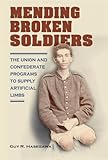
Guy R. Hasegawa. Mending Broken Soldiers: The Union and Confederate Programs to Supply Artificial Limbs. Carbondale: Southern Illinois University Press, 2012. 160 pp. $24.95 (cloth), ISBN 978-0-8093-3130-7.
Reviewed by Sarah Handley-Cousins (University at Buffalo SUNY)
Published on H-CivWar (August, 2013)
Commissioned by Hugh F. Dubrulle (Saint Anselm College)
Repairing the "Melancholy Harvest"
Several years ago, I attended a small Civil War reenactment on a college campus. Visitors browsed through several small displays, but the one that garnered the most attention belonged to a surgeon. He and his assistant deftly “amputated” a leg, replicating the stomach-turning sound of the operation by sawing through pieces of wood and metal piping. Spectators were drawn to the scene and watched with a combination of fascination and horror. There was something about the imagined surgery that seemed to evoke an intrinsically Civil War experience.
In recent years, amputation has captured the attention of historians as it did those reenactment visitors. Several historians have begun to consider the issues that arose from the physical destruction of the Civil War. Most works have focused on the postbellum period, examining the issues that faced amputees as they tried to reintegrate into a civilian society. Several historians have considered how the bodily disarticulation caused by the war affected the creation of Civil War memory. Brian Jordan, Jalynn Olsen Padilla, and Frances Clarke, for example, have all investigated the essays written by the contestants of William Oland Bourne’s left-handed writing contests, held in 1866 and 1867, and have drawn important conclusions regarding amputees’ attitudes toward their disabilities, the war, and reunification. Other historians have considered the anxiety expressed by the American public at the specter of so many disabled men returning home--could they work? Would they be marriageable? How should their government repay veterans who had made such a sacrifice?[1]
Guy R. Hasegawa’s new work Mending Broken Soldiers adds an important dimension to the conversation. While recent attention to amputees has focused on the social, cultural, and political reactions to amputation after the conclusion of the war, very little exists that explains the practical consideration taken to provide amputees with prosthetic limbs during the war years. Hasegawa attempts to fill that gap by detailing both the Union and Confederate programs to provide artificial limbs between 1861 and 1865.
Hasegawa begins with an examination of the foundations of the American prosthetics industry. The manufacture of artificial limbs was by no means new when war was declared. The first patent for a limb was issued in 1846 to B. Frank. Palmer, an amputee who became a well-known prosthetic manufacturer. Over the next two decades, many new manufacturers entered the market, each with slightly different designs for their limbs. Some made their artificial legs out of vulcanized rubber, arguing that the material lasted longer than the traditional wood. Palmer apparently wrapped his wooden arms in “delicate fawnskin,” while his great rival, Douglas Bly, covered his with a “delicate tinted flesh-colored enamel, shaded to suit each particular case” (p. 13). Still others crafted limbs from brass, steel, rawhide, and even whalebone. Most of the limbs were articulated, meaning they had functioning joints, but a few experimented with lateral motion ankles or movable fingers. The proliferation of limbs in the antebellum years led to fierce competition. Manufacturers published advertisements in popular newspapers and magazines that boasted endorsements from well-known amputees or respected physicians, giving the growing industry increasing visibility.
When Congress passed an act to provide limbs to Union amputees in 1862, the competition between Northern manufacturers grew more intense. Congress designated $15,000 (a small figure compared to subsequent years) to purchase legs, and tasked Army Surgeon General William A. Hammond with deciding how to best use the sum. Hammond created a committee of several of the best military and civilian surgeons in the country to evaluate artificial legs, decide on price points, and choose what kind of prosthetics to provide. Should they keep it simple with plain pegs, or consider the more modern articulated models? After much deliberation, they finally agreed upon five manufacturers, B. Frank. Palmer, Douglas Bly, E. D. Hudson, William Selpho, and Benjamin Jewett, to provide articulated limbs at fifty dollars each. Despite his efforts, William Hammond was ousted by Edwin Stanton in 1863 and replaced with Joseph K. Barnes, who faced a nearly identical challenge when he was required to choose arm manufacturers.
Perhaps the most fascinating story in Hasegawa’s volume is the surprising saga of the attempt to supply limbs in the Confederacy. Many historians would have focused their energies on examining the policies of either the Union or the Confederacy, but Hasegawa does an admirable job of exploring both. The result is an important comparison between the two programs and, by extension, the two governments. When the Confederate Congress failed to make a decision regarding the provision of limbs in 1863, Mississippi minister Charles K. Marshall founded the Association for the Relief of Maimed Soldiers (ARMS). ARMS became the sole provider of prosthetic legs to Southern soldiers, without any recognition or assistance from the Confederate government, and run, essentially alone, by its secretary, William Allen Carrington. Since the South only had two limb producers, neither of which produced arms, Carrington faced a complicated undertaking. Carrington was able to secure two leg manufacturers, James E. Hanger and G. W. Wells, though at significantly higher prices than those paid by the United States to Northern manufacturers. Ironically, ARMS was never able to provide any artificial arms.
What is most compelling about the story of ARMS is that its struggle is emblematic of the larger problems of the Confederacy. “Indeed,” Hasegawa writes, “the South’s artificial-limb makers faced the same obstacles that hindered the Confederacy’s other businesses: a scarcity of skilled workers, shortages of vital materials, and ever-increasing prices”(p. 57). Conscription made it incredibly difficult to maintain a workforce with the skills to create artificial limbs, and although exemptions were supposedly allowed for work details, the dire military straits of the Confederacy in 1864 and 1865 made these details scarce. Carrington’s manufacturers struggled so much to get raw materials that he pleaded with J. Marion Sims to “procure files, brass wires for springs--gutta percha or india rubber, & some of the other constituents of the legs” while the physician was in Paris (p. 59). ARMS agents worked somewhat successfully to solicit donations, but these weren’t enough to cover the organization’s expenses. Carrington hoped to get state governments to reimburse ARMS for providing their soldiers with artificial limbs, but was never successful. According to Hasegawa, several states promised donations, but only Louisiana actually gave money. Carrington, along with several other ARMS officers, had to pour their own money into the ARMS coffers to keep it afloat. On March 11, 1865, the Confederate Congress passed a “Bill for the Relief of Maimed Soldiers,” which, among other provisions, exempted ARMS from manufacturer’s taxes, gave them access to materials at cost, and secured them skilled workers on details. This would have made a tremendous difference for the organization, but the bill was passed just weeks before the final defeat of the Confederacy. The record of ARMS ends on March 31, 1865.
In the final chapter of Mending Broken Soldiers, Hasegawa compares the Union and Confederate programs to supply limbs and argues convincingly that despite its many disadvantages ARMS matched the Union program in limb distribution during its short fifteen months of operation. The two Confederate producers were able to nearly outpace four of the five Union manufacturers in their production of legs, despite their struggle to obtain materials. However, what is missing is a discussion of how much ARMS could have accomplished if the Confederate government had only found the needs of its disabled soldiers of national importance. This shortcoming on the part of the South calls to mind Stephanie McCurry’s arguments in Confederate Reckoning: Power and Politics in the Civil War South (2010) regarding the Confederacy’s reluctance to provide support for its women, while using the same women as a crucial part of the ideological underpinning of the war itself. Hasegawa’s work suggests that Southern politicians saw soldiers in much the same way. The Confederacy depended upon the bodies of men to fill its gray uniforms, yet dragged its feet to help when those bodies returned, broken, from the war.
Hasegawa’s description of the continuing efforts to provide limbs to Union veterans under the Civil War pension system also raises important points. In 1870, legislation made it possible for veterans to receive an artificial limb, or its monetary value, every five years. Hasegawa’s examination of the number of limbs issued during that period shows that veterans overwhelmingly chose commutation payments instead of new prosthetics, suggesting that veterans were more likely to find themselves in need of money rather than another limb. Further, Hasegawa reminds us that aside from pension payments, limbs, and commutation funds, “a veteran with an artificial limb could not look to the government for assistance in mastering his prosthesis, finding a job, or dealing with the other difficulties that attended his injury” (p. 79). Civilians and politicians made much of their ability to “mend broken soldiers,” but it would take far more than an artificial limb to do that.
Hasegawa has filled a gap in the literature on disability in the Civil War era, and the accompanying database of soldiers who received limbs will be a great asset to students and scholars. While this book focuses more on relaying facts than on drawing conclusions, Hasegawa raises important points that will inspire future scholars to ask new questions about disability, the state, and the Civil War.
Note
[1]. For more on Civil War amputees, see Brian Matthew Jordan, “Living Monuments:” Union Veteran Amputees and the Embodied Memory of the Civil War,” Civil War History 57, no. 2 (June 2011); Jalynn Olsen Padilla, “Army of Cripples: Civil War Amputees, Disability and Manhood in Victorian America” (PhD diss., University of Delaware, 2007); Frances Clarke, War Stories: Suffering and Sacrifice in the Civil War North (Chicago: University of Chicago Press, 2012); Lisa Herschbach, “Fragmentation and Reunion: Medicine, Memory, and Body in the American Civil War” (PhD diss., Harvard University, 1997); James Marten, Sing Not War: The Lives of Union and Confederate Veterans in Gilded Age America (Chapel Hill: University of North Carolina Press, 2011); and Megan Kate Nelson, Ruin Nation: Destruction and the American Civil War (Athens: University of Georgia Press, 2012).
If there is additional discussion of this review, you may access it through the network, at: https://networks.h-net.org/h-civwar.
Citation:
Sarah Handley-Cousins. Review of Hasegawa, Guy R., Mending Broken Soldiers: The Union and Confederate Programs to Supply Artificial Limbs.
H-CivWar, H-Net Reviews.
August, 2013.
URL: http://www.h-net.org/reviews/showrev.php?id=38839
 | This work is licensed under a Creative Commons Attribution-Noncommercial-No Derivative Works 3.0 United States License. |

