



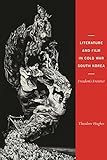
Theodore H. Hughes. Literature and Film in Cold War South Korea: Freedom's Frontier. New York: Columbia University Press, 2012. xi + 271 pp. $55.00 (cloth), ISBN 978-0-231-15748-3; ISBN 978-0-231-50071-5.
Reviewed by Christopher Grieve (University of North Dakota)
Published on H-War (November, 2013)
Commissioned by Margaret Sankey (Air University)
If the Cold War was at least partially a battle between communism and liberal democratic capitalism for “hearts and minds” , then cultural analysis may be somewhat more germane to the subject of military history than is normally the case. As Korea was one of the early flashpoints, and a central location, of Cold War conflict, an understanding of mid-twentieth-century Korean cultural development is necessary for a more thorough view of Korean history, the ways in which the super-powers tried to mold world opinion, and the general course of the Cold War. Theodore Hughes’s Literature and Film in Cold War South Korea is a dense, incredibly sophisticated analysis of literary and visual culture that provides meaningful insight into how South Korean cultural producers navigated the Cold War Manichean ethos, the division of the peninsula, and neocolonialist domination under United States developmentalist theory and practice. By doing so, this work opens new doors for interpreting the subtle, and often overlooked, ways in which the Cold War was fought within the cultural field in East Asia.
Hughes argues that post-1945 South Korean authors and filmmakers organized much of their work around the repudiation of three main themes: a government-imposed ban on Japanese colonial period left-wing literature, most significantly that of the Korean Artists Proletarian Federation (KAPF); the suppression of memories of mobilization and imperialization in the 1930s and 1940s; and the expurgation and “othering” of the North. Because of these limits about what and how subject matter could be seen and discussed, it is difficult for scholars to fully assess how Cold War South Korean cultural producers viewed the cultural productions from the Japanese colonial period and how they affected their worldview and identifications. Hughes found that it is possible to access what was forbidden to discuss openly through an examination of the relationship between the verbal and the visual, or the way in which words evoke meaningful images and how images invoke particular ideas. Many of these relationships were transferred from the colonial period, allowing cultural producers to discuss forbidden topics, authors, or works without violating governmental and societal restrictions. The discussions were within the proper bounds of discourse, but the ways that they were presented, the language used, and the images invoked, at times alluded to banned cultural movements, and authors. According to Hughes, “[p]ost-1945 cultural production in South Korea cannot be understood without looking at what was excised, alluded to, or appropriated in different ways--the literary, artistic, and filmic movements of the Japanese colonial period (1910-1945)” p. (2). In the end, South Korean authors and filmmakers used these relationships to critique authoritarianism in the government, examine their relation to the United States, evaluate the effects of developmentalism upon the economy and society, and define what it meant to be ethnically Korean while nationally South Korean.
As literary and cultural analysis, Literature and Film does an excellent job tracing the progress of discussions about ethnonationalism, modernism, developmentalism, and colonialism from the early Japanese colonial period through 1970s developmentalist South Korea. It artfully analyzes the main literary works of the period and brings out some suppressed and neglected items from the past, which Hughes convincingly argues had significant impacts upon later works and interpretations. He uses keen insight to dissect and isolate particular types of imagery and symbolism, which served as the foundation for these discussions, following them through periods and across genres. It is a remarkable feat that requires the balancing of a dizzying array of complex theoretical concepts with deep insight into literary and filmic presentation and allusion. While these strengths do add up to create an important addition to the historiography, the thickly layered theory, complicated argument, and difficult language limit the potential audience for this work to a handful of experts in the field.
One oversight in Literature and Film is the lack of analysis about the reception that the literary and visual culture under consideration received among the public. Because Hughes provides no gauge for how these works were received, interpreted, and understood, there is no clear way to assess their effects on the politics, economy, familial life, or any other aspect of South Korean society. Literature and Film lays out significant evidence that developmentalist South Korean cultural production drew significantly from colonial period verbal/visual relationships. However, Hughes does not provide the necessary context to describe how those common themes and ways of seeing impacted the course of Korean history. Thus, a reader who does not already understand the greater context in which the work fits is left wondering why the influence of discussions about the colonial modern upon the creation of film and literature in developmentalist Cold War South Korea is of such great import.
If there is additional discussion of this review, you may access it through the network, at: https://networks.h-net.org/h-war.
Citation:
Christopher Grieve. Review of Hughes, Theodore H., Literature and Film in Cold War South Korea: Freedom's Frontier.
H-War, H-Net Reviews.
November, 2013.
URL: http://www.h-net.org/reviews/showrev.php?id=38760
 | This work is licensed under a Creative Commons Attribution-Noncommercial-No Derivative Works 3.0 United States License. |

