

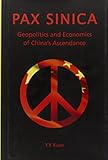
Y. Y. Kueh. Pax Sinica: Geopolitics and Economics of China's Ascendance. Hong Kong: Hong Kong University Press, 2012. 400 pp. $45.00 (cloth), ISBN 978-988-8083-82-4.
Reviewed by Zhiqun Zhu (Bucknell University)
Published on H-Diplo (September, 2013)
Commissioned by Seth Offenbach (Bronx Community College, The City University of New York)
Pax Sinica: Geopolitics and Economics of China’s Ascendance, by Hong Kong economist Y. Y. Kueh, contains slightly revised articles published between 1993 and 2009 in various academic journals. It chronicles China’s rapid ascendance as an economic giant and its gradual integration into the international economic system from the late 1970s through 2010, with focus on key junctures in China’s economic development including its opening up and reform initiatives, the creation of the “Greater China” growth triangle, the Asian financial crisis, China’s World Trade Organization (WTO) membership, and the changing economic landscape and realignment of productive forces in the Asia-Pacific region. The chronological study is complemented with topical analysis of key issues such free trade agreements between China and other economies and integration within Asia Pacific Economic Cooperation (APEC).
Unlike most interpretations that use the Third Plenary Session of the 11th Central Committee of the Chinese Communist Party (CCP) in 1978 as the turning point in China’s economic and political transition, Kueh argues that China’s opening up strategy started with the April 1971 “ping pong diplomacy” and President Richard Nixon’s February 1972 visit to China. It was the geopolitical imperative of China in the early 1970s under Mao Zedong and Zhou Enlai to open up and reach out to the United States that eventually gave rise to Deng Xiaoping’s vigorous push for China’s modernization and liberalization beginning in the late 1970s. In the following three decades China was able to take advantage of the relative peaceful regional environment to eventually emerge as the largest economy in Asia and the second largest in the world.
The book provides a detailed study of China’s growth trajectory and its implications, especially how Greater China (the PRC, Hong Kong, and Taiwan) has become increasingly interdependent economically and how the rise of China has fundamentally changed the geo-economic and geopolitical landscape of the Asia-Pacific region. The author does a fine job in discussing the delicate interplay between economic priorities and geopolitical dynamics. He contends that economic imperatives have often, if not always, prevailed over geopolitics in the Asia-Pacific political economy in the past thirty-plus years. Economic construction as the core of China’s modernization drive since 1978 has clearly yielded extraordinary outcomes.
The book covers several significant developments associated with China’s rapid growth, such as Guangdong’s becoming the fifth “dragon” economy largely thanks to its proximity to Hong Kong and Southeast Asia and the Special Economic Zones established in 1980; Hong Kong’s economic and political transformation after the 1997 transfer of sovereignty; the impact of the 1997 financial crisis on Greater China; China’s admission into the WTO after more than sixteen years of negotiations with the United States; and the 2010 Economic Cooperation Framework Agreement (ECFA) between Taiwan and China that further spurred trade and promoted economic integration across the Taiwan Strait. All these developments have been integral to China’s rise to great economic power status, leading many, including the author of this book, to believe that a Pax Sinica is on the horizon.
Though the author is cautious about the imminent advent of a Pax Pacifica dominated by China, he seems quite upbeat about the continued growth of Greater China and the eventual arrival of a Pax Pacifica with China at its center (or “Pax Sinica” as the book title suggests) interfacing with Pax Americana and Europe.
A great strength of the book lies in the author’s interdisciplinary approach to analyzing China’s phenomenal growth and its significance. His simple argument is convincing that geo-economics and geopolitics have worked together to help China transform itself from a poor Third World country into a major political and economic force on the world stage.
Kueh is optimistic about further integration of the Greater China growth triangle, following the mainland’s signing of Closer Economic Partnership Arrangement (CEPA) with Hong Kong in 2003 and the ECFA with Taiwan in 2010. With Japan and South Korea also shifting closer to China economically and trading more with China than they do with any other country, a North APEC agglomerated economic entity is being formed. As the author suggests, even Mongolia might be motivated to board the bandwagon of trade and development. A North APEC proper has become a formidable force in international political economy. On the other hand, in Southeast Asia, with the signing of the Association of Southeast Asian Nations (ASEAN) 10 plus 1 (China) free trade agreement in 2002 and its formal launch in 2010, a South APEC proper is being formed. The author confidently predicts that the North-South APEC proper synergy will shape the realpolitik of the Asia-Pacific region in the future (p. 13).
This is a panoramic, somber, and thought-provoking study of China’s economic growth and Asian integration in the past thirty years from a geopolitical perspective. The author should be commended for his clear and cogent argument and presentation. The interdisciplinary approach adds a new perspective to the existing literature about how China has grown from a backward poor economy to a prosperous global power.
Despite the author’s success in making his argument and analysis in a coherent way, the book contains several weaknesses. First of all, as a collection of previously published essays which were only slightly adapted for this book, much of the data in most chapters was outdated. For example, the Greater China economic triangle is a key part of the book and there are several chapters on the topic. Unfortunately there are no updates about the growth triangle in the past decade, especially after the signing of CEPA and ECFA. The chapter about the emergence of the growth triangle was first published in 1993 (chapter 2), and chapters on how Hong Kong and Greater China fared during the Asian financial crisis were published in 2000 and 2001, respectively (chapters 6 and 7). An update on the complex interplay of the three economies since 2001 would add much value to the study.
Secondly, Professor Kueh highlights China’s success and seems very positive about China’s continued rise, without paying sufficient attention to the problems China’s development has created and the challenges and obstacles ahead before China can fully develop its potentials. This important aspect is neglected in the analysis. In fact, China’s economic growth began to sputter in 2012, with far-reaching impact on China itself and the world economy.
Internally, China faces tremendous challenges such as a growing income gap, a worsening environment, rampant corruption, declining morality, etc., which will all impede China’s further growth. Externally, Kueh may be right that geopolitical clashes such as Diaoyu/Senkaku and the South China Sea dispute are unlikely to erupt into large-scale military confrontations, but one should not belittle such serious obstacles to further economic and political integration in Asia.
Indeed, security challenges have become very grave in Asia now. North Korea, led by the young Kim Jong-un, exploded its third nuclear device in February 2013. The Six-Party Talks on denuclearization have stalemated since 2007. The China-Japan relationship has sunk to its lowest ebb in recent history, ostensibly owing to their territorial dispute over a few small, uninhabited islands. Some Japanese politicians’ unrepentant attitude toward Japan’s wartime history has complicated its diplomacy with its neighbors and the United States. On the other hand, several Southeast Asian nations and India complain that they are facing an increasingly assertive China, as evidenced in Beijing’s handling of the South China Sea dispute and the border issue with India. Although the likelihood of a major military conflict on the Korean Peninsula or between China and a neighboring country remains slim, such recent developments do not bode well for regional integration.
Thirdly, Kueh seems to have downplayed the importance of the United States in the political economy of the Asia Pacific. He notices that the United States continues to enjoy more popularity than China in the region, but fails to explain why. The hard truth is that China has not become a trusted great power in the eyes of many of its small neighbors, who all welcome America’s continued presence in Asia. The Asia Pacific is undergoing profound changes as China rises. Most in the region face a paradox: their prime trade and economic connections are with China, but many countries look to the United States for their principal security relationship. For a long time to come, this dual-track arrangement--with China serving as the major engineer of economic growth and trade and the United States continuing to provide security guarantee to countries in the region--will be the main feature of the Asia-Pacific political economy.
Fourthly, his interpretation of the U.S. “pivot” to Asia and the Trans-Pacific Partnership (TPP) is questionable. He is highly critical of Secretary of State Hillary Clinton and President Barack Obama’s “rebalance” toward Asia and seems to suggest that the United States is out of touch with the geopolitical and geo-economic reality of Asia. He thinks Secretary Clinton’s remarks about America’s “return” to Asia sound like “anti-China rallying” and are “highly provocative” (p. 368). However, many observers agree that America’s “return” to Asia is a policy readjustment out of its own economic and strategic interests, and countering China’s development is not a major motivation.[1] Both the United States and China seek cooperation in their relationship and no country in the region wants to see a head-on clash between the two big powers. As far as the TPP is concerned, more recently, the United States has welcomed China’s participation in this economic and trade group, and China has expressed its interest, too. This is contrary to Kueh’s perception that the TPP is exclusive and has a geopolitical overtone as a tactical approach to counterweigh China’s rise within the Asia Pacific (p. 372).
Finally, “Greater China” remains an economic concept and political integration among the three is highly unlikely in the near future given the huge political and institutional gaps. Though Professor Kueh has painstakingly chronicled the economic integration among the three Chinese economies, political developments make further integration extremely difficult and perhaps impossible in the short run. Both Taiwan’s ruling party, the Kuomintang (KMT), and the biggest opposition party, the Democratic Progressive Party (DPP) consider Taiwan a separate entity from the mainland and have vowed to preserve Taiwan’s distinct identity. Even the CCP under the leadership of Xi Jinping now seems to understand that a political union cannot be forced upon Taiwan. In Hong Kong, the “one country, two systems” formula has largely worked despite some misgivings. What has complicated the Hong Kong-mainland relationship is that the demand for universal suffrage has been on the rise and popular elections for the territory’s chief executive may be held as early as 2017, creating an even larger political difference between Hong Kong and the mainland. Despite his cautiousness, Professor Kueh is probably too sanguine about the Greater China political integration when he claims that “[e]conomic integration is essentially a process of unification” (p. 15).
Nevertheless, the above-mentioned shortcomings should not diminish the value of this research. Overall Professor Kueh’s book is a solid study of China’s trajectory to rise over the past thirty-plus years and should be recommended reading for students of Chinese and Asian economics and politics, international business, and integration studies.
Note
[1]. See, for example, Shawn Brimley and Ely Ratner, “Smart Shift,” Foreign Affairs (January/February 2013).
If there is additional discussion of this review, you may access it through the network, at: https://networks.h-net.org/h-diplo.
Citation:
Zhiqun Zhu. Review of Kueh, Y. Y., Pax Sinica: Geopolitics and Economics of China's Ascendance.
H-Diplo, H-Net Reviews.
September, 2013.
URL: http://www.h-net.org/reviews/showrev.php?id=38633
 | This work is licensed under a Creative Commons Attribution-Noncommercial-No Derivative Works 3.0 United States License. |

