



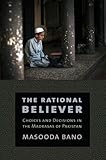
Masooda Bano. The Rational Believer: Choices and Decisions in the Madrasas of Pakistan. Ithaca: Cornell University Press, 2012. xii + 250 pp. $39.95 (cloth), ISBN 978-0-8014-5044-0.
Reviewed by Usha Sanyal (Queens University of Charlotte)
Published on H-Asia (November, 2013)
Commissioned by Sumit Guha (The University of Texas at Austin)
Rational Choice and Madrasa Education
This book is written in a post-9/11 context, in which a number of foreign policy experts have pointed fingers at Pakistani madrasas as centers of jihad against the West. Among others, Masooda Bano mentions Jessica Stern's essay, "Pakistan's Jihad Culture," published in Foreign Affairs in 2000, which asserts that South Asia has replaced the Middle East as the leading locus of world terrorism, and the International Crisis Group, which published a series of reports from 2002 to 2007 linking Pakistani madrasas with global terrorism.[1] Specialists in South Asian studies and Islamic studies (historians, political scientists, and others) have presented data that contest these claims in books of their own (e.g., Barbara M. Metcalf, Islamic Revival in British India: Deoband, 1860-1900 [1982]; Mareike Jule Winkelmann, From "Behind the Curtain": A Study of a Girls' Madrasa in India [2005]; and Arshad Alam, Inside a Madrasa: Knowledge, Power and Islamic Identity in India [2011]). Alam, writing about madrasas in India, points out that "the process of 'othering'" that takes place in a madrasa focuses more on fellow Muslims than on non-Muslims. "Thus, assuming that madrasas preach hatred towards non-Muslims is simply erroneous."[2]
Bano contributes to this debate in the present book, The Rational Believer, by looking closely at the motivation of people associated with madrasa education in Pakistan, whether as founders, scholars, teachers, parents, or students. She argues that religious actors must be seen as acting rationally, and to understand their motives, we need to listen carefully to their own voices and perspectives. With this in mind, she conducted extensive fieldwork in different parts of the country over an eighteen-month period (in 2007-2008), with data from a representative sample of 110 madrasas in eight different districts. Her goal was to provide both a macro and a micro view of the subject, taking into account rural-urban variations across all four provinces, as well as two regions with a dense madrasa presence, namely, Khyber Pakhtunkhwa and Multan in southern Punjab. In addition, given the recent surge in madrasas for girls, she looks at female madrasas in one chapter.
Bano uses the framework of New Institutional Economics (NIE) to structure her study. NIE began as an inquiry into the factors governing economic decision making by profit-seeking individuals but soon expanded beyond that to encompass the complexities of decision making resulting from historical, cultural, psychological, and other constraints on "rational" economic behavior. Bano sees NIE as a promising approach--in contrast to structural-functionalism and rational choice theory--on account of its interest in understanding institutions and how they constrain economic and political outcomes, how they operate, and how they change over time. Distinguishing between formal and informal institutions is key to NIE's mode of analysis, as elucidated by Douglass C. North in Institutions, Institutional Change and Economic Performance (1990), and to Bano's methodology. Overall Bano's work demonstrates the strength of Pakistani informal institutions, such as madrasas, in contrast to formal state institutions.
In part 1, chapter 2, Bano makes an interesting but surprising comparison between Oxford University from its inception in the thirteenth century and three leading madrasas in eighteenth- and nineteenth-century South Asia--namely, Farangi Mahall in Lucknow, Madrasa-i Rahimiyya in Delhi, and Dar al-Ulum at Deoband. In chapter 3, Bano turns to a comparative survey of madrasas in Pakistan, India, and Bangladesh in order to answer the question why inefficient institutions persist through time, and to examine existing theories of "path dependence" (i.e., institutions are shaped by their previous histories and resist change). Because the postcolonial governments of Pakistan, India, and Bangladesh have been led for the most part by secularists who regarded madrasas as impediments to their modernization goals, Bano argues, an adversarial relationship between the two was set up, with governments trying to persuade madrasas to accept curricular reform in the face of ulama opposition. Bano shows that even when madrasas do accept government-directed reforms, as in Aliya madrasas in Bangladesh, their graduates do not enjoy public respect. Because these madrasas' relations with the community around them are poorly developed and their students' knowledge of Islamic texts is less comprehensive than that of students in traditional (Qaumi) madrasas, they have no influence with the ulama. Second, Bano shows that the reason the madrasas in the three countries failed to accept government-initiated reforms was that their goals were different. While the Aliya madrasas want to secularize the madrasas, the ulama want to "improv[e] the quality of religious learning" within the madrasas (pp. 56-57).
Here, I think an interesting comparison could have been made with Iqra schools, an experiment in hybrid or "integrated" education in Pakistan, discussed in chapter 5, that has been very successful. The difference between Aliya madrasas and Iqra schools lies not only in the social class of students (Aliya students are presumably largely middle class while Iqra schools are geared for well-to-do, upper-class Pakistanis). But they also appear to be coming to the same place from different starting points: secularization of madrasas in the first case and teaching memorization of the Quran and akhlaaqiaat (moral education) to students whose main focus is on secular subjects. What accounts for the high success rate of the second, but not the first?
Bano's discussion of madrasa education in Pakistan, beginning in chapter 4, is detailed and insightful in many ways. In chapter 4, she argues that the madrasa hierarchy in Pakistan, which is pyramidical in structure, has not been sufficiently recognized by scholars. Bano shows that the competition between madrasas, and the ulama within them, to rise to the top tier (she identifies four tiers, ranging from those that offer research opportunities to those in which students simply memorize the Quran) is similar to that of secular educational institutions globally. For a scholar to rise to the top echelons of the religious hierarchy, he must possess a combination of "caliber" and "capital," and attract the patronage of those in business, the government, and presumably the army (p. 77). Here again, the larger point is that the madrasa system is "rational."
In this chapter, she also discusses the five waqafs in Pakistan, based on the major schools of thought (Deobandi, Barelwi, Ahl-i Hadith, Jama`at-i Islami, and Shia), and their important function in representing the interests of all Pakistani madrasas vis-à-vis the government. She argues that this collective platform (created between the 1950s and 1980s by each of the five groups) has been a great source of bargaining strength in protecting rights that the madrasas care about (such as curricular reform) and has also brought the five groups together in collective action against a common foe despite a history of intergroup rivalry. However, there is no real discussion of the inter-waqaf rivalries and to what extent these have affected the madrasas' ability to function with greater efficiency and with greater focus on the educational needs of students. This seems to me to be a major lack, given the endemic nature of conflict between Deobandis and Barelwis, Sunnis and Shia, and so on. Does Bano not bring it up directly because it does not fit into her argument about the rationality of madrasas, or does she simply not see it as important?
Part 2 shifts the focus to the "micro" level of the individual believer. To my mind, this is the strongest section of the book. Chapter 5 asks, "Why join a madrasa?" and how does the individual choose among alternatives? Disputing the argument of American think tanks and students of political Islam that most of those who join madrasas are poor, Bano shows that it is the middle class that is most attracted to madrasa education for their children. She explains the demand for madrasa education as a response in part to endemic uncertainty and resulting psychological anxiety in Pakistani society, and in part as a result of genuine religious faith in God and the rewards of the hereafter that an orthoprax lifestyle is believed to bring. In chapter 6, Bano turns to girls' madrasas, which began to take off in the 1970s and have become particularly popular among Pakistani families since the 1980s. Strongly disputing Martha C. Nussbaum's argument in Women and Human Development: The Capabilities Approach (2001) that Muslim women opt for subordinate status because "they have lost any sense of alternatives" (a phenomenon dubbed "adaptive preference"), she presents a variety of reasons why the ulama, parents, and female students themselves have opted to study in a madrasa (pp. 126-127). She contrasts their positive embrace of madrasa education at the present time to the situation one hundred years ago, when women "engaged with" secular society by seeking to participate in it. In her view, the reasons for the change relate in part to the mismatch between economic modernization in Pakistan, which promised rewards in the form of employment opportunities to university-educated women, which did not materialize, and cultural modernization in the form of TV and other mass media, which create unrealizable material and emotional demands and threaten to destabilize family relationships. In addition, though, there are positive reasons as well: a "genuine desire" to learn about Islamic beliefs, a sense of empowerment from living away from their families in a residential madrasa and meeting other women from different parts of the country, and the "authoritative voice" they acquire when they return to their homes and communities (p. 144). These women have embraced Islamic precepts because they feel that fulfilling the societal roles of wife and mother is more conducive to their long-term stability than the search for economic independence through paid work outside the home. Bano believes that Nussbaum's universalist position about women's best interests is thus wrong.
In part 3, Bano wraps up the arguments of the preceding chapters related to the rationality of religious actors by asking in chapter 7 what prevents "free-riding" in religious institutions (why do people contribute financially to religious institutions when such contributions are voluntary?), and finally, in chapter 8, why are people willing to sacrifice their lives for a cause that is unlikely to succeed? This brings her to the Red Mosque attack of 2007 with which she begins the book. Her argument here is that these events must be understood in light of the political context of post-9/11 Pakistan in which the ulama and many ordinary citizens felt that the Pervez Musharraf government was working in alliance with the United States on a number of fronts against its own people. The madrasa and associated mosque had a thirty-year history of peaceful relations with the government prior to the events of 2007; only when the leaders felt pushed beyond the limit did they choose to oppose the government. Their jihad was not an irrational act but the result of conscious choice on the part of actors acting rationally, given the logic of their own desired goals.
Let me conclude by saying that the fieldwork on which this book is based is very impressive and commendable. It brings to light a number of facets of madrasa education in Pakistan that have been glossed over or have simply not been analyzed on account of a dearth of careful studies that combine a macro and micro approach, as this does. However, in terms of the NIE framework, South Asianists of different disciplines have for long assumed that it is only by placing madrasa education in its historical, political, and social contexts, and listening to the voices of those who teach and study in them that we can hope to enter into their heads and hope to understand why they do what they do. That there is an internal logic and rationality to these actions that is the scholar's job to try to figure out is also assumed. It seems to me that the utility of the NIE approach lies mainly in the fact that this is the language that appeals to foreign policy experts and think tanks who need to be persuaded that madrasas are "rational" rather than "fanatical," "dangerous," and the like, and that the arguments of this book will therefore strike them as novel and worth heeding.
Notes
[1]. Jessica Stern, "Pakistan's Jihad Culture," Foreign Affairs (November-December 2000), http://www.foreignaffairs.com/articles/56633/jessica-stern/pakistans-jihad-culture.
[2]. Arshad Alam, Inside a Madrasa: Knowledge, Power and Islamic Identity in India (Delhi: Routledge, 2011), 196.
If there is additional discussion of this review, you may access it through the network, at: https://networks.h-net.org/h-asia.
Citation:
Usha Sanyal. Review of Bano, Masooda, The Rational Believer: Choices and Decisions in the Madrasas of Pakistan.
H-Asia, H-Net Reviews.
November, 2013.
URL: http://www.h-net.org/reviews/showrev.php?id=38538
 | This work is licensed under a Creative Commons Attribution-Noncommercial-No Derivative Works 3.0 United States License. |

