



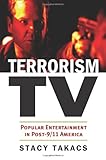
Stacy Takacs. Terrorism TV: Popular Entertainment in Post-9/11. Lawrence: University Press of Kansas, 2012. 333 pp. $24.95 (paper), ISBN 978-0-7006-1838-5.
Reviewed by William Mari (University of Washington, Department of Communication)
Published on Jhistory (March, 2013)
Commissioned by Heidi Tworek (University of British Columbia)
As Seen on TV: Portrayals of Terrorism in U.S. Television after 9/11
Even with the advent of the Internet and the customized media silos it sustains, television still shapes how we think and feel about shared, traumatic events on a national scale. Stacy Takacs, associate professor and director of American Studies at Oklahoma State University, takes a critical look at how entertainment television in the United States has done just that in the decade after the terrorist attacks of September 11, 2001. Examining the TV industry’s portrayal of the resulting “War on Terrorism” in network shows, documentaries, and movies, Takacs is interested in “how TV texts collide, and, in that collision, mark out the boundaries of social discourse” (p. 28). Takacs says that this collision is part of a dynamic “cultural forum,” in which TV shows such as 24 or JAG formed fictional “militainment” dramas that justified the Bush administration’s domestic and military policies (p. 28).
Takacs rejects conspiracy theories that simplistically tie together the entertainment industry, the government, and the military, while highlighting how societal beliefs and values reinforce the more subtle connections between them. She takes a broad view of how TV helps to create our culture’s sense of “history-in-making” and has built up a militarized “discourse of national security” (p. 20). The “trauma frame” that resulted was decontextualized and ahistorical, she argues, precisely because it was focused so much on the immediate here and now (p. 238).
Her study is divided into three broad, chronological sections. The first two chapters review the initial framework for interpreting 9/11. In this first chapter, this is seen through breaking-news TV coverage and special, “soft-news” programs such as America’s Most Wanted (but also in scripted dramas such as The West Wing), and in the second chapter, through the spate of counterterrorism shows that appeared in the early 2000s, such as The Grid and The Agency (along with, of course, 24). Both helped to forge a rapid “defense-reaction that linked fear to vigilance and violence to emotional release (p. 58). These shows exacerbated “popular feelings of vulnerability” and made routine the state of emergency that existed during and after 9/11 (pp. 95-96).
The next three chapters examine the ways “militainment” dramas (those shows that contained especially strong military plots) blended ideas of citizenship with a newly reinvigorated martial ethos. Chapters 3 and 4, for example, describe military-media coproductions including the Discovery Channel’s Making Marines, CBS’s Profiles from the Front Lines, and Paramount’s JAG. These shows tended to reaffirm “the president’s [Bush’s] construction of the cause and conduct of the war as proportionate and just” (p. 98). “Gamedocs” and “docusoups” focused on the competitive and personal aspects of war at the expense of the nasty realities of combat. Some, such as VH1’s Military Diaries, which used raw footage produced by young service members to portray their gritty, day-to-day experiences, were more nuanced than others. Most, however, remained stridently jingoistic. The fifth chapter looks at more offbeat productions, such as FX’s Over There and HBO’s Generation Kill, that included antiwar sentiments and pushed the militainment genre to its logical limit. But even these programs halted their engagement before they reached deeper political questions, instead focusing on the “imperial grunt” and his or her professionalism and technical prowess.
The last section deals with the counternarratives that Takacs identifies as pushing back against previous depictions of the wars in Iraq and Afghanistan as inherently good, if hard, struggles. To that end, chapter 6 looks at how programs as diverse as The Daily Show, Lost, and Battlestar Galactica created dissenting spaces that questioned some of the methods used to fight the war on terror. “They invited viewers to wake up from the ‘terror dream’ and embrace a more active role in the deliberation of the nation’s values and practices” (p. 200). Chapter 7 traces the appearances of wounded, returning veterans in reality-TV shows such as Extreme Makeover Home Edition and scripted shows such as ER, Law and Order, and Six Feet Under. In all these case studies, Takacs reminds us that TV is not a democratic public sphere, but it is a “prodigious storytelling machine” that has given its increasingly interactive viewers “a wealth of opportunities to confront and test the guiding assumptions of their society” (p. 236).
As an American studies scholar, Takacs is inspired by Michel Foucault and the latter’s investigations into how knowledge and power act as controlling phenomenon in Western society. She also claims that “there is an obsession with terrorism that is out of all proportion to the actual occurrence of terrorist activities in or against this country;” this has had the effect of reorienting “social policy away from domestic needs and toward foreign affairs, sanctioned the conduct of wars with questionable strategic merit, institutionalized surveillance and the suspension of civil liberties … and promoted an imperialistic expansion of U.S. power” (pp. 21-22).
This worldview heavily structures how she views the popular media’s framing of 9/11 and its aftermath. This is not to say that such a pronounced point of view is not helpful. Most of her analysis remains informed, and not co-opted, by her stated political beliefs. But by downplaying some of the immediate anxieties surrounding terrorism (and the then very real unknown quality of the specter of terrorism, at the time), it should be remembered that Takacs, in her study, is not acting as an historian. To be fair, she does not claim to be. And indeed, by looking critically at such a wide range of media materials, she provides an engaging, opinionated foray into the ways our media mediated our national processing of 9/11.
If there is additional discussion of this review, you may access it through the network, at: https://networks.h-net.org/jhistory.
Citation:
William Mari. Review of Takacs, Stacy, Terrorism TV: Popular Entertainment in Post-9/11.
Jhistory, H-Net Reviews.
March, 2013.
URL: http://www.h-net.org/reviews/showrev.php?id=38493
 | This work is licensed under a Creative Commons Attribution-Noncommercial-No Derivative Works 3.0 United States License. |

