

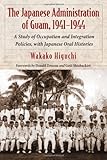
Wakako Higuchi. The Japanese Administration of Guam, 1941-1944: A Study of Occupation and Integration Policies, with Japanese Oral Histories. Jefferson: McFarland, 2013. 336 pp. $49.95 (paper), ISBN 978-0-7864-3978-2.
Reviewed by Andrew Hill (MSUM)
Published on H-War (April, 2013)
Commissioned by Margaret Sankey (Air University)
The Occupation of Guam through the Eyes of the Japanese
Having spent two years working on the island of Guam and studying its occupation through the eyes of its inhabitants, I welcomed Wakako Higuchi's contribution to scholarly work on the Japanese occupation. Higuchi uses primary source documents and oral histories to establish the intent and effectiveness of both the civilian and military occupation of Guam during WWII. Of specific note is his inclusion of oral histories and written documents of individuals who were part of the occupation and integration force, including letters sent home of one of the teachers who survived.
The text on the occupation administration is divided into three key parts: political, economic, and cultural integration of the island into the wartime Japanese sphere of influence. Unlike other Pacific islands that the Japanese occupied and administered prior to December 1941, Guam was administered by the United States and was considered an occupied territory rather than a Japanese territory. This resulted in a number of differences in how the occupying forces treated the people of Guam and the inhabitants of other Pacific islands. These differences are key in Higuchi's examination throughout the book; he specifically references them several times when discussing the use of Saipanese workers.
As with many works on WWII, this book extensively uses primary sources, including oral histories and interviews with participants. Higuchi's knowledge of both English and Japanese languages allows him to analyze documents from military and civilian sources in Japan. Furthermore, he intersperses a large number of photos throughout the book to assist in emphasizing his points, and includes graphs to show the economic efficiency of the island throughout the occupation.
One missing component in the book is a comparison between islanders' and occupiers' recollections, a topic that could be explored further in future research. I found especially interesting the transcripts of oral history interviews of some of the occupation force. The current theme of Japanese history textbooks suggests that the Japanese were not at fault for the war and that the Japanese military did not engage in any wrongdoing during the war. These points are reflected well in the oral histories, but even more research could be done in this area. Finally, since the information is split into three sections, each following the occupation chronologically, a timeline of events also would have assisted readers.
Overall this text effectively shows the defenders' point of view and adds greatly to a subject that is lacking in resources.
If there is additional discussion of this review, you may access it through the network, at: https://networks.h-net.org/h-war.
Citation:
Andrew Hill. Review of Higuchi, Wakako, The Japanese Administration of Guam, 1941-1944: A Study of Occupation and Integration Policies, with Japanese Oral Histories.
H-War, H-Net Reviews.
April, 2013.
URL: http://www.h-net.org/reviews/showrev.php?id=38466
 | This work is licensed under a Creative Commons Attribution-Noncommercial-No Derivative Works 3.0 United States License. |

