

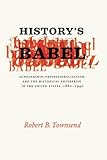
Robert B. Townsend. History's Babel: Scholarship, Professionalization, and the Historical Enterprise in the United States, 1880-1940. Chicago: University of Chicago Press, 2013. xiii + 258 pp. $90.00 (cloth), ISBN 978-0-226-92392-5; $30.00 (paper), ISBN 978-0-226-92393-2.
Reviewed by Brian M. Ingrassia (Middle Tennessee State University)
Published on H-SHGAPE (October, 2013)
Commissioned by K. Stephen Prince (University of South Florida)
The Construction and Scattering of America's Historical Profession
Robert B. Townsend, a longtime deputy director of the American Historical Association (AHA), has written a perceptive study examining the growth and fragmentation of America's historical profession. He begins by reminding readers that professional historians once saw their enterprise "as a vast panorama of activity" encompassing "popular history making, school teaching, and the work of historical societies" (p. 1). For such scholars, the history profession was not just an academic discipline--doing history was about disseminating ideas widely. This is a fitting opening to an analysis that aims to correct teleological understandings of the profession by "recenter[ing] the narrative about history in America on a broader set of professional practices that extend well beyond academia" (p. 5). Townsend's extensive research and clear prose enable him to demonstrate that from the Gilded Age and Progressive Era through the interwar years, the historical enterprise splintered into separate professions representing research, pedagogy, and archival practice.
The book is divided into nine thematic and chronological chapters within three broad sections: First, 1880-1910, when scholars constructed a scientific historical profession; second, 1911-1925, when the professional edifice started to disintegrate; third, 1926-1940, when the historical enterprise scattered. Each section includes chapters on academic history, archives, and teaching. Although ambitious in interpretive scope, Townsend's primary analytical focus is the AHA, which "gradually pared its ambit of responsibility down to the interests of college professors and monograph writers"; by 1940, "teachers at the secondary and collegiate levels and specialists in the archives and historical societies were essentially defined out of the larger project and voted with their feet by leaving the organization" (p. 8).
At first glance, the narrative sounds familiar: In the late 1800s, historians who had trained in German-style seminars at nascent research universities constructed a profession with its own national association. But the story is more nuanced than that. Townsend shows how turn-of-the-century scholars--often working at the boundaries between disciplines--assembled their own archives and produced research mostly as a byproduct of learning and teaching. The AHA, which saw its role as disseminating historical knowledge to a wider public, established its Historical Manuscripts and Public Archives Commissions by 1904. Initially, the American Historical Review (AHR), begun in 1895, reviewed a variety of textbooks, monographs, and document collections. At this time, professionally trained historians often took positions outside the academy, frequently in state historical societies or archives--especially the more scientific (and less antiquarian) institutions then being established in the Midwest and South. As history became more prominent within public schools, academic historians envisioned an emergent teaching profession "that extended from the schools to the universities" (p. 58). In the 1890s, the AHA even assembled a series of committees that reported on the state of history education and made curricular recommendations. By the early 1900s, AHA members included teachers in high schools and private academies. The organization "had built up the infrastructure and personnel to represent the wider historical enterprise" (p. 35).
From 1910 to the mid-1920s, though, the profession began to balkanize. "[A]ny lingering perceptions of unity in the historical enterprise were being sundered under the weight of wide-ranging social and cultural changes in the discipline" (p. 133). One contributing factor, argues Townsend, was the rise of the New History, which encouraged historians to explore social and cultural topics. This movement, in turn, "placed new pressure on archivists and documentary editors to gather a wider range of materials" (p. 80). After World War I, universities grew in size and the demand for professors rose, leading to a proliferation in the number of history PhD programs. Dissertations expanded to book length and the AHR almost exclusively reviewed works of original, interpretive scholarship. Increasingly, the AHA's membership rolls were populated by academics and its leaders were drawn from elite universities. As older historians passed on, the younger practitioners "sought to establish a clear set of professional parameters for academia that could serve as a container for their increasingly esoteric subjects of research" (p. 133). Local historians, archivists, and schoolteachers were becoming marginal within the profession, even though their work was more socially prominent than ever before. Growing state historical societies used new technologies (like photostat machines) to disseminate their holdings, while in public schools history became part of the new field of "social studies" and teacher training programs prioritized pedagogy over content. Academic historians did not seem concerned when archivists left the AHA to form the Society of American Archivists (SAA) in 1935, or when the National Council for the Social Studies (NCSS) gained its independence from the AHA by 1939. After 1940, "it was hard to find anyone actively trying to articulate a common vision of the historical enterprise that embraced all areas of work in the discipline" (p. 181).
Townsend makes a significant contribution to the historical literature on academic production by showing how relatively broad, turn-of-the-century fields of knowledge gave way to narrow professional identities in the post-World War I era. Intellectual historians have long observed that disciplines became increasingly specialized by the late 1920s, but Townsend does an exceptional job of detailing how the academic shop floor fragmented and the carefully circumscribed boundaries of modern scholarship emerged. Specialists in Gilded Age and Progressive Era intellectual life will appreciate this book for its detailed illustration of the growth and splintering of the American historical profession at a time when other specialized professions and disciplines were similarly developing.
Townsend's research is solid. He has carefully mined published sources--including AHA publications and journals such as School Review and Educational Review--as well as archival manuscript collections, especially the AHA papers at the Library of Congress. (The endnotes are thorough and clear, but a bibliography or a note on sources would be helpful.) Nevertheless, the book can seem overly narrow at times. Although Townsend does not neglect historical context, the book is focused tightly on institutional matters and debates. World War I does play a prominent role as a watershed moment, yet specialists in early 1900s American history will notice that topics such as muckraking journalism and the Wisconsin Idea are alluded to without being unpacked. Rather than being a wide-ranging cultural or intellectual analysis, History's Babel is primarily a story of how an institution lost control of aspects of a profession over which it had once claimed authority.
Ultimately, this is a smart, well-conceived book that presents a number of satisfying revelations that improve our understanding of the history of America's historical enterprise. Even though Townsend's analysis ends in 1940, his conclusion prompts readers to view more recent events--such as the post-1970 academic job crisis and the rise of public history--in longer-term perspective. This volume will be especially useful in historiography seminars or courses in public history. One can see it being read alongside Peter Novick's That Noble Dream: The "Objectivity Question" and the American Historical Profession (1989), Rebecca Conard's Benjamin Shambaugh and the Intellectual Foundations of Public History (2002), or Ian Tyrell's Historians in Public: The Practice of American History, 1890-1970 (2005). The distinct strength of History's Babel is its conscious attempt to integrate the stories of academic history, public history, and history teaching. Townsend's insightful volume deserves a wide readership among all those interested in the development and fracturing of America's historical profession.
If there is additional discussion of this review, you may access it through the network, at: https://networks.h-net.org/h-shgape.
Citation:
Brian M. Ingrassia. Review of Townsend, Robert B., History's Babel: Scholarship, Professionalization, and the Historical Enterprise in the United States, 1880-1940.
H-SHGAPE, H-Net Reviews.
October, 2013.
URL: http://www.h-net.org/reviews/showrev.php?id=38453
 | This work is licensed under a Creative Commons Attribution-Noncommercial-No Derivative Works 3.0 United States License. |

