



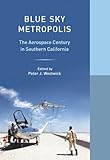
Peter J. Westwick, ed. Blue Sky Metropolis: The Aerospace Century in Southern California. Western Histories Series. Berkeley and San Marino: University of California Press and Huntington Library, 2012. Illustrations. 290 pp. $44.95 (cloth), ISBN 978-0-87328-249-9.
Reviewed by Roger Eardley-Pryor
Published on H-California (July, 2013)
Commissioned by Eileen V. Wallis (Cal Poly Pomona)
Making SoCal Soar: Consequences of the Aircraft and Aerospace Industries in Southern California
Upon retirement of the space shuttle in 2011, NASA selected the California Science Center in Los Angeles as the final home for the shuttle orbiter Endeavour. One of only three coveted orbiters that actually flew to outer space and returned safely, Endeavour soon found itself dragged awkwardly yet amazingly across the palm-treed streets of Los Angeles instead of piercing the blue sky above, as it had on so many flights back to Earth. Out of several fiercely competing locations across the nation, why did NASA choose Southern California for one of the aerospace industry’s greatest emblems of flight?
An array of possible answers run through the multidisciplinary essays by thirteen authors in Blue Sky Metropolis: The Aerospace Century in Southern California, edited superbly by Peter J. Westwick. Blue Sky Metropolis, a product of the Aerospace History Project at the Huntington-USC Institute on California and the West, explores the process and implications of Southern California becoming “the aerospace capital of the world” (p. 2), from the Los Angeles International Aviation Meet in January 1910, to the armies of air-industry labor in World War II, to the Cold War transition from aircraft to spacecraft, to the private launch of SpaceShipOne in 2004. Not intended as a comprehensive history of the aerospace industry, the kaleidoscopic chapters in Blue Sky Metropolis argue convincingly that the boom-and-bust cycles of the aerospace industry, more than entertainment or oil, fueled Southern California’s tremendous twentieth-century growth with profound and disparate repercussions. Multiple historiographies intersect, including histories of the American West; science, technology, and the environment; labor and business; Cold War; gender studies; and social and cultural history. Geographically, the collection focuses on the greater Los Angeles basin but also ventures south to San Diego, north to Lompoc and San Jose, and inland to the Antelope Valley and Mojave. Though tastefully illustrated, including Westwick’s photo-essay on early Southern Californian aviation, the book lacks any maps, making detailed place descriptions sometimes sound like directions in the Saturday Night Live skit “The Californians.”
Westwick introduces each of the book’s five thematic sections and aptly places the authors in conversation with one another. The first section, titled “The Human Element,” features memoirs on aerospace’s social costs. D. J. Waldie’s essay argues that “Aviation Okies” lent L.A. aerospace a Dust Bowl inflection before industry layoffs jilted its laborers (p. 39). M. G. Lord, an aerospace engineer’s daughter, provides a personal reflection on how women propelled the area’s aviation and aerospace economies. The book’s second section, labeled “The Work,” includes Sherman N. Mullin’s audit of Robert E. Gross, the long-time chairman and financial wizard of Lockheed, who became reluctantly reliant on federal largess. Anita Seth’s essay on organizing aircraft workers outlines how unions struggled against unpatriotic accusations when the aviation industry’s primary customer remained the national government. Mihir Pandya’s ethnography on the construction of Stealth airplanes suggests that Cold War classification and secrecy muted the public memory of Southern Californian aerospace until defense industry job losses rendered it visible.
“Culture” connects the book’s third and most engaging section about aerospace’s aesthetic, technological, and ideological influences on Southern California. Stewart W. Leslie reconstructs the space-age modernism of William Pereira’s architecture, whose designs helped Southern Californian firms recruit top engineering talent, encouraging both a regional brain gain and a distinct missile maker’s aesthetic. Westwick describes how the computer-generated imagery (CGI) in today’s graphics-dominated movies and video games derive directly from space-program animation first developed at NASA’s Jet Propulsion Laboratory. His intertwined history of Hollywood and aerospace cites Star Wars and Carl Sagan’s Cosmos, while highlighting how government investment in science produced surprising but substantive returns. W. Patrick McCray’s chapter revisits visions of space colonies in the 1970s and 1980s as the roots of California’s alternative space movement, which aims to privatize space launches and space flight. McCray’s essay straddles the state’s north and south divide by identifying a libertarian “California ideology” that combines the hippie counterculture with yuppie entrepreneurialism.
Two remaining sections examine ethnic experiences and the politics of place. In the fourth section, titled “Communities,” Zuoyue Wang explains how immigrant Chinese scientists and engineers, both pushed and pulled toward Southern California, occasionally found their fates shaped by the shifting geopolitics of U.S.-China relations. Dwayne A. Day surveys a troubled space-launch complex at Vandenberg Air Force Base, supposedly cursed by the local indigenous Chumash tribe. While overly reliant on military sources, Day tells how the federal government expropriated Chumash land, and he indicts the invention of an Indian curse that enlisted the Chumash as scapegoats for technological failures. The final section, titled “Geography,” finds Glenn E. Bugos analyzing aerospace from Silicon Valley. Bugos notes how microelectronics demands by southern aerospace firms drove Silicon Valley’s early growth. He suggests that fluid boundaries between savvy customers and suppliers in the aerospace industry fostered and reflected Silicon Valley’s now-celebrated work culture, with its conspicuous production, teamwork, and acceptance of failure. Wade Graham’s excellent essay examines the local, regional, and super-regional impacts of Southern California’s unsustainable “aerospace ecology” (p. 226). Graham traces the region’s distinctive cultural formation by linking the aerospace industry’s legacy of urban structuring and development with its legacy of pollution, which fostered growth but sowed seeds that failed to sustain the long-term health of Southern California’s communities and environment. Philip Scranton’s afterword reconsiders the collected essays and offers suggestions for future investigation, including analyses of air and space starts-ups that failed and incorporation of underutilized sources like trade and technical journals.
The disciplinary diversity of Blue Sky Metropolis provides breadth and depth without specialized jargon or off-putting technical detail, which helped the Los Angeles Public Library list the collection among the best nonfiction books of 2012. Its array of topics will appeal to readers in varied subfields, especially those seeking a vibrant examination of one industry’s outsized impact over one of North America’s most dynamic and influential regions. Today, much of sprawling Southern California stands as a high-tech metropolis, a main employer of scientists and engineers, a leading consumer of related research, and still a primary producer of advanced technology. While eschewing an overarching conceptual framework, Blue Sky Metropolis suggests that aerospace drove these developments and, furthermore, evolved to shape and reshape Southern California’s communal, cultural, economic, and environmental landscapes over the past century and into the foreseeable future. Although a narrow focus on aerospace overlooks other components in Southern California’s takeoff, and multiple targets of inquiry remain for exploration, Blue Sky Metropolis takes its readers on an insightful and altogether enjoyable ride. It is a worthwhile flight with an assortment of windows on the aerospace industry’s importance to the past, present, and possible future of Southern California.
If there is additional discussion of this review, you may access it through the network, at: https://networks.h-net.org/h-california.
Citation:
Roger Eardley-Pryor. Review of Westwick, Peter J., ed., Blue Sky Metropolis: The Aerospace Century in Southern California.
H-California, H-Net Reviews.
July, 2013.
URL: http://www.h-net.org/reviews/showrev.php?id=38349
 | This work is licensed under a Creative Commons Attribution-Noncommercial-No Derivative Works 3.0 United States License. |

