

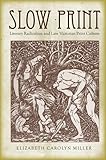
Elizabeth Carolyn Miller. Slow Print: Literary Radicalism and Late Victorian Print Culture. Stanford: Stanford University Press, 2013. 392 pp. $60.00 (cloth), ISBN 978-0-8047-8408-5.
Reviewed by Eugenia M. Palmegiano (St. Peter's University)
Published on Jhistory (May, 2013)
Commissioned by Heidi Tworek (University of British Columbia)
Creating Order from Chaos
As every scholar of the Victorian press admits, its ephemeral nature spawns a host of research problems. If ready to concede that they can only represent, not re-present the past, investigators of periodicals perennially complain that altered titles, anonymous authors, and arbitrary indexing hinders achievement of this aim. And the worst offenders are typically publications on the cultural periphery. Elizabeth Carolyn Miller understands these knowledge barriers but, to her credit, brings order to some fin-de-siècle small-scale radical periodicals. She labels them “slow print” because they opposed “literary and journalistic mass production” paid by advertising that compromised both politics and aesthetics (p. 2). And she labels their backers, socialists primarily and anarchists occasionally, radicals because of their commitment to fundamental political and economic change. United by this goal and antipathy to fast, big, profitable newspapers, radicals presumed that they could start a mass campaign without a mass press. Miller contends that their press commentary, serial novels, plays, and poetry demonstrate how they tried to achieve this objective. To counteract the popularity of New Journalism among compulsory education graduates, radicals opted for a limited audience even though elitism seemed inappropriate for socialists and contravened the much broader labor journalism crusade for a free press until the 1850s. Struggling with this issue would test any marginal operation. But late-century radical enterprises surfaced precisely when innovative technology (telephone, phonograph, film) began to compete with literature. Yet, as Slow Print explains, radicals rose to the challenge.
The book’s introduction suggests some practical techniques for success, each fraught with potentially deadly outcomes. For instance, cutting and pasting material from a major newspaper, a procedure long favored by country editors and metro subeditors, furnished an opportunity for glossing or correcting but inadvertently acknowledged the clout of the original. Soliciting volunteers sidestepped the taint of advertising but invited the taunt of exploiting workers. Payment was better unless it required a price rise or reliance on a firm unfair to compositors. Devising an atypical format might attract or alienate labor audiences. Atypical ideas might likewise distance them unless one sponsored “subcultural communities of working-class socialists,” as Robert Blatchford did in his Clarion (p. 25). But he obviously comprehended that his cycling and swimming clubs could engage the same men who perused New Journalism’s sports reports. The complexity of the reader-writer-reader relationship, wherein the press may create or reflect opinion and the reader may sustain or spurn capitalism, is the motif that Miller explores by drawing on socialist and anarchist sheets.
William Morris is the subject of chapter 1, which covers his 1880s penny newspaper, Commonweal, and his 1890s typographically stunning Kelmscott Press. Morris launched his mouthpiece for the Socialist League after he broke with the Social Democratic Foundation (SDF). He planned to educate readers for a socialist revolution that would make art the “preeminent human experience” and newspapers unnecessary (pp. 35, 69). This notion influenced many other radical heralds, among them the Worker’s Cry, the Workman’s Times, and Justice, the SDF gazette. Notwithstanding Commonweal’s quality type, consistent layout, and Walter Crane political cartoons, Morris worried that print’s ties to commerce transformed all words into a commodity, preventing journals from fostering the rationality essential for progress. By 1890, convinced that journalism was not his métier, he concentrated on Kelmscott but not before Commonweal serialized his News from Nowhere, which blasted newspapers’ purported objectivity.
The press plays a secondary role in chapter 2, which centers on why and how socialists rejected the realistic novel. Although the Marxist To-Day and the parliamentary socialist Fabian Society’s Our Corner serialized narratives by George Bernard Shaw, many radicals assumed that readers would be exclusively middle class. This hypothesis apparently rested on the facts that labor tribunes ordinarily did not live long enough to complete serialization and purchase what otherwise was beyond a worker’s pocket. Moreover, according to Miller, some radicals opined that novelists of socialism penned caricatures no more realistic than Morris’s utopias. Soon even Shaw considered theater a better venue to disseminate socialist tenets even though it reached fewer people. He did, however, recognize the value of New Journalism, which managed to combine a contradictory personal approach and mass marketing. Consequently, he did not abandon newspapers but instead encouraged socialists to freelance for major dailies.
The radicals’ interest in theater occupies chapter 3 because, Miller postulates, it provided another alternative to mass-oriented print. Here she references the writings of Shaw and Henrik Ibsen for their effects on socialists and the production of Percy Bysshe Shelley’s The Cenci for its impact on censorship. Shaw set the proverbial stage for the interaction between theater and socialism in his 1890 Fabian Society lecture that was subsequently published as The Quintessence of Ibsenism (1891). Because he talked about the individualist Ibsen in a series captioned “Socialism in Contemporary Literature,” Shaw provoked much debate in socialist and anarchist newspapers for worker-readers.[1] Meanwhile, as Miller observes, he was swerving from the press to private theater clubs with the communalism of socialism and without the censorship of large print. And the staging of Shelley’s The Cenci in 1886 had already transmogrified the liberal doctrine of a press for all to an artistic right for small audiences. Ironically, radicals now viewed expensive theater memberships as an antidote to cheap print sales.
Chapter 4 shifts gears from radical prose and drama to press poetry, with Commonweal in the forefront again, and lyric parody of old songs. Miller argues that verse allowed radicals to anticipate political revolution using a precapitalist, thus familiar, genre but with a community rather than an individual voice. Citations from a plethora of offerings, revolutionary and evolutionary socialist and anarchist, not only prove her case, but also underscore the importance of periodicals as sources. Particularly significant is the repetition of groans heard since the 1850s about the habit of scissoring and the flood of submissions that pressured editors. By the 1890s, the radicals’ insistence on equality further complicated editorial selection. The prototype for equality was Tom Maguire, a worker praised for mastering the craft of poetry despite borrowing New Journalism’s human-interest perspective for his stories. While his Labour Champion never achieved the circulation of the Clarion, it did highlight the joys and pains of working-class women. But slow print for ballads had, as Henry Solly’s Common Good bemoaned, little hope of luring sizable audiences because of their “defective education” and the widespread “devotion to newspaper reading” (p. 327, n. 8).
Chapter 5 examines how theosophy and aestheticism verified radicals’ loss of faith in a far-flung open press as a forum for rational discourse. Miller chose Annie Besant and Alfred R. Orage, supporters of slow print, as emblematic of this disbelief. Before they took new roads, Besant edited the Fabian Our Corner and co-edited, with W. T. Stead, the Law and Liberty League’s The Link. Orage edited the Fabian, then modernist New Age. Miller finds in Besant’s later Autobiography a connection between her transitory self of theosophy and a transitory print whose hasty self was destroying its incremental accrual of authority. Besant also wrestled with the custom of press anonymity, which buttressed the collectivism cherished by socialists but relieved journalists from responsibility for their writings. Miller maintains that Orage, once a scribe for the Independent Labour Party’s Labour Leader, distanced himself from the Fabians by promoting guild socialism and issuing the New Age in language so linguistically bewildering and so conceptually abstruse as to bar a labor audience. Miller characterizes his grumbling about the deluge of books for review as a “typical socialist attack on the culture of overprint,” but this attitude was not confined to socialists, especially at a publisher’s year end (p. 247).
The last chapter reverses the trends described earlier. There, radicals universally disdain the free but capitalist press as an instrument for political change; here, they disagree about the value of a free press as a site for dialogue about sexuality. The results of this conflict, Miller points out, were to politicize the body and divide radicals. Reproduction led Fabians to assert that procreation was a socialist duty to the state whereas it led anarchists to uphold the merits of free love. Attempts to discuss sexuality, in novels like The Woman Who Did (1895)and monthlies like The Adult, met with workers’ acceptance of regulation in contrast to intellectuals. Perhaps the crucial segment of chapter 6 for journalism study is the identification of readers, such as the working-class women of the Clarion’s birth control columns, and of the female columnists to whom they wrote. This literacy would pose a dilemma for labor’s women in the future when they, and the men who drove socialism, had to decide whether to prioritize class or gender.
Slow Print reminds us that magazines and newspapers are a storehouse of often jumbled contents in need of sorting, which the book does very well by its clear prose, many illustrations, and extensive bibliography. It includes in a list of forty-nine periodicals both famous and forgotten radical titles as well as sixteen pages naming significant contemporary and recent articles and books. Less helpful are the content endnotes, numbering about four pages per chapter. This placement, which requires constant movement from text to notes, is unfortunate because the notes frequently contain information very relevant for journalism, such as discussions of the definition of “public opinion” and of the controversy about anonymous writing (p. 311, n. 21; p. 329, n. 19). Alternatively, the notes occasionally miss evidence, such as Joel H. Wiener’s probe of the unstamped press and the Nineteenth Century number in which Matthew Arnold’s critique of New Journalism appeared. Still, if Miller sometimes forgets that there is no historical whole without context, one can learn much about the late-Victorian radical press from her examination of its parts.
Note
[1]. For a more detailed assessment of the reactions to this lecture, see I. M. Britain, “Bernard Shaw, Ibsen, and the Ethics of English Socialism,” Victorian Studies 21 (1977-78): 381-401.
If there is additional discussion of this review, you may access it through the network, at: https://networks.h-net.org/jhistory.
Citation:
Eugenia M. Palmegiano. Review of Miller, Elizabeth Carolyn, Slow Print: Literary Radicalism and Late Victorian Print Culture.
Jhistory, H-Net Reviews.
May, 2013.
URL: http://www.h-net.org/reviews/showrev.php?id=38316
 | This work is licensed under a Creative Commons Attribution-Noncommercial-No Derivative Works 3.0 United States License. |

